Which ecommerce filters should Google index?
Let shoppers filter freely, but give search engines a smaller, deliberate set of useful destinations. A filter deserves an indexable landing page when it serves a real buying need, has a stable product selection, and offers something the parent collection does not. Most sort orders and increasingly narrow combinations do not meet that test.
Dahna, original planning diagram
In this article
Overview
Let shoppers filter freely, but give search engines a smaller, deliberate set of useful destinations. A filter deserves an indexable landing page when it serves a real buying need, has a stable product selection, and offers something the parent collection does not. Most sort orders and increasingly narrow combinations do not meet that test.
A useful shopping feature can create a large URL problem
A skincare store may let visitors choose concern, texture, ingredient, size, price, and availability. That is sensible merchandising. The difficulty begins when each choice, each order of choices, and each sort direction produces another crawlable address. A small catalog can then appear to contain an enormous number of pages. Those pages may all show nearly the same products.
Google’s faceted-navigation guidance identifies wasted crawling and slower discovery as risks of uncontrolled filter URLs. It distinguishes filters that need search visibility from those that do not. That distinction is the starting point for the agency brief: list the URL families, decide their purpose, and then choose a technical treatment. A canonical tag and a robots rule do different jobs; neither should be applied to the entire store because a crawler report looks large.
Gary Illyes’s December 2024 Google Search Central article frames faceted navigation as a recurring source of unnecessary crawling. His practical distinction is whether the filtered destinations actually need to be discoverable in search. That is a useful question to put directly into the project brief.
Divide filter states into three working groups
Use the business question first. Would someone who has never heard of the brand reasonably want to arrive on this exact selection? “Fragrance-free moisturizers” might meet that standard if the store has enough relevant products and accurate information. “Moisturizers sorted from highest price, page three” usually describes a browsing state rather than a distinct destination.
Treat the categories below as decisions to validate, not automatic rules. A large retailer and a brand with four products need different architectures. Inventory volatility also matters: an attractive collection that is empty every other week may disappoint the very visitors the SEO work attracts.
| Filter state | Search role | Proposed treatment | Evidence to collect |
|---|---|---|---|
| Fragrance-free moisturizers | Potential durable buying destination | Consider a curated collection URL | Relevant assortment, customer language, stable stock |
| Price low to high | Alternative view of the same products | Keep usable; control duplicate crawl paths | URL behavior and internal links |
| Three ingredients + one size + discount | Very narrow browsing state | Usually avoid indexable combinations | Whether anyone needs this exact destination |
| Invalid or impossible combination | No useful result | Return an appropriate empty/error response | Actual status and recovery navigation |
Ask for examples, not only a total URL count
The useful audit export contains representative addresses, their status codes, canonical targets, index directives, inbound links, and product counts. Include a fresh session, a shared filtered URL, a mobile visit, and an empty result. Sorting can behave differently after a shopper changes a filter, so one screenshot of the default collection is not a complete test.
Keep a separate list of published landing pages the business has promised to preserve. Changes to those pages require deliberate approval; a cleanup script should not quietly erase a campaign destination or an article’s working link. When the existing URL is valuable, repair its role rather than replacing it merely to make the address look cleaner.
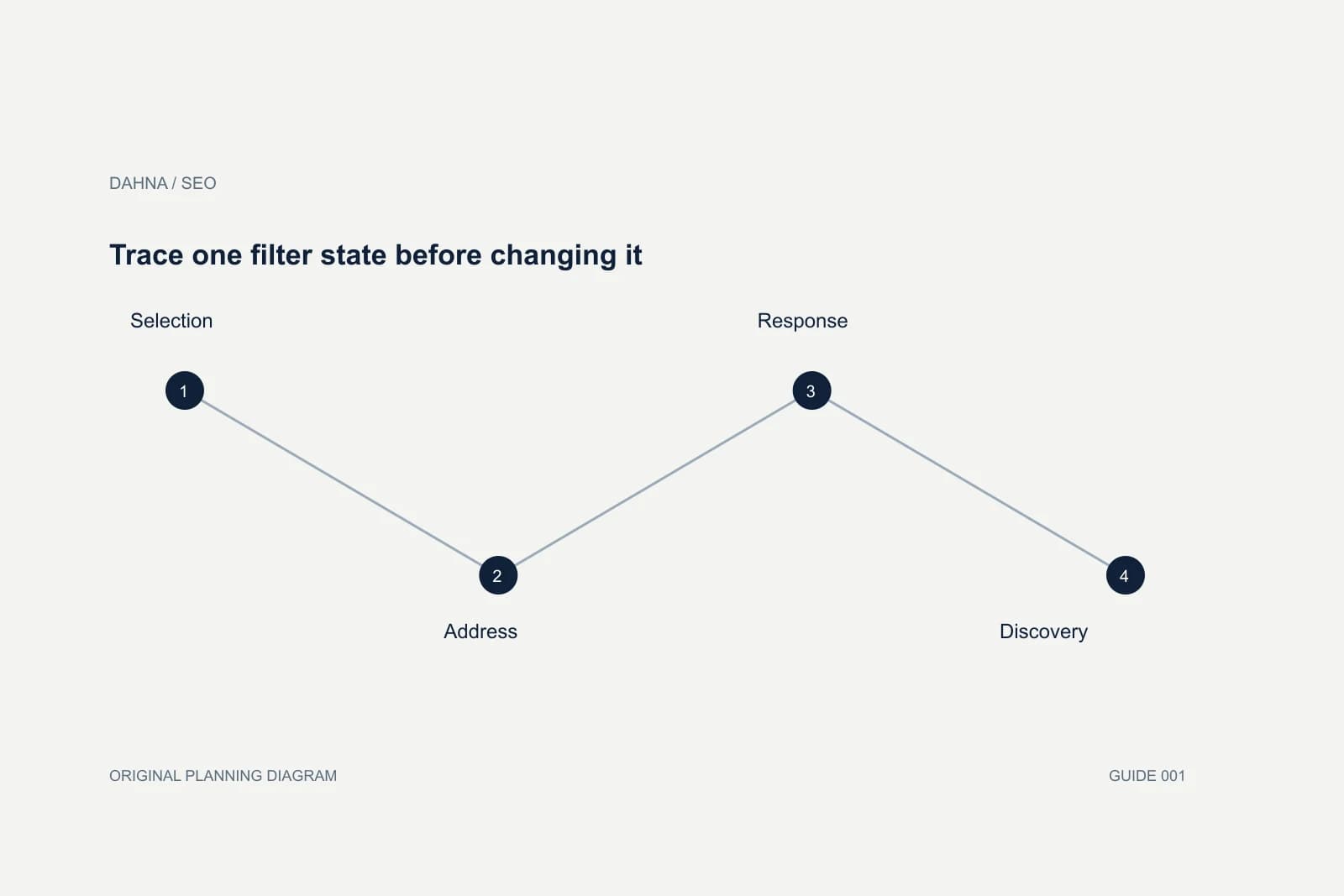
Trace one filter state before changing it
Selection
Shopper chooses a useful attribute.
Address
Record the exact resulting URL.
Response
Inspect content, status, and directives.
Discovery
Check links and the intended search role.
Match the technical choice to the objective
Blocking crawling is about whether a crawler can fetch a URL. Canonicalization indicates the preferred representative of similar content. Removing a page from search is another objective again. Google notes that a blocked URL can still be indexed without its content, so a robots exclusion is not a substitute for an indexing removal plan. An agency should explain these differences in plain language before making changes.
For a duplicate sort view, the team may prefer one canonical collection while keeping the interface available to people. For unwanted combinations, crawl controls may be appropriate. For an intentionally indexable filtered collection, require useful content and a stable address. Have the developer validate the platform’s actual behavior, including how apps inject links or overwrite metadata. Do not copy a generic robots file from a different store.
An illustrative 60-product store decision
Imagine a US store with 60 skincare products and six filter groups. Its agency discovers 9,000 addresses in a crawl, but that number alone does not say which work matters. The team identifies eight stable category destinations that shoppers use, 14 filter concepts with plausible buying value, and many sort or price combinations with no separate purpose. These counts are fictional and do not predict what a real crawl will find.
The merchandiser approves three of the 14 concepts for curated landing pages because they have clear product eligibility and enough stock. The remaining eleven stay as shopping controls. The developer then fixes inconsistent parameter ordering and checks that all 60 product pages remain reachable from ordinary collections. The SEO lead measures discovery of the approved pages and changes in unnecessary crawling; the commercial lead watches whether those destinations attract relevant product visits.
This produces a bounded project: three reviewed collections, specific URL-family controls, and a regression checklist. “Reduce indexed pages by 90%” would be a poor objective because the business could meet it by hiding useful products. The target is better access to the right inventory, with less effort spent on duplicate browsing states.
Make the release reversible and reviewable
Before launch, save representative before-and-after responses. Test known useful collections, an excluded sort URL, a multi-filter state, an empty result, pagination, and a direct product link. The product team should also confirm that back navigation and sharing still work. Crawl efficiency does not justify a broken shopping experience.
After deployment, check server or crawl evidence over a reasonable observation window and inspect the approved pages in Search Console. Search changes will not appear everywhere at once. If a useful collection loses accessibility or the wrong pages receive directives, correct the implementation promptly rather than waiting for a monthly report.
| Deliverable | What a usable version contains |
|---|---|
| Decision register | URL family, business purpose, owner, intended search treatment |
| Developer change list | Exact patterns affected and protected exceptions |
| Regression evidence | Saved examples of useful, duplicate, empty, and paginated states |
| Follow-up report | Discovery and crawling observations, with commercial context |
Do not let a temporary stock gap erase a useful collection
A curated collection can briefly lose most of its stock without losing its underlying customer purpose. Agree on how merchandising handles that situation before automating an empty-page policy. A temporary assortment problem and an impossible filter combination are different cases. The first may need an honest availability message and a review date; the second may be an invalid address. The developer should not infer that distinction from product count alone.
Where Dahna can help
Bring a catalog export, the main collection URLs, and examples of filters you want customers to find through search. Dahna can help turn that material into an SEO and merchandising brief, prioritize the useful destinations, and coordinate acceptance criteria with the implementation team. The scope should state who writes collection content, who edits platform behavior, and who checks the result.
If the real problem is that shoppers cannot understand the filters, include conversion work as a separate decision. If products are inaccessible throughout the site, start with the broader technical repair. Keeping those jobs visible makes the proposal easier to compare and prevents a narrow crawl cleanup from being sold as a complete growth strategy.
Continue with the related decision
Use these guides when the next question goes beyond the scope of this article.
Use the editable decision sheet
Download the completed tables as a CSV, then replace the example inputs and add your evidence, owner and review date. Illustrative figures are teaching examples, not default targets.
Sources & further reading
Bring this decision to Dahna
Use this guide to prepare a focused brief. Tell Dahna what needs to change, which evidence you already have and when you need a decision.
Why consider Dahna for this work?
Dahna brings bilingual Korean and English strategy together with creator, content, and measurement work for brands growing in the US. You can review the people behind the recommendations and the kind of work we propose before starting a conversation.
Founder experience includes prior and contracted roles. Sample deliverables illustrate our approach; they are not client results or a performance promise.