How should an international brand target US shoppers with SEO?
Create a clear US buying experience and make its relationship to your other market pages explicit. The US page should describe the products, currency, availability, and customer conditions that actually apply there. Regional SEO then helps search systems and people find the appropriate version without forcing every visitor into the same store.
Dahna, original planning diagram
In this article
Overview
Create a clear US buying experience and make its relationship to your other market pages explicit. The US page should describe the products, currency, availability, and customer conditions that actually apply there. Regional SEO then helps search systems and people find the appropriate version without forcing every visitor into the same store.
Separate language from market
English content is not automatically US content. An English page for the UK can carry different prices, delivery conditions, product availability, and spelling from a US page. Conversely, a Korean brand may serve US customers through one English storefront without needing a separate page for every country in which someone might read it.
Google distinguishes multilingual sites from multiregional sites and recommends separate URLs for language versions. Its guidance also warns that automatic location or language redirects can prevent access to alternatives. The practical brief is to specify which genuinely different experiences exist and give users a clear way to select them.
Map equivalent pages before adding annotations
A regional homepage relationship is straightforward; a product relationship can be harder. A US formula may differ from a global item, a bundle may contain different products, or a device may have different accessories. Do not label pages as equivalents merely because the names resemble each other. Have the product owner confirm the relationship.
Build a matrix of the important destinations: home, collections, products, support, and buying guides. Mark pages with true regional equivalents and pages that exist only in one market. This matrix informs both the user-facing market switcher and the technical annotations. It also reveals where the US experience lacks information needed to complete a purchase.
| Global destination | US destination | Relationship | Review needed |
|---|---|---|---|
| Global hero serum | US hero serum | Equivalent only after product confirmation | Formula, size, claims and availability |
| European routine bundle | No US bundle | No direct equivalent | Do not invent a destination |
| English global guide | US-specific guide | Related regional guidance | Local product and policy references |
| Global support | US support | Market-specific service | Contact and warranty information |
Treat hreflang as a precise mapping job
Google’s localized-version documentation explains hreflang methods and requires consistent relationships among alternate versions. For a buyer, the key is not memorizing the syntax. It is asking for a tested page-pair inventory and making sure the implementation describes the real site.
Canonical and alternate-language signals must also make sense together. A developer should explain the intended canonical for each regional page, how equivalent pages refer to one another, and what happens when a counterpart is missing. Do not approve a blanket rule that points every US product to the global homepage; that is not a useful equivalence map.
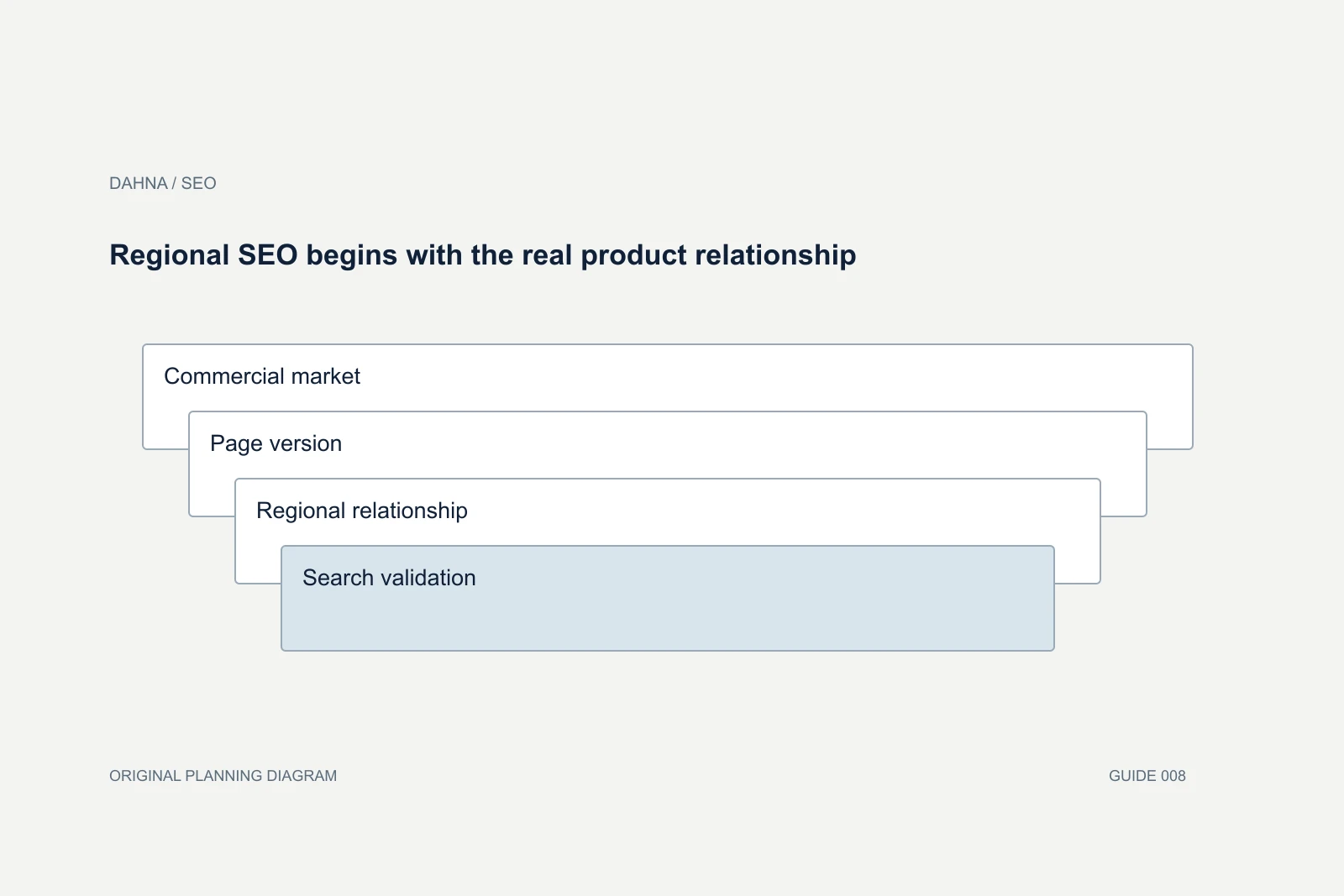
Regional SEO begins with the real product relationship
Commercial market
What US customers can actually buy.
Page version
The matching US content and purchase path.
Regional relationship
Verified equivalent or market-only destination.
Search validation
Access, canonical, alternate annotations and discovery.
KASH Beauty shows why market fit is operational
Shopify’s KASH Beauty case study describes the Irish brand adapting storefronts for international markets. Director Conor Cochrane discusses the importance of local marketing, copy, and currency. The example is useful because it connects international growth with the experience customers actually receive, rather than reducing localization to a technical tag.
This is a vendor-published case study, not independent evidence that a particular SEO configuration caused a result. Our application is narrower: the search architecture should lead people into a market experience the brand has intentionally built. If pricing, messaging, or availability differs, the URL plan needs to reflect that reality.
Illustrative Korean-brand US launch
Imagine a Korean beauty brand with a Korean-language store, a global English catalog, and a new US storefront. The US store initially carries six of the global catalog’s twenty products. The team maps those six product equivalents, creates clear US delivery and return information, and leaves the other fourteen global products accessible without pretending they are purchasable in the US.
The market selector offers a meaningful choice and warns when switching changes the product selection. The SEO team tests links from the global catalog, checks that US pages can be crawled directly, and verifies the intended regional relationships. The content team reviews product claims and terminology with the relevant brand owner.
The report separates US search activity from global activity. A rise in visits from other countries is neither automatically bad nor evidence that US targeting failed; it needs commercial context. The primary question is whether the US experience is being discovered by relevant people and whether those people can take a useful next step. This is an illustrative plan, not a traffic forecast.
Test the experience from several entry points
Open direct product links, links from search, links from the global site, and shared URLs in a fresh session. Check whether the requested page remains accessible or is unexpectedly redirected. Test a product that has an equivalent and one that does not. Include mobile, where market selectors can be difficult to find.
Ask for a small evidence pack containing URL pairs, intended signals, rendered checks, and known exceptions. The pack should identify the owner who updates relationships when catalogs diverge. Regional SEO is not finished if the first new product launch breaks the mapping.
| Check | What to verify |
|---|---|
| Direct access | US URLs open without an unwanted location redirect |
| Equivalent mapping | Alternate pages refer to genuinely corresponding content |
| Product truth | US quantity, price and availability are accurate |
| User choice | Visitors can find and use the market selector |
| Reporting | US observations are separated from other markets |
Plan the exception when one market has no equivalent product
A market switch should not imply that a missing item exists. If a visitor opens a global product that has no US equivalent, the experience can explain the limitation and offer a relevant US collection. It should not silently claim that a different formula is the same product. The precise interface choice depends on the platform, but the customer’s understanding is the acceptance criterion.
Build these exceptions into the mapping file alongside the straightforward pairs. Otherwise a developer may fill every blank with a homepage link and an editor may later assume those links represent actual equivalents. A missing counterpart is useful information, not an error to conceal.
Also review mixed-market editorial links. A US routine guide can accidentally link to a global product when the writer copies a reference from a manufacturer brief. Sample the complete journey from guide to product to checkout. The regional annotations can be technically correct while those contextual links still send buyers into the wrong offer. Assign the final link check to a person who understands the market catalog, with the SEO and website teams handling their respective technical checks.
How to scope the work with Dahna
Dahna can help an international brand define its US search architecture, coordinate localized content, and review the resulting customer journey. Bring the global and US catalog lists, current domain structure, and the markets you plan to support. The proposal should separate strategy, content, platform configuration, and technical validation so responsibilities are clear.
If the US offer is still undecided, resolve that before creating a large regional content program. A stable product and service promise gives the search work something meaningful to support.
Continue with the related decision
Use these guides when the next question goes beyond the scope of this article.
Use the editable decision sheet
Download the completed tables as a CSV, then replace the example inputs and add your evidence, owner and review date. Illustrative figures are teaching examples, not default targets.
Sources & further reading
Bring this decision to Dahna
Use this guide to prepare a focused brief. Tell Dahna what needs to change, which evidence you already have and when you need a decision.
Why consider Dahna for this work?
Dahna brings bilingual Korean and English strategy together with creator, content, and measurement work for brands growing in the US. You can review the people behind the recommendations and the kind of work we propose before starting a conversation.
Founder experience includes prior and contracted roles. Sample deliverables illustrate our approach; they are not client results or a performance promise.