How to build an ecommerce keyword map beyond your brand name
Start with the problems and product choices your catalog can genuinely help solve. Build a query inventory, separate brand demand from category demand, and assign each useful intent to an existing or justified new page. The result should be a prioritized map of customer needs, not a spreadsheet of every phrase a tool can generate.
Dahna, original planning diagram
In this article
Overview
Start with the problems and product choices your catalog can genuinely help solve. Build a query inventory, separate brand demand from category demand, and assign each useful intent to an existing or justified new page. The result should be a prioritized map of customer needs, not a spreadsheet of every phrase a tool can generate.
Set the commercial boundary first
A small fragrance brand can answer many questions about scent, but not every question is a sensible acquisition target. “How to make perfume at home” may attract readers with little interest in buying the brand’s finished products. “Travel-size fragrance discovery set” is closer to a purchase the business can fulfill. Relevance comes from the offer and the customer’s task, not simply from sharing a category word.
Write the boundary in the brief: target customer, market, product range, price context, and the decisions the brand can support. For a Korean brand entering the US, include the products actually available to US customers. Do not build a content plan around an overseas bestseller that cannot be purchased or supported in the target market.
Combine observed queries with customer language
Search Console is useful for queries where the site already receives visibility, but its query tables are not a complete census of demand. Google documents privacy-related omissions and data differences in its performance reporting. Treat those records as observed evidence rather than the total market. A new category may have little site data precisely because the brand has no useful destination for it yet.
Add support tickets, onsite search terms, sales conversations, and public brand-side questions. Remove personal information before sharing customer material. Record the source of each idea so the team can distinguish an actual repeated customer question from a brainstormed possibility. Tool suggestions belong in the latter category until checked.
| Candidate need | Evidence type | Commercial check | Next step |
|---|---|---|---|
| Choose a fragrance discovery set | Observed customer question | A relevant set is available in the US | Inspect existing destination |
| Understand a product refill | Support and onsite-search question | The brand sells a compatible refill | Improve the product explanation |
| Compare two ingredient routines | Research candidate | Claims and product fit need review | Validate the decision and evidence |
| Make the product at home | Broad informational interest | Weak fit with the current offer | Usually defer |
Use Google Trends as context, not a volume forecast
Google Trends normalizes interest rather than reporting an absolute count of searches. Geography, date range, and the chosen comparison affect what the chart means. A score of 100 identifies a relative high point within that comparison; it is not 100 searches, a conversion forecast, or proof that an agency should publish immediately.
For US prioritization, keep the geography and period consistent, distinguish a topic from a literal search term, and save the exact comparison. Compare candidate needs only after checking that the terms mean the same thing in context. A product nickname, a celebrity name, and a generic ingredient can produce misleading comparisons if the team ignores what people were actually looking for.
When a trend is concentrated around a short event, record that context. A temporary spike may justify a timely campaign but not a permanent collection page. This article does not claim measured search volume or a current trend ranking for any example term.
One customer decision can produce many phrases
Group queries by the task a visitor is trying to complete. “Which size should I buy?” and “How long does the small bottle last?” may belong to the same product-size explanation, depending on the catalog. Conversely, “refill compatibility” and “refill subscription cancellation” concern different decisions even though both contain “refill.”
Before proposing a new URL, compare the candidate with the existing page’s primary question and outline. If the page already answers the decision, improve its useful detail or presentation when authorized. Do not create a second article because the wording differs. A map becomes valuable when it prevents unnecessary pages as often as it identifies missing ones.
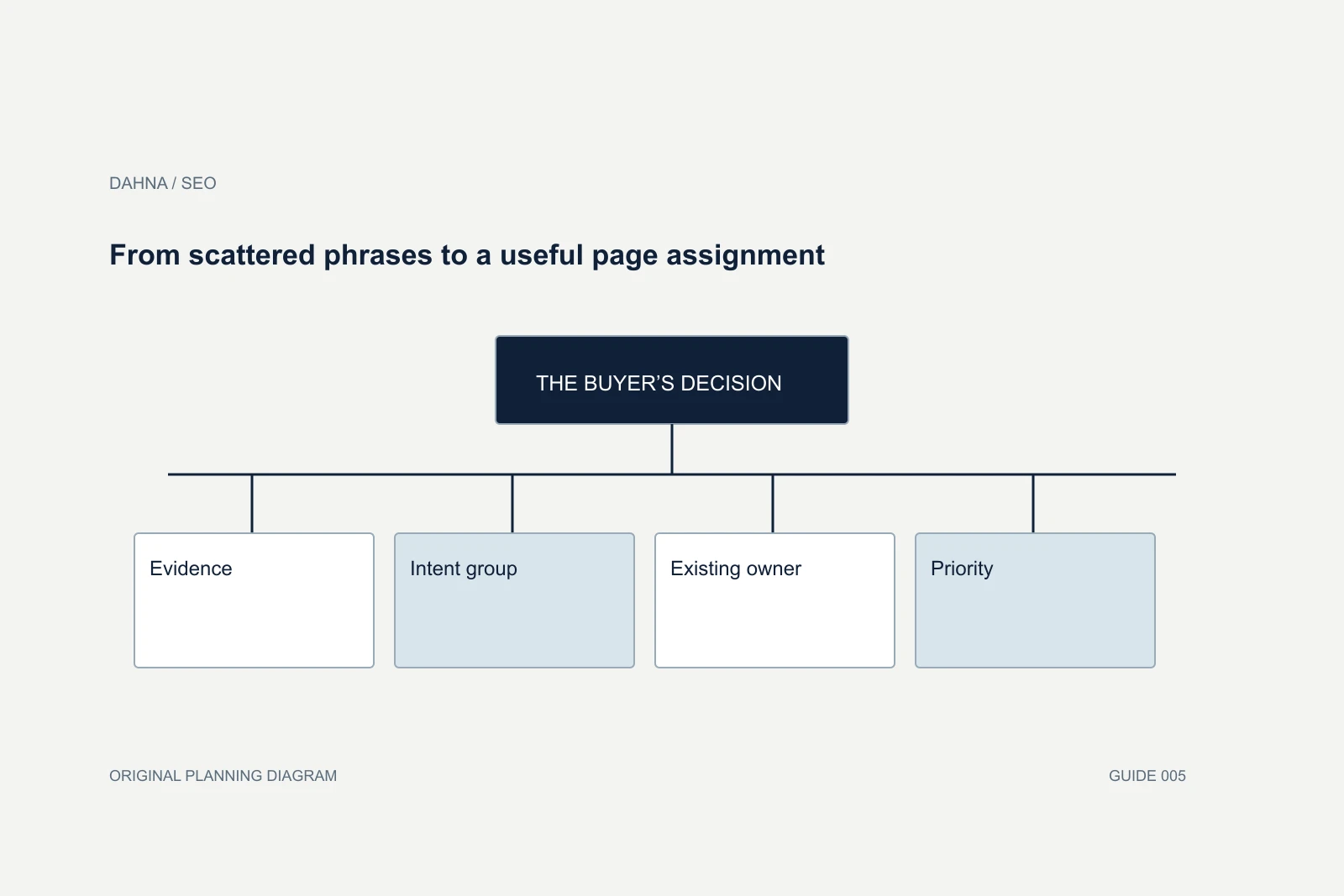
From scattered phrases to a useful page assignment
Evidence
Collect observed and proposed questions separately.
Intent group
Combine phrases that serve the same decision.
Existing owner
Check the current page and its real coverage.
Priority
Approve the best next improvement or new destination.
Prioritize with reasons that a founder can challenge
Use a simple review across relevance, evidence, current coverage, product readiness, and effort. Avoid compressing weak assumptions into a precise-looking score. A high estimated volume cannot rescue a topic the brand has no authority or product fit to answer. A lower-volume question can matter when it removes a recurring purchase obstacle.
The map should also show the cost of acting. Some opportunities require only a factual clarification on an existing page; others need original photography, a comparison study, or a developer. That information lets the founder choose a realistic sequence and see why an apparently attractive keyword is deferred.
| Opportunity | Reason to act | Dependency | Decision |
|---|---|---|---|
| Refill compatibility question | Recurring purchase confusion | Verified compatibility matrix | High priority existing-page improvement |
| New category collection | Relevant inventory and buyer interest | Stable assortment and merchandising owner | Plan after catalog confirmation |
| Broad ingredient encyclopedia | Large possible audience but diffuse offer fit | Specialist evidence and maintenance capacity | Defer until a narrower need is established |
Illustrative example: a four-product US launch
Imagine a European haircare brand launching four products in the US. Its first list contains 120 phrases from tools and customer conversations. After grouping by decision, the team has 18 needs. Ten are already handled adequately by product or support pages, five require clearer information on existing pages, and three appear to justify new resources. The numbers are illustrative, not a benchmark for keyword research.
The team chooses one guide explaining how to select among its routines, one collection for a stable product grouping, and one original demonstration answering a repeated use question. It postpones unrelated celebrity-hair searches despite their apparent popularity. Each approved need has an owner page, evidence, internal-link plan, and review date.
The important output is not the reduction from 120 to three. It is the explanation of each decision. Another brand with a larger catalog might justify more pages; a narrower offer might justify none. The process keeps the content investment tied to what the business can usefully help a US customer decide.
Record why an attractive topic was rejected
A useful map includes a short deferred list. A topic may have weak product fit, require expertise the brand cannot currently supply, duplicate an existing answer, or depend on a product that is not ready for the US. Recording the reason prevents the same tempting phrase from returning in every planning meeting.
Revisit a deferred topic when its dependency changes. A newly available product or an original research asset can make a previously weak idea useful. This is more productive than treating the initial keyword list as a permanent publishing obligation. The map should guide judgment as the business changes.
Ask for the map and the reasoning
Dahna can help connect customer questions, observed search data, and catalog priorities into a practical content plan. Request a map that names the existing destination, the missing contribution, and the next action for every approved intent. Ask the team to mark unavailable analytics access or unverified demand instead of presenting guesses as research.
Once the intent is approved, use the page-type guide to decide where the answer belongs. This keeps research and publishing connected without assuming that every keyword needs a blog post.
Continue with the related decision
Use these guides when the next question goes beyond the scope of this article.
Use the editable decision sheet
Download the completed tables as a CSV, then replace the example inputs and add your evidence, owner and review date. Illustrative figures are teaching examples, not default targets.
Sources & further reading
Bring this decision to Dahna
Use this guide to prepare a focused brief. Tell Dahna what needs to change, which evidence you already have and when you need a decision.
Why consider Dahna for this work?
Dahna brings bilingual Korean and English strategy together with creator, content, and measurement work for brands growing in the US. You can review the people behind the recommendations and the kind of work we propose before starting a conversation.
Founder experience includes prior and contracted roles. Sample deliverables illustrate our approach; they are not client results or a performance promise.