How to write a beauty packaging design brief
A beauty packaging brief should connect the product’s use, approved information, brand identity and manufacturing constraints. Give the designer the actual container and copy requirements early, then review prototypes at real size before committing to production.
Dahna, original planning diagram
In this article
Overview
A beauty packaging brief should connect the product’s use, approved information, brand identity and manufacturing constraints. Give the designer the actual container and copy requirements early, then review prototypes at real size before committing to production.
Define what the package must help someone do
A package has several jobs: identify the brand, explain what the product is, distinguish the variant and support correct use. It may also need to survive shipping, fit a retailer’s shelf and appear clearly in ecommerce photography. Rank those jobs for your product instead of asking the designer to make everything equally prominent.
For a skincare device, the outer box and quick-start insert may carry different information from a small cosmetic bottle. For a refill, compatibility may matter more than a decorative story. The brief should explain the actual buying and use situation so the visual hierarchy follows a customer need.
lululemon selfcare connects packaging to a use occasion
Pentagram’s historical lululemon selfcare project, led by Eddie Opara with the client team led by Rémi Paringaux, connected naming and packaging to personal care around exercise. The case describes compact containers and tactile details. It is a design example, not a claim about current product availability or commercial performance.
The transferable question is practical: where will the customer carry, open, store and use your product? A beautiful container that is awkward in that situation can contradict the brand promise. Bring a realistic use scenario to the designer and supplier, then distinguish what can be solved graphically from what requires structural development.
Provide a complete input packet
Give the designer the approved product name, size, variant list, factual copy, barcode information and all required market-specific content from the responsible specialists. Identify which text is locked and which can be edited. Do not allow a layout deadline to turn provisional claims into approved packaging copy.
Include supplier dielines, material choices, printing limitations, minimum quantities and the production timeline. Ask the supplier to confirm the file specifications and proofing process. A generic box mockup can hide fold lines, seams or areas that cannot reliably carry small text.
| Input | Why it matters | Owner |
|---|---|---|
| Approved product facts and claims | Controls what the package can communicate | Product and qualified review team |
| Dieline and container dimensions | Defines usable space and construction | Packaging supplier |
| Variant and future-range plan | Prevents one-off designs that cannot expand | Brand and merchandising |
| Printing and material constraints | Connects appearance to feasible production | Supplier and production lead |
| Retail and ecommerce uses | Tests shelf and thumbnail recognition | Sales and marketing |
| Approval sequence | Prevents conflicting last-minute changes | Project owner |
Worked example: three nearly identical serum boxes
Consider a fictional brand with three serums in the same bottle size. The first concepts distinguish them only through pale background colors. In a small online image, the boxes look almost identical. In a poorly lit bathroom, a customer may also struggle to choose the intended product.
The team tests a clearer product-name hierarchy and a secondary identifier that remains legible without relying solely on color. It reviews the boxes together, individually and at thumbnail size. These tests do not establish sales lift; they expose an identification problem before production. The same review should include the container itself, because customers often discard the outer box.
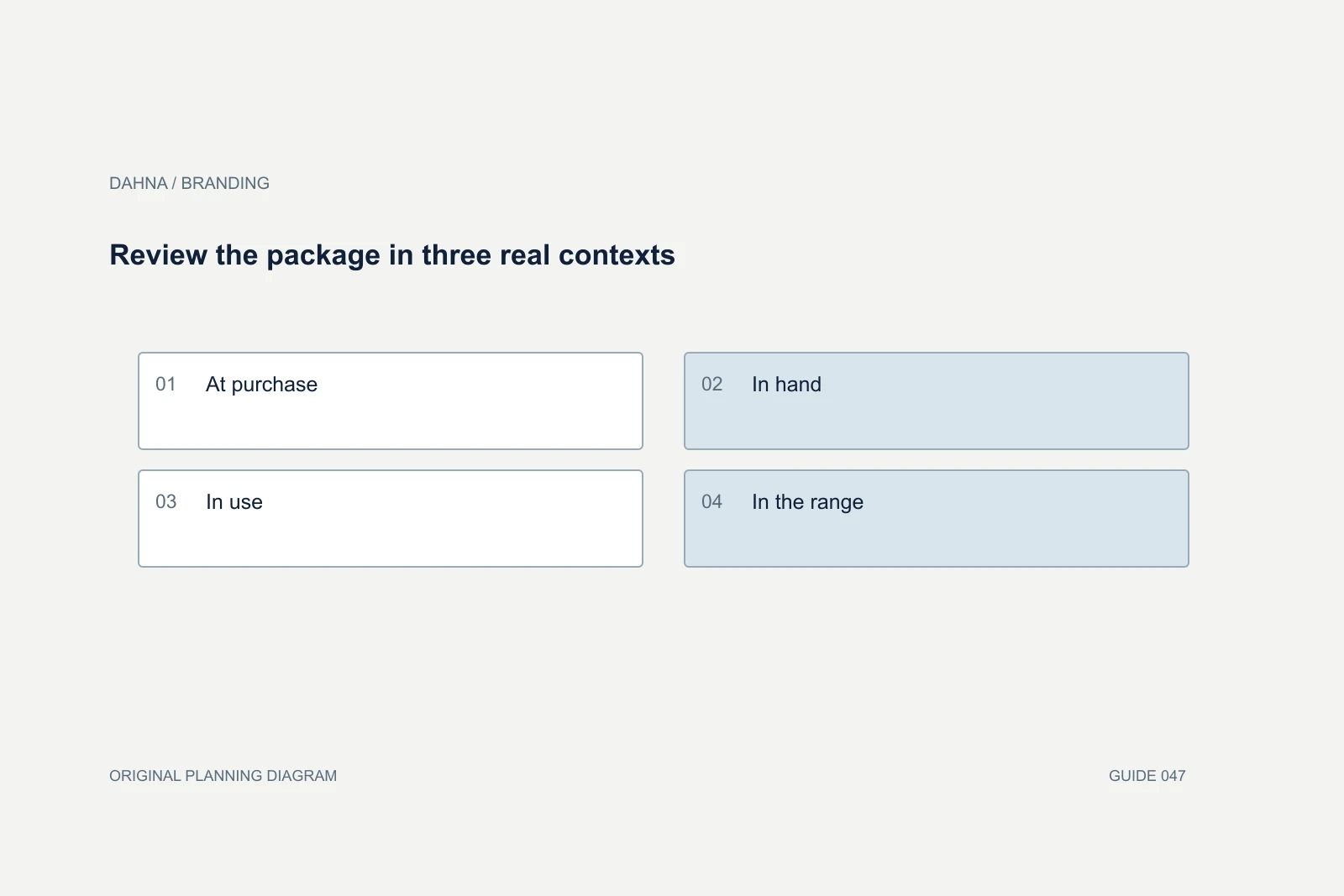
Review the package in three real contexts
At purchase
Product and variant identifiable on shelf or screen
In hand
Important information legible at actual size
In use
Opening, dispensing and storage make sense
In the range
New variants fit the same hierarchy
Keep design approval separate from factual approval
A designer can make copy legible and persuasive without being the person qualified to approve a product claim. Give factual reviewers a version-controlled copy document and a final artwork proof. Changes made during layout can alter emphasis or omit a qualifier, so the final package needs another check.
For US-bound beauty products, use the appropriate product and legal specialists to determine required labeling and permissible claims. This article is a design brief, not a compliance checklist. The useful project rule is simple: every factual or required element has an owner, and nobody assumes someone else has approved it.
Budget for proofs and production decisions
Clarify whether the quote includes digital mockups, printed proofs, structural samples, supplier coordination and final artwork revisions. These are different deliverables. A screen rendering can help choose a direction, while a physical proof reveals scale, finish, contrast and handling.
Document what the proof represents. A hand-finished prototype may look different from a mass-produced package. Ask the supplier which tolerances and color variations are expected. If the desired finish exceeds the budget, decide which qualities matter most before the designer spends more time refining an impossible specification.
Check the package when the ideal view is unavailable
A customer may see only the side of a box on a shelf, the back of a bottle in a bathroom or a tiny crop in a retailer grid. Review those views as part of the brief. The product name, variant and essential identifying information should not depend entirely on the front-facing hero composition.
For a range with several sizes, check that the smaller package can carry its approved information without reducing everything to unreadable type. The solution may involve a different hierarchy, an insert or another supplier-approved structure, with required content decisions handled by the responsible specialists. Do not quietly remove text to preserve the preferred layout.
Include a practical handling review with a physical sample: opening, closing, dispensing and returning the product to storage. Ask whether the package can be distinguished from neighboring products when used in ordinary conditions. A glossy mockup cannot reveal every difficulty with a cap, a label seam or an easily confused variant. Record the findings and decide which belong to graphic design, structural packaging or the product itself. That division helps the team solve the actual problem instead of asking the designer to compensate for a physical limitation through another round of artwork.
Deliver a package the next launch can use
Keep final artwork, approved copy, dielines, supplier notes and variant rules in one controlled library. Name files so the production team can identify product, market, version and approval status. Archive superseded files in a way that prevents accidental reuse.
Dahna can help turn the brand direction into a packaging communication brief and coordinate it with product photography and the website. Bring the product, use occasion and supplier constraints early. That makes the creative discussion more specific and gives the finished package a clear role in the customer’s experience.
Continue with the related decision
Use these guides when the next question goes beyond the scope of this article.
Use the editable decision sheet
Download the completed tables as a CSV, then replace the example inputs and add your evidence, owner and review date. Illustrative figures are teaching examples, not default targets.
Sources & further reading
Bring this decision to Dahna
Use this guide to prepare a focused brief. Tell Dahna what needs to change, which evidence you already have and when you need a decision.
Why consider Dahna for this work?
Dahna brings bilingual Korean and English strategy together with creator, content, and measurement work for brands growing in the US. You can review the people behind the recommendations and the kind of work we propose before starting a conversation.
Founder experience includes prior and contracted roles. Sample deliverables illustrate our approach; they are not client results or a performance promise.