How to develop a brand voice through a practical workshop
Develop brand voice by making and testing real writing choices, not by agreeing to a list of flattering adjectives. A workshop should produce a small set of clear principles, contrasting examples and decisions about how the brand speaks in different customer situations.
Dahna, original planning diagram
In this article
Overview
Develop brand voice by making and testing real writing choices, not by agreeing to a list of flattering adjectives. A workshop should produce a small set of clear principles, contrasting examples and decisions about how the brand speaks in different customer situations.
Bring actual customer language into the room
Collect product questions, support conversations, reviews and existing copy that the team considers strong or weak. Remove personal information and keep the context of each example. A frustrated customer asking about a late order should not be treated as evidence of the voice you should use in a launch announcement.
Ask participants to mark where existing writing becomes vague, exaggerated or difficult to understand. This gives the workshop a concrete starting point. It also reveals when a supposed voice problem is actually a missing product fact. No tone exercise can answer a question the business has not resolved.
Learn from Mailchimp without copying its personality
Mailchimp’s public style guide distinguishes a relatively consistent voice from tone that changes with the reader’s situation. That is useful for a beauty brand: the same company can sound lively in a launch caption and careful in a product-use explanation without becoming two different brands.
The lesson is a structure for judgment, not permission to borrow Mailchimp’s humor. Your voice should fit the relationship you want with customers and the facts you can support. A skincare brand should be especially cautious when playful wording makes a product sound more certain or medically authoritative than its evidence allows.
Use contrasting drafts to expose real preferences
Prepare two or three versions of a product introduction, a delayed-order response and a campaign caption. Keep the facts identical so participants can discuss language rather than accidentally choosing the version with the better offer. Ask what each version implies about the company and what the customer would understand.
Replace abstract adjectives with observable choices. ‘Confident’ might mean stating the product’s purpose directly and removing apologetic qualifiers. ‘Warm’ might mean acknowledging the customer’s situation before giving instructions. ‘Scientific’ should not mean adding technical language that the reader cannot use.
| Vague instruction | Observable choice | Boundary |
|---|---|---|
| Warm | Acknowledge the customer’s question in ordinary language | Do not invent familiarity or emotional pressure |
| Clear | Name the product, use and next action directly | Do not omit a necessary limitation |
| Confident | State supported facts without filler | Do not turn uncertainty into certainty |
| Playful | Use light humor in low-stakes moments | Keep complaints and instructions straightforward |
Worked example: a calm but capable skincare voice
Imagine a fictional brand choosing between ‘Your skin’s new obsession has arrived’ and ‘A lightweight moisturizer for your evening routine.’ The first creates energy but says little about the product. The second is clear but may need a more distinctive phrase around a supported benefit. The workshop can develop a third version that keeps the useful information and adds the brand’s character.
Now test that voice on a delivery delay. A line about an ‘obsession’ is unlikely to help someone whose order is missing. The team should choose a direct acknowledgement, the known status and the next action. The voice remains recognizable through clarity and care, while the tone responds to the situation.
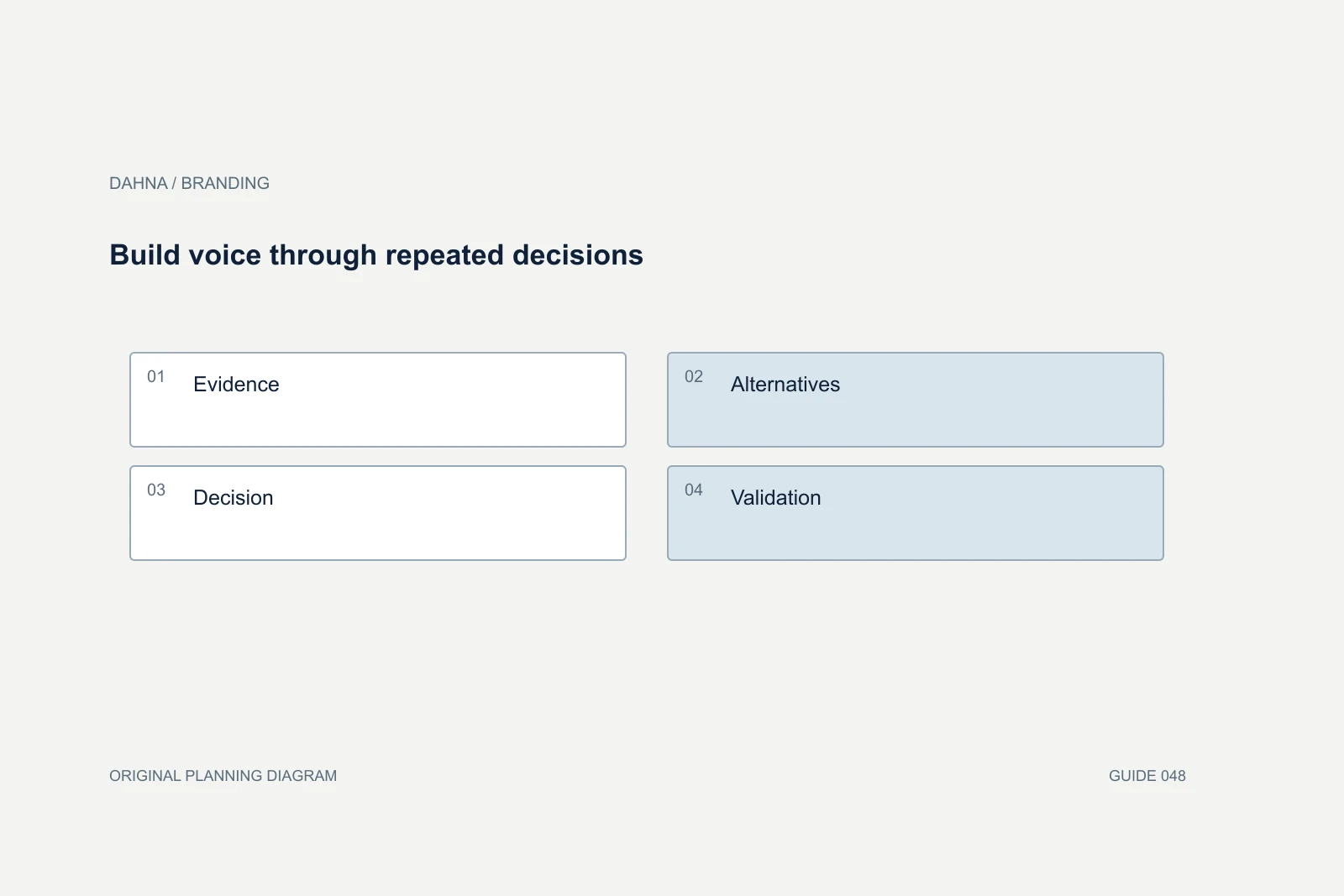
Build voice through repeated decisions
Evidence
Customer questions and existing copy
Alternatives
Same facts written in contrasting ways
Decision
Specific language choice and boundary
Validation
New customer situation tested
Ask readers what they understand and infer
Nielsen Norman Group’s tone research discusses testing how language affects users’ brand perception. For a workshop, ask representative readers what they think the company is like and what the passage is asking them to do. A preference vote alone cannot show whether they understood the product.
Use a small study to discover confusion and unintended associations, not to claim precise market-wide preference. Record who participated and the context. If US customers interpret a translated phrase differently from the home-market team, examine the phrase and the cultural assumption behind it rather than treating either group as wrong.
Resolve disagreements with an editor and a boundary
A workshop can reveal legitimate tension: the founder wants warmth, the product team wants precision and the social team wants energy. Appoint an editor who can reconcile those needs using the brief. Requiring unanimous approval of every sentence often produces bland compromises.
Create a short decision log. It might say that product instructions use direct verbs, captions can use light wit, and unsupported superlatives are removed. Include examples the team rejected and why. Those explanations help future writers make decisions when the exact sentence they need does not appear in the guide.
Give the new voice an uncomfortable scenario
Most voice directions sound convincing in a launch caption. Test a harder situation: a delayed order, an unavailable product or a customer misunderstanding. The writer must preserve the brand’s character while giving a clear answer and taking the customer’s concern seriously. If the direction only works when everything is positive, it is not ready to guide the whole team.
Use an exercise with fixed facts. For example, the order has not shipped, the team is investigating and a confirmed update will be available at a stated time. Ask two writers to produce a response independently. Compare the results for clarity, unsupported promises and tone. Differences reveal where the guidance needs a sharper principle or example.
Then test a technical product explanation. The brand should be able to sound approachable without replacing precise information with a metaphor that changes the meaning. Have the product owner check the facts and a representative reader explain what they understood. This creates a useful bridge between brand expression and customer comprehension. The workshop output becomes stronger when it survives both emotional and technical situations, rather than earning approval only through the most flattering sentence in the presentation.
Leave with a usable first version
The deliverable should include a voice statement, three or four working principles, situation-specific examples and a short editing exercise for the team. Avoid filling the guide with synonyms for friendly and premium. A new writer should be able to apply it to a page the workshop never discussed.
Use the voice on a small set of live drafts before declaring it final. Collect where writers still disagree or need missing facts, then refine the guidance. Dahna can connect the workshop to website, creator and campaign production so the voice is tested through the work your team needs next, rather than remaining a presentation everyone likes but nobody uses.
Continue with the related decision
Use these guides when the next question goes beyond the scope of this article.
Use the editable decision sheet
Download the completed tables as a CSV, then replace the example inputs and add your evidence, owner and review date. Illustrative figures are teaching examples, not default targets.
Sources & further reading
Bring this decision to Dahna
Use this guide to prepare a focused brief. Tell Dahna what needs to change, which evidence you already have and when you need a decision.
Why consider Dahna for this work?
Dahna brings bilingual Korean and English strategy together with creator, content, and measurement work for brands growing in the US. You can review the people behind the recommendations and the kind of work we propose before starting a conversation.
Founder experience includes prior and contracted roles. Sample deliverables illustrate our approach; they are not client results or a performance promise.