How to test whether customers recognize your brand assets
Test distinctive assets by asking category buyers which brand a cue brings to mind, without showing the brand name first. Measure correct associations alongside confusion and nonrecognition, then use the results to decide which assets to preserve, build or reconsider.
Dahna, original planning diagram
In this article
Overview
Test distinctive assets by asking category buyers which brand a cue brings to mind, without showing the brand name first. Measure correct associations alongside confusion and nonrecognition, then use the results to decide which assets to preserve, build or reconsider.
Separate recognition from liking
A team may love a color palette that customers associate with another brand. Conversely, an asset that feels familiar or unfashionable internally may be one of the few cues customers recognize. Ask two different questions: does the cue identify the brand, and does the team want to use it? Treating them as the same question can discard useful memory.
A recognition study is most useful before changing established assets or investing heavily in a new system. A very young brand may have little recognition to measure, which is an expected starting point rather than a design failure. In that case, the immediate decision is what to use consistently and how to avoid confusion.
Use Jenni Romaniuk’s distinction carefully
Jenni Romaniuk and Louise Dunstone at the Ehrenberg-Bass Institute describe distinctive assets as learned cues that help buyers identify and find brands. Romaniuk’s discussion of fame and uniqueness distinguishes how widely an asset is linked to a brand from how exclusively it is linked to that brand.
For a practical study, this means recording both correct recognition and competitor associations. A popular category color may attract attention without being uniquely yours. The research does not supply a universal pass mark for your project, and a small agency exercise should not claim to reproduce a validated large-scale study without the appropriate design and expertise.
Create a test that does not reveal the answer
Prepare individual cues at realistic sizes: a cropped package shape, a color combination, an illustration style, a sound or a short phrase. Remove explicit brand names when the objective is to test a non-name asset. Randomize exposure where practical and avoid placing several obvious clues together in the first question.
Ask for spontaneous brand associations before providing a list. A prompted multiple-choice answer can be easier than recognition in the market. Record the method so later comparisons use the same task. If the study changes its prompt or audience, a higher score may reflect the method rather than stronger memory.
Record uncertainty instead of hiding it
Recruit category buyers relevant to the business question and describe the sample. Existing customers and noncustomers can produce different results, so avoid combining them without explanation. A small qualitative exercise can reveal confusion; a quantitative estimate needs an appropriate sample and analysis plan.
The following table is a planning structure, not a benchmark or an actual dataset. Use it to decide what you will collect before running the study. Keep raw responses so the team can examine unexpected associations rather than reduce everything to one attractive percentage.
| Field | What it captures | Why it matters |
|---|---|---|
| Asset shown | Exact stimulus and exposure conditions | Allows repeatable testing |
| Spontaneous association | Brand named without a list | Shows what the cue retrieves |
| Competitor association | Other brand named | Reveals confusion |
| No association | No brand comes to mind | Distinguishes unfamiliarity from misattribution |
| Buyer context | Relevant customer/category status | Makes audience differences visible |
Worked example: a distinctive cap or a generic green?
Imagine a fictional skincare brand testing its pale green background and an unusual ridged cap. In exploratory sessions, participants describe the background as natural skincare but rarely name a brand. Several existing customers recognize the cap. The team should not call the green a proven distinctive asset merely because participants like it.
The next decision might be to preserve the cap in photography and packaging while using the green as a supporting color. A larger study may be warranted before a major redesign. No numerical finding is implied by this example; it shows how different response patterns can lead to different design decisions.
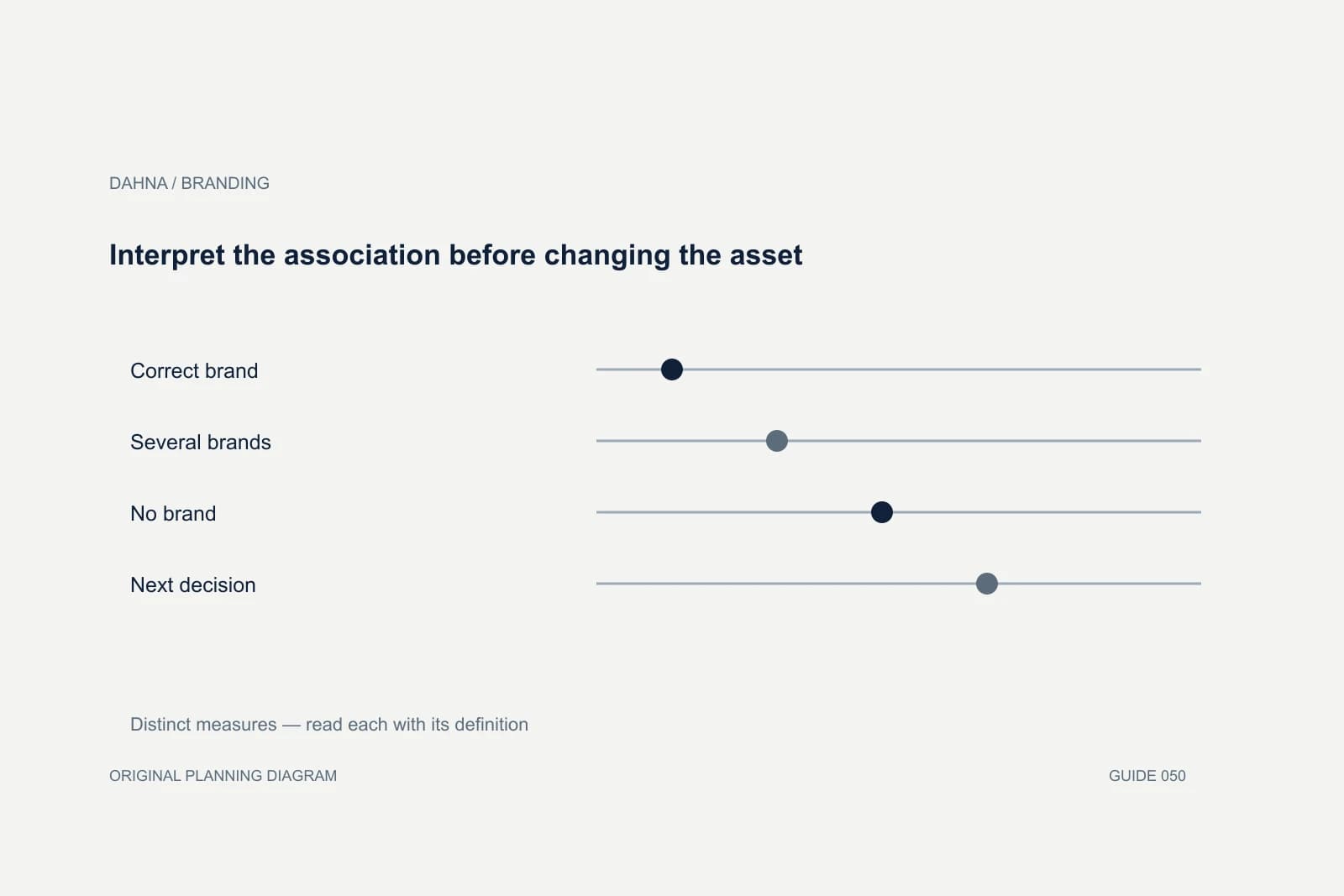
Interpret the association before changing the asset
Correct brand
Potential recognition to preserve and build
Several brands
Possible category cue or confusion
No brand
Association may not be established
Next decision
Preserve, strengthen, investigate or reconsider
Test the asset where customers encounter it
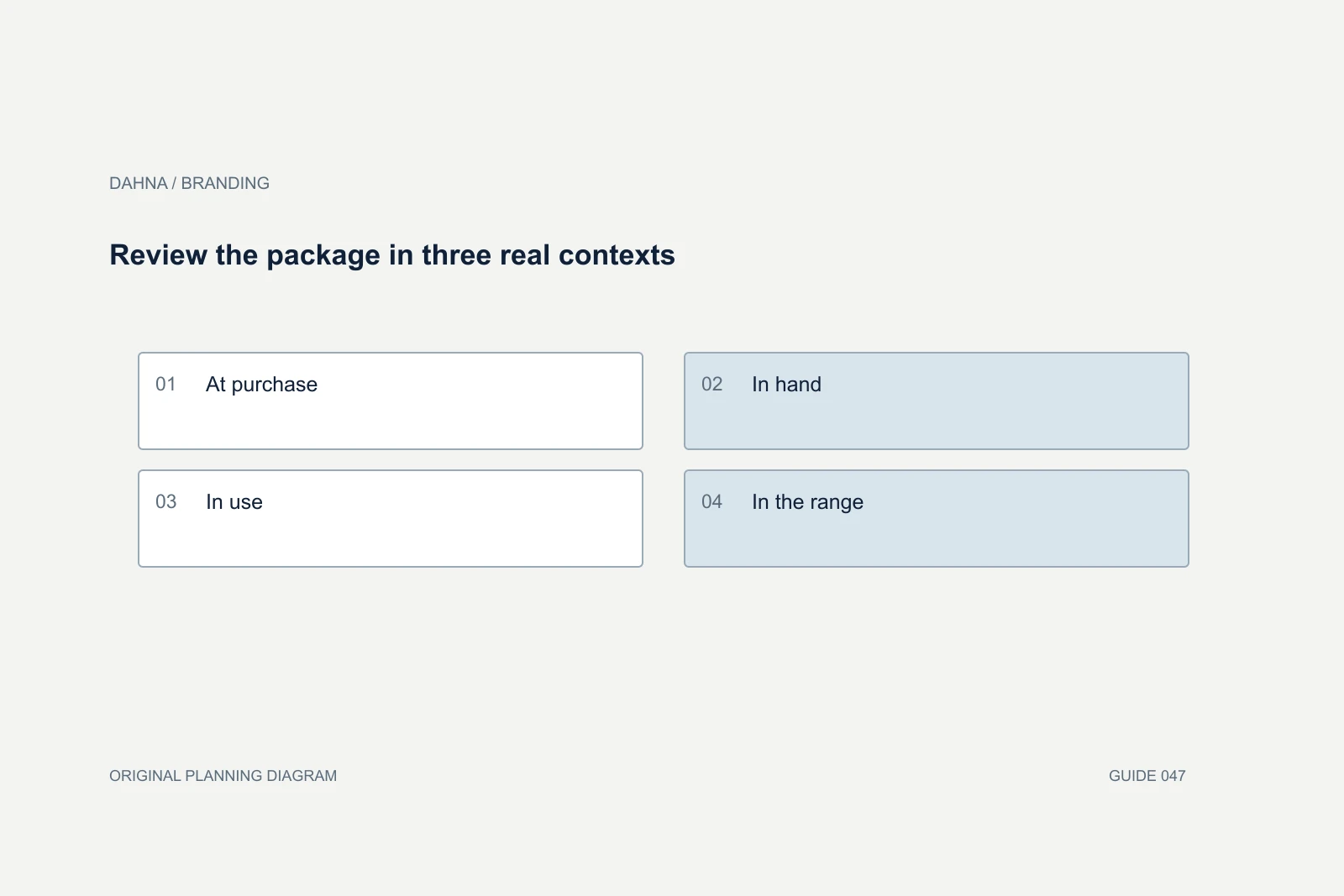
Recognition in a large clean image does not guarantee visibility in a crowded product grid. After testing the cue itself, examine realistic contexts such as mobile thumbnails, retail shelves or creator videos. Keep these tasks distinct so you know whether a problem comes from weak association or poor visibility.
An asset may work well on packaging and poorly in a small social avatar. The solution could be a clearer application rather than a new identity. Ask the designer to show how the cue survives cropping, low contrast and competing information. Do not assume every asset must appear at full intensity in every format.
Do not turn a small test into a precise growth forecast
Suppose a cue is correctly associated with the brand more often among existing customers than among noncustomers. That pattern may reflect experience with the product rather than a universally strong asset. Report the groups separately and explain what the study can support. It may justify more consistent use, but it does not establish how much additional sales that use will create.
Similarly, a low recognition result for a newly introduced asset does not necessarily justify abandoning it immediately. The team should consider exposure history, competing associations and the strategic role of the cue. A research specialist can help determine whether the next step is a better study, a clearer application or a longer period of consistent use.
For the decision meeting, prepare one page per asset with the stimulus, method, observed associations and recommended action. Include an uncertainty statement in ordinary language. This format makes it harder to select only the favorable number and ignore the context. It also keeps the agency honest about the difference between a useful exploratory exercise and a statistically designed brand-tracking program. The brand can then invest in identity work with a clearer view of what is known and what remains a hypothesis.
Turn the study into a preservation brief
Document which assets the team will retain, which need more consistent use and which remain uncertain. Attach the evidence and limits. If leadership chooses to change a recognized asset for a strategic reason, record that tradeoff explicitly rather than rewriting the study to justify the decision.
Dahna can connect this research brief to an identity refresh and the content system that carries the assets. Bring existing packaging, campaign examples and the proposed changes. The study’s value is a more informed design decision, with recognition evidence kept separate from aesthetics and unsupported claims about future sales.
Continue with the related decision
Use these guides when the next question goes beyond the scope of this article.
Use the editable decision sheet
Download the completed tables as a CSV, then replace the example inputs and add your evidence, owner and review date. Illustrative figures are teaching examples, not default targets.
Sources & further reading
Bring this decision to Dahna
Use this guide to prepare a focused brief. Tell Dahna what needs to change, which evidence you already have and when you need a decision.
Why consider Dahna for this work?
Dahna brings bilingual Korean and English strategy together with creator, content, and measurement work for brands growing in the US. You can review the people behind the recommendations and the kind of work we propose before starting a conversation.
Founder experience includes prior and contracted roles. Sample deliverables illustrate our approach; they are not client results or a performance promise.