How to configure a Shopify store for US customers
A US storefront needs a consistent market configuration across product availability, displayed prices, checkout, delivery information and customer service. Translating the homepage is one part of the work; the agency should prove that a US customer can complete a real purchase under the intended commercial terms.
Dahna, original planning diagram
In this article
Overview
A US storefront needs a consistent market configuration across product availability, displayed prices, checkout, delivery information and customer service. Translating the homepage is one part of the work; the agency should prove that a US customer can complete a real purchase under the intended commercial terms.
Write the commercial decisions before touching settings
Start with the assortment approved for the US, the intended selling currency, regional prices, fulfillment locations and the customer-service contact. Ask the brand’s responsible specialists to resolve product eligibility and tax or import questions. The website team can implement approved decisions, but should not quietly invent them while configuring a store.
A Korean or European team may already sell internationally through a single checkout. That does not mean the US experience is deliberate. Look for prices changing unexpectedly, promotions that exclude the destination, products visible but unavailable at checkout and delivery language copied from the home market. These inconsistencies are easier to resolve when one owner holds the complete market brief.
Understand what the platform can customize
Shopify describes Markets as a way to tailor experiences by location or other audience conditions, including currency, pricing, availability, language and theme content. The exact options available depend on the store and configuration. Have the agency verify the current admin capabilities before committing to a design or a multi-store architecture.
Ask for a configuration register, not only screenshots. It should record which market owns each setting, what is inherited and which exceptions apply. Inherited settings can be helpful until someone changes a parent configuration without realizing that a US storefront depends on it. Include a named reviewer for changes that affect more than one market.
KASH Beauty illustrates why the pieces must agree
Shopify’s KASH Beauty case study identifies the brand’s founder, Keilidh Cashell, and quotes director Conor Cochrane on aligning local marketing, copy and currency. The useful point is coherence across the shopping experience. The case does not prove that changing a currency selector by itself causes international growth.
For a brand preparing its own US launch, turn that example into a review across several touchpoints. Does the ad show the same offer the product page supports? Does the cart retain the selected market? Does the confirmation email describe the correct delivery process? These are practical acceptance questions that can be answered before launch.
Build a market acceptance matrix
Use representative products rather than testing only the easiest SKU. Include a bundle, a discounted item, an unavailable product, a variant and an address outside the supported delivery area. If customers can switch markets, test that switch from a product page and from the cart.
Document expected behavior before executing the tests. A result is not correct merely because checkout completes. The displayed currency, charged amount, selected assortment and customer communication must match the business decision. Keep payment information out of the shared report and use approved test methods.
| Journey | Expected result | Responsible reviewer |
|---|---|---|
| US visitor opens a product | Approved US assortment and intended price | Merchandising |
| Customer changes country | Clear destination and currency state | Ecommerce owner |
| US address enters checkout | Supported delivery methods and approved charges | Operations |
| Order confirmation arrives | Correct product, currency and service contact | Customer service |
| Unsupported address is entered | Clear explanation before payment | Operations and web team |
Worked example: one catalog, two launch assortments
Imagine a European body-care brand with eighteen products, twelve of which are approved for the first US release. The project initially imports all eighteen and translates the pages. During review, the brand notices that a US customer can discover an excluded gift set through search, even though the main menu only shows the approved twelve.
The fix is to define availability consistently across catalog, search, recommendations, campaigns and checkout. The project records the six exclusions, the reason each is excluded and who can change that status. The example demonstrates an operating requirement; it does not establish legal eligibility for any product. Specialists still own the underlying market decision.
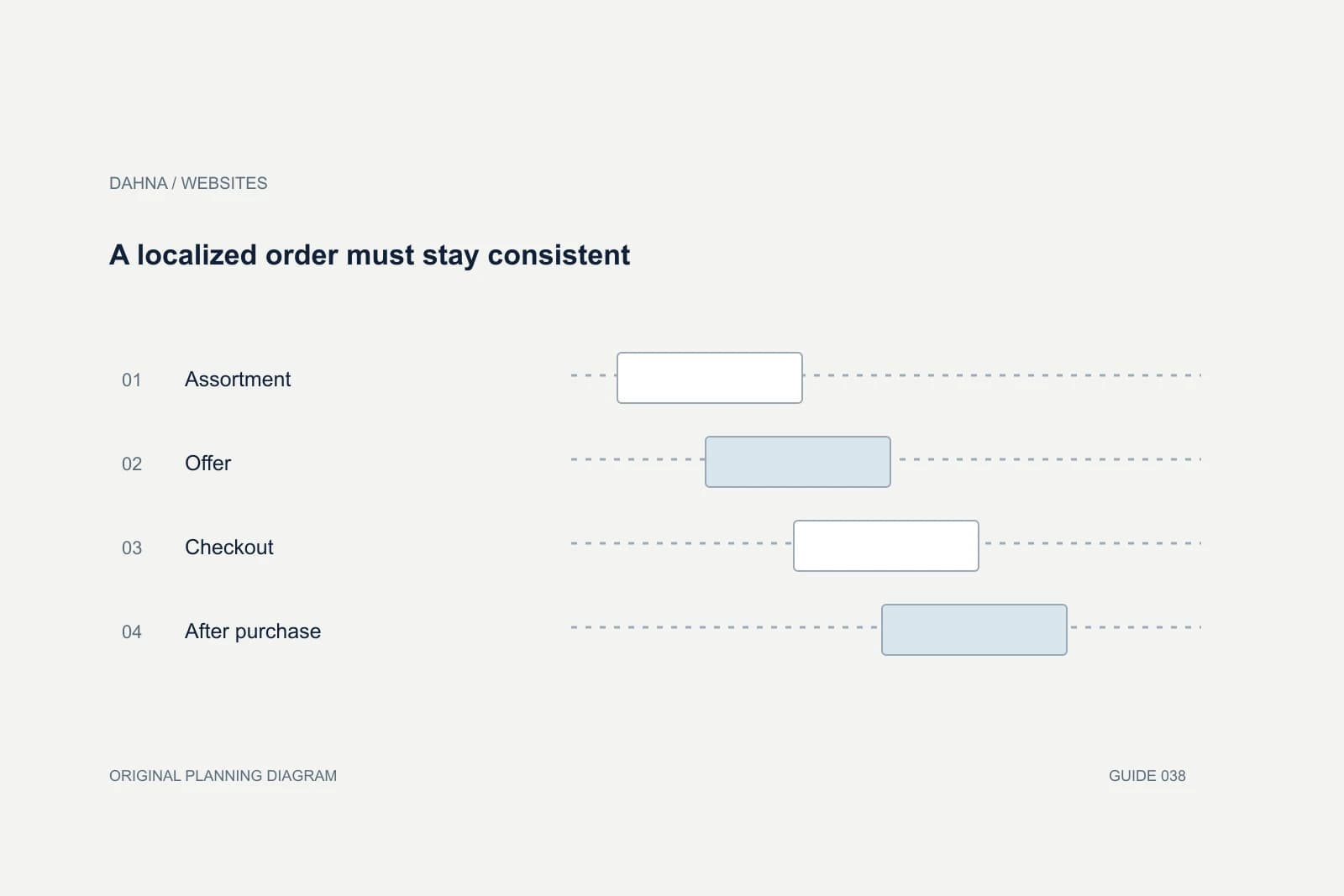
A localized order must stay consistent
Assortment
US-approved product and variant
Offer
US price and eligible promotion
Checkout
Supported address and delivery method
After purchase
Matching confirmation and service route
Separate shared brand assets from local operations
Some content should remain consistent across markets: the identity, approved product facts and core imagery. Other details may need local ownership, including delivery statements, offers, retailer references and service hours. Record the distinction so that a home-market update does not overwrite a US-specific promise.
A shared store can make coordination easier, but only if the team understands its permissions and publishing workflow. A separate store can provide independence while creating more places to maintain data. Decide using actual operational needs, not the assumption that every new country deserves another storefront. Include the time required to keep product versions and promotional dates synchronized.
Test visitors whose location and shopping destination differ
A US customer may browse while traveling, use a work network in another country or choose a gift for a different destination. A Korean team member may need to review the US experience from Seoul. The project should not assume that a location signal always equals the intended market. Provide a clear way to understand and change the selected shopping context where the platform supports it.
Test what happens to a cart when the market changes. Some products, prices or promotions may no longer apply. The customer needs an understandable explanation, and the operations team needs to know which state the final order used. A silent switch can create confusion even if the platform is technically following its configuration.
Include a second reviewer who did not configure the market. Give that person an expected order scenario and ask them to verify the visible price, available items, delivery choices and confirmation. This independent acceptance check can catch assumptions shared by the setup team. Record the result and any remaining exceptions, especially if the store supports several regional experiences. The aim is a predictable US buying journey that also remains understandable for international visitors, rather than a geographic rule that works only in the simplest case.
Launch with an exception log and a support plan
Set a short period in which the team checks real orders for configuration errors, with access limited to the people who need it. Review failed checkouts, customer questions about currency and delivery, and products that appear in the wrong market. These signals should feed an issue log with an owner and next action.
Do not judge localization only by a first-week conversion rate. Traffic quality, unfamiliarity with the brand and the offer can change at the same time. First establish that the intended experience works. Then use customer feedback and appropriately segmented analytics to improve the local journey. Dahna’s website brief can connect those customer-facing decisions to the configuration and creative work needed to support them.
Continue with the related decision
Use these guides when the next question goes beyond the scope of this article.
Use the editable decision sheet
Download the completed tables as a CSV, then replace the example inputs and add your evidence, owner and review date. Illustrative figures are teaching examples, not default targets.
Sources & further reading
Bring this decision to Dahna
Use this guide to prepare a focused brief. Tell Dahna what needs to change, which evidence you already have and when you need a decision.
Why consider Dahna for this work?
Dahna brings bilingual Korean and English strategy together with creator, content, and measurement work for brands growing in the US. You can review the people behind the recommendations and the kind of work we propose before starting a conversation.
Founder experience includes prior and contracted roles. Sample deliverables illustrate our approach; they are not client results or a performance promise.