How to make a premium price understandable to customers
A premium price needs a clear account of the value a customer receives, supported by product facts and a credible experience. Build the explanation around meaningful differences, their evidence and their relevance to the buyer; expensive-looking design alone cannot answer why the product costs more.
Dahna, original planning diagram
In this article
Overview
A premium price needs a clear account of the value a customer receives, supported by product facts and a credible experience. Build the explanation around meaningful differences, their evidence and their relevance to the buyer; expensive-looking design alone cannot answer why the product costs more.
Identify what the customer is actually paying for
List possible sources of value: a useful function, a material or formulation choice, service, durability, design, a simpler routine or a distinctive experience. Then ask which differences the intended buyer cares about and which the company can demonstrate. A costly internal process is not automatically valuable to a customer.
Avoid treating premium as a synonym for clinical, sustainable or luxury. Each word introduces a different promise and may require different evidence. A brand can offer a carefully made sensory experience without implying medical superiority. The explanation should match the product rather than borrow whichever category language currently sounds expensive.
Dyson makes an engineering story concrete
Dyson’s introduction of its Supersonic Flyaway attachment connects an engineering mechanism to a specific styling task, with Emma Sheldon explaining the design objective. It is a manufacturer’s explanation, not independent proof that every user will get the same result. Its usefulness as a branding example is the connection between a technical feature and a recognizable use.
For a beauty brand, the equivalent is to explain what a design choice helps someone do. A special dispenser might support controlled application; a refill system might change the ownership experience. State the actual benefit and its limits. Do not borrow Dyson’s technical authority to imply that an unrelated product has comparable engineering or performance.
Build an evidence ladder for each important claim
Begin with the proposed customer-facing statement and work backward. What observation, document or test supports it? Who owns that evidence? Does it apply to the current product version and the intended use? A claim can become unreliable when its source refers to an older formula or a different device model.
Distinguish a factual specification, a measured result, a customer opinion and a brand belief. Each can play a role, but they are not interchangeable. A founder’s conviction can explain purpose; it cannot substitute for product testing. A selected testimonial can illustrate an experience without establishing a typical outcome.
| Proposed value | Evidence to inspect | Communication boundary |
|---|---|---|
| More controlled dispensing | Current dispenser specification and demonstration | Describe the mechanism without inventing dose accuracy |
| More durable construction | Relevant testing and warranty terms | State tested conditions and exclusions |
| Distinctive sensory experience | Product demonstration and attributed user feedback | Do not universalize subjective preference |
| Convenient ownership | Actual service and replacement process | Promise only what operations can deliver |
| Specialized performance | Appropriate product-specific substantiation | Have qualified reviewers approve consequential claims |
Worked example: a $68 serum and a vague explanation
Consider a fictional serum brand whose page says ‘luxury science for exceptional skin’ beside a $68 price. The team cannot explain what the phrase means. In a value workshop, it identifies a distinctive texture, a specific packaging mechanism and a well-documented formulation story. It also finds that a dramatic performance claim lacks suitable support.
The revised brief leads with the product’s intended role, shows the texture and dispenser, and explains the supported formulation choices in plain language. It removes the unsupported claim. The example is not a pricing recommendation or a prediction of willingness to pay. It shows how evidence can make a premium proposition more understandable without exaggeration.
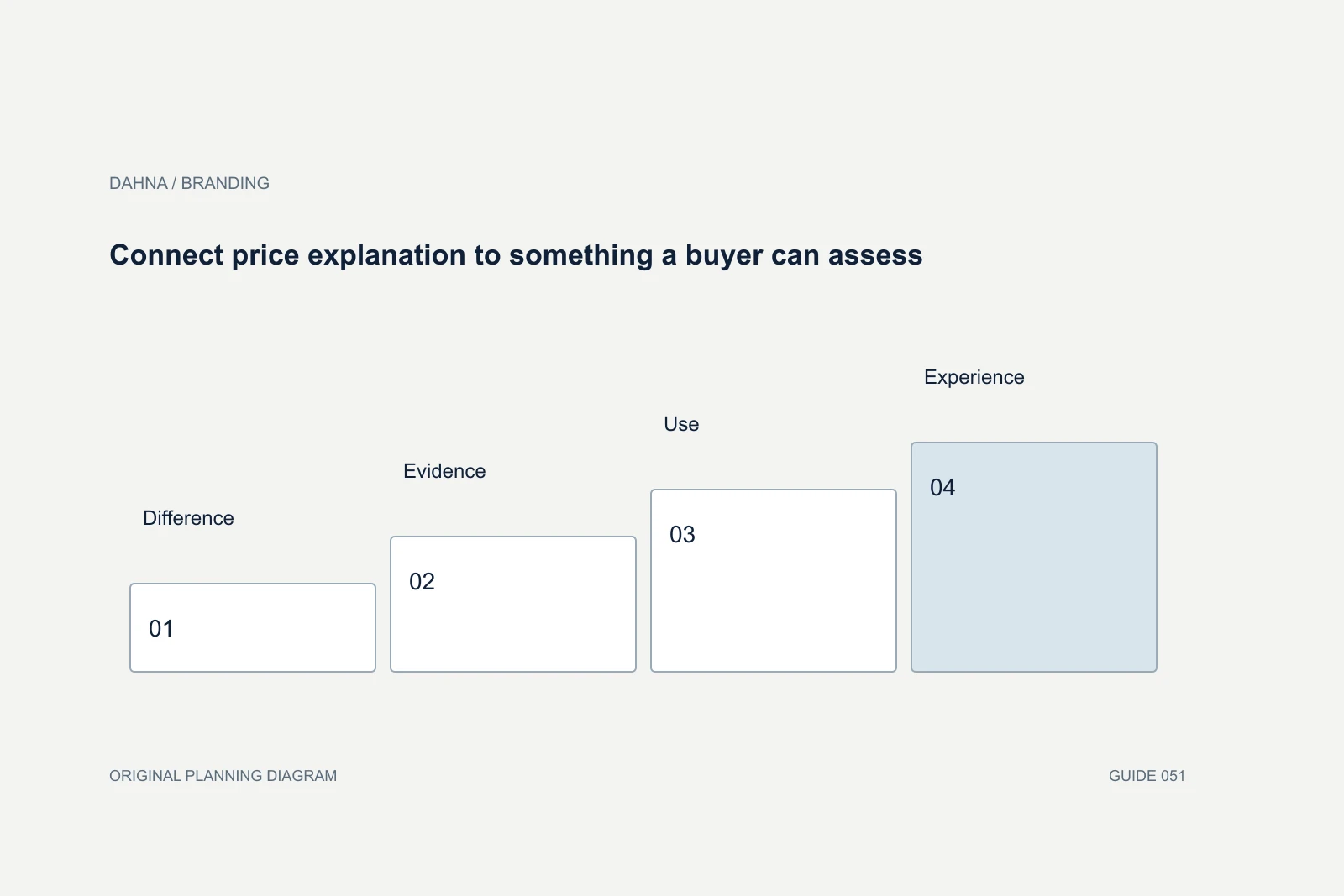
Connect price explanation to something a buyer can assess
Difference
What is materially different?
Evidence
What supports that statement?
Use
Why might the difference matter?
Experience
Does the delivered product keep the promise?
Test comprehension before asking about price
Show representative buyers the explanation and ask what they believe is different, who the product seems suited to and what remains unclear. If people cannot identify the value, a willingness-to-pay question may measure their reaction to the design or category rather than the proposition you intended to test.
Price research requires careful design and should not be reduced to one informal survey question. Keep exploratory feedback distinct from a pricing decision. Record the audience, context and competing options presented. A person responding in a research session may behave differently when spending their own money.
Audit the promise after purchase
Premium communication can be undermined by the ordinary experience: confusing instructions, damaged packaging, inaccessible support or a replacement process nobody owns. Include operations in the value discussion so the brand does not promise service that the business cannot sustain.
Review the complete sequence from product page to delivery and use. Some improvements may be simple, such as clearer setup instructions or a well-organized support page. Others require a product or service investment. An agency should identify the gap and its owner rather than imply that better copy alone can solve it.
Compare value without constructing an unfair rival
If the premium explanation uses a competitor comparison, choose a relevant product and compare current, verifiable features under equivalent conditions. Do not select an obviously unsuitable alternative merely to make your product look superior. A customer who recognizes the mismatch may lose trust in the whole explanation.
Separate the company’s cost from the customer’s value. A more expensive ingredient, component or production method may matter, but the page needs to explain its practical significance and the evidence behind that connection. If the difference is primarily aesthetic or sensory, describe it honestly rather than translating it into an unsupported performance claim.
Use a customer-service rehearsal as an acceptance test. Ask a colleague to answer ‘Why does this cost more?’ using only the approved brief, without adding superlatives or apologizing for the price. Then ask a new reader what they understood. If the explanation still depends on vague prestige language, the team may need better product evidence, a clearer audience or a different value proposition. The exercise does not determine the correct price. It tests whether the current price story can be communicated plainly and supported by the experience the business actually delivers.
Give the creative team a defensible value brief
The brief should contain the value statement, evidence links, approved limitations, demonstration ideas and claims that remain off limits. Include one plain-language explanation a customer-service colleague could comfortably use. If the team needs jargon to make the price sound justified, revisit the substance.
Dahna can help translate supported product differences into branding, website and content work. Bring the product evidence and the questions customers ask about price. The goal is a coherent explanation that helps the right buyer make an informed choice, with results and pricing decisions evaluated through the appropriate research rather than asserted by the creative team.
Continue with the related decision
Use these guides when the next question goes beyond the scope of this article.
Use the editable decision sheet
Download the completed tables as a CSV, then replace the example inputs and add your evidence, owner and review date. Illustrative figures are teaching examples, not default targets.
Sources & further reading
Bring this decision to Dahna
Use this guide to prepare a focused brief. Tell Dahna what needs to change, which evidence you already have and when you need a decision.
Why consider Dahna for this work?
Dahna brings bilingual Korean and English strategy together with creator, content, and measurement work for brands growing in the US. You can review the people behind the recommendations and the kind of work we propose before starting a conversation.
Founder experience includes prior and contracted roles. Sample deliverables illustrate our approach; they are not client results or a performance promise.