What should a TikTok brand moderation plan include?
A TikTok moderation plan should tell the team what to answer, what to move into support, what to remove or report and who can make a difficult decision. It should protect useful criticism as well as the people participating in the conversation. Write the plan around actual customer situations and operating hours, then test it before a campaign attracts more attention than the team can comfortably manage.
Dahna, original planning diagram
In this article
Overview
A TikTok moderation plan should tell the team what to answer, what to move into support, what to remove or report and who can make a difficult decision. It should protect useful criticism as well as the people participating in the conversation. Write the plan around actual customer situations and operating hours, then test it before a campaign attracts more attention than the team can comfortably manage.
Make the comment space useful to customers
The purpose of moderation is not to create the appearance that everyone likes the product. A reasonable complaint, a skeptical question and a request for clarification can be useful to the brand and other shoppers. Distinguish those from harassment, spam, impersonation or the exposure of private information. Write the distinction in plain language so a new team member can apply it consistently.
Keep the brand’s response proportional. A minor misunderstanding may need a short factual correction; a pattern of delayed orders needs an operational investigation. Humor can be appropriate in some conversations but can sound dismissive when someone is describing a real problem. The plan should give responders enough judgment to sound human while making the important boundaries clear.
| Situation | Response path | Evidence to retain |
|---|---|---|
| Product question | Answer from approved facts or seek the answer | Question and verified source |
| Reasonable criticism | Acknowledge and investigate where needed | Issue and action owner |
| Order-specific complaint | Move to approved private support | Restricted support reference |
| Harassment or spam | Apply consistent removal/reporting rules | Minimal record needed for review |
| Personal information posted | Limit exposure and route safely | Avoid unnecessary copying |
| Potentially serious product issue | Escalate to responsible brand specialist | Secure factual record |
Use filters as aids, then inspect their effects
TikTok’s July 2025 announcement, attributed to Adam Presser, describes Creator Care Mode and additional LIVE comment controls. Those tools can help manage unwanted content, but the brand still needs its own response policy and review process. Check the current account’s available settings rather than relying on a screenshot from an old tutorial.
A keyword filter can also hide a legitimate question if the word appears in both abuse and ordinary product discussion. Review filtered material where the tool permits it and refine the configuration thoughtfully. Do not treat automation as a reason to stop listening. The human task is to decide whether a comment is harmful, useful, private or in need of a specialist response.
A fictional launch with three comments arriving together
A fictional skincare brand launches a new cleanser. One viewer asks whether the formula contains fragrance, another reports a missing parcel and a third posts an abusive remark about the presenter. The moderator checks the approved ingredient information for the first, sends the second through the private order-support route and applies the account’s harassment rule to the third.
These actions should not be collapsed into a generic “negative sentiment” total. The fragrance question can reveal missing product information. The parcel complaint may reveal an operating problem. The abusive remark is a moderation issue. Each belongs to a different owner and can lead to a different improvement. A useful weekly report preserves those categories and the action taken.
| Comment | Action | Next owner |
|---|---|---|
| Does this contain fragrance? | Answer from verified product facts | Product/content team if information is hard to find |
| My parcel has not arrived | Acknowledge and route privately | Customer support and fulfillment |
| Abuse directed at presenter | Apply harassment rule and report if appropriate | Moderation lead |
| Several users repeat the fragrance question | Add to information-gap review | Product-page and video owners |
Make corrections visible enough to be useful
If the brand’s own post contains an error, identify what was wrong and correct the relevant surface. A reply buried far down a thread may not reach people who saw the original claim. Depending on the issue, the team may need to edit, replace or remove the content, update the product page and brief any creators using the same facts. The plan should name who can authorize that action.
Keep a correction record with the original issue, approved new wording and affected assets. This is not about preserving every hostile comment forever; it is about preventing the same inaccurate message from reappearing in the next campaign. Where a complaint raises a product-safety or legal question, the responsible specialist should guide the response rather than the social team improvising a conclusion.
Measure resolution and learning, not only speed
Response time is useful when defined consistently, but a fast irrelevant reply does not resolve a customer’s concern. Track unresolved questions, repeated issues, correct routing and the time needed to obtain an approved answer. Review a sample of interactions for tone and accuracy. A smaller queue can result from hiding comments, so queue size alone should not be celebrated as success.
The moderation report should also show what changed elsewhere in the business. A recurring size question may lead to a clearer image. A confusing promotion may need a better listing. A recurring shipping complaint may need operational attention. Those actions make the service valuable to a brand owner because conversation management becomes a source of concrete improvements.
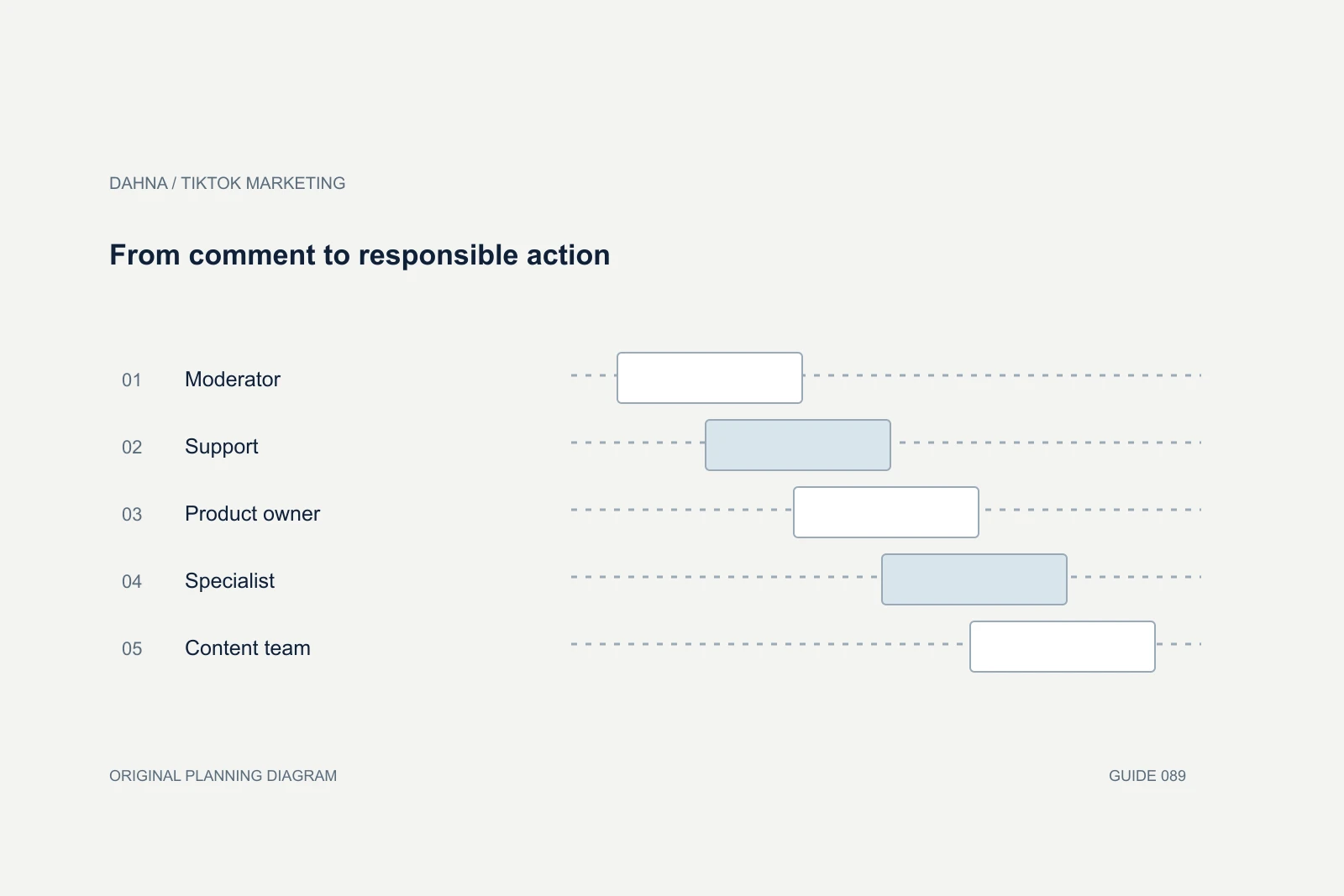
From comment to responsible action
Moderator
Classifies the issue and responds within scope.
Support
Resolves private order matters.
Product owner
Supplies verified product information.
Specialist
Handles matters beyond promotional authority.
Content team
Corrects recurring information gaps.
Prepare for a post that attracts more attention than expected
Set a surge procedure before launch: who can add moderation coverage, who can pause scheduled promotional replies and who decides whether a public clarification is needed. A sudden increase in comments can contain ordinary questions, repeated misinformation and unrelated attention at the same time. The team should avoid treating the entire queue as one crisis or answering every item with the same copied response.
During the surge, keep a short issue summary for the brand owner with verified facts, unresolved questions and the next action. Do not amplify an unverified allegation merely to show that the agency is monitoring it. Afterward, review whether the account’s content or support route created avoidable confusion. The goal is to preserve useful conversation and accurate information while giving the people handling the queue enough authority and support to work consistently.
What Dahna needs to build the plan
Bring your recent comment themes, approved product facts, support process and operating hours. We can help define the response matrix, escalation contacts and coverage needed for the account. A useful proposal includes a rehearsal with realistic comments and an agreed review process, not just a promise to “engage the community.”
The brand should finish with a plan that makes ordinary responses easier and difficult responses more accountable. That lets the account sound like people who understand the product and respect the customer, while giving the team a reliable way to handle the situations that require more than a quick social reply.
Continue with the related decision
Use these guides when the next question goes beyond the scope of this article.
Use the editable decision sheet
Download the completed tables as a CSV, then replace the example inputs and add your evidence, owner and review date. Illustrative figures are teaching examples, not default targets.
Sources & further reading
Bring this decision to Dahna
Use this guide to prepare a focused brief. Tell Dahna what needs to change, which evidence you already have and when you need a decision.
Why consider Dahna for this work?
Dahna brings bilingual Korean and English strategy together with creator, content, and measurement work for brands growing in the US. You can review the people behind the recommendations and the kind of work we propose before starting a conversation.
Founder experience includes prior and contracted roles. Sample deliverables illustrate our approach; they are not client results or a performance promise.