How to map TikTok beauty searches to useful brand videos
Map a search phrase to the question the viewer needs answered, then choose a video that can answer it accurately. Use TikTok search insights, observed results, customer questions and the brand’s own analytics as different evidence sources. A popular phrase is not automatically a good topic for your product, and putting a keyword in a caption does not guarantee distribution or sales.
Dahna, original planning diagram
In this article
Overview
Map a search phrase to the question the viewer needs answered, then choose a video that can answer it accurately. Use TikTok search insights, observed results, customer questions and the brand’s own analytics as different evidence sources. A popular phrase is not automatically a good topic for your product, and putting a keyword in a caption does not guarantee distribution or sales.
Keep the origin of each question visible
Collect questions from the brand’s comments, customer support, product reviews and search tools available to the account. Preserve the wording, date, market and source. A support question comes from an existing customer; a TikTok search suggestion may reflect broader interest; a website query describes people who encountered the site. These are different populations, and the map should not flatten them into a single claim about what everyone wants.
TikTok introduced Creator Search Insights to surface search topics and content gaps in supported regions. Use the actual account access available today, and record what the tool displays. A popularity label is not an exact monthly search volume. If a source cannot be accessed, leave that field unavailable rather than filling it with an estimate that looks measured.
| Source | What it can support | What it cannot establish |
|---|---|---|
| Creator Search Insights | Observed topic or gap signal in the tool | Exact Google search volume |
| TikTok result review | Current examples of how a question is answered | A stable universal ranking |
| Customer support | Real questions from the brand’s customers | Population-wide demand |
| Website search analytics | Queries associated with the brand’s site | Total TikTok demand |
| Reddit brand/customer discussion | Language and unresolved decisions | Verified performance benchmarks |
Translate the phrase into a buying task
“Cleansing balm” is a category. “How much cleansing balm should I use?” is a task that can be demonstrated. “Cleansing balm versus oil” asks for a comparison. The video should make the task clear early and then supply the information needed to complete it. A list of loosely related hashtags cannot repair an answer that never addresses the question.
Group phrases that lead to the same useful answer. Do not commission nearly identical videos merely because the wording differs slightly. Keep a separate topic when the buyer’s decision, required demonstration or product evidence changes. This makes the map more efficient for a small team and reduces the chance that a content calendar becomes a collection of repetitive intros with the same generic product footage.
Filter for US purchase relevance and product truth
For a US-focused brand, check whether the question refers to products, sizes and buying conditions the US customer can actually access. A Korean or European trend can be useful context, but its product availability and language may not transfer directly. Record whether the planned answer serves US shoppers, international customers or both, and choose the linked destination accordingly.
Also ask whether the brand can answer the question responsibly. A product-use demonstration can show the amount and sequence on the label. A medical or diagnostic question may require a qualified response outside a promotional video’s scope. Do not chase a high-interest term by stretching the product’s approved claims. A useful map contains topics to decline or redirect as well as topics to produce.
Sephora’s search case is paid evidence, not an organic shortcut
TikTok’s Sephora UK case describes a phased Search Ads approach and identifies David Hastings as Head of Performance Marketing. It illustrates a retailer treating search behavior as a distinct part of its program. The reported paid-campaign results do not establish an organic-video ranking formula.
A smaller brand can take the organizational lesson without copying the campaign: separate search questions from general entertainment ideas, give them appropriate product destinations and review the resulting behavior. If the brand later adds paid search, the organic question map can inform hypotheses, but the paid campaign still needs its own budget, permissions and measurement. Keep those outcomes separate in the report.
A completed fictional cleansing-content map
A fictional skincare brand receives repeated questions about amount, rinse feel and the difference between its balm and oil. It creates three videos because each requires different evidence. The amount video shows the labeled use quantity. The rinse video uses a clear continuous sequence without pretending it proves a long-term skin result. The comparison video explains differences between the brand’s actual products and acknowledges where the choice is personal.
The production brief includes the question, the proof shot, the approved facts and the next step. It does not prescribe a keyword density or claim that saying the phrase a certain number of times will secure visibility. The team reviews whether viewers understand the answer and whether the video attracts relevant interest, using available search and post analytics with their limitations.
| Question | Required visual | Useful next step |
|---|---|---|
| How much balm should I use? | Actual amount and application sequence | Current product directions |
| What does the rinse look like? | Continuous water/emulsification demonstration | Product details and limits |
| Balm or oil for my routine? | Side-by-side format and usage comparison | Choose between the actual available items |
| Will this treat a skin condition? | No unsupported promotional demonstration | Route to appropriate qualified information |
Review discoverability and usefulness separately
Save a dated search-result observation if the video appears for a target question, but do not treat one personalized result as a stable rank. Record available search-source performance separately from overall views. A video can be useful to existing followers without gaining much search exposure, and a widely viewed video can fail to answer the intended buying question.
Look for specific evidence of understanding: fewer repeated basic questions, more precise follow-up questions or relevant product-page behavior. These signals are suggestive, not a substitute for a controlled sales-effect study. When the evidence is weak, improve the answer or revisit the topic choice rather than promising that a caption rewrite will unlock the algorithm.
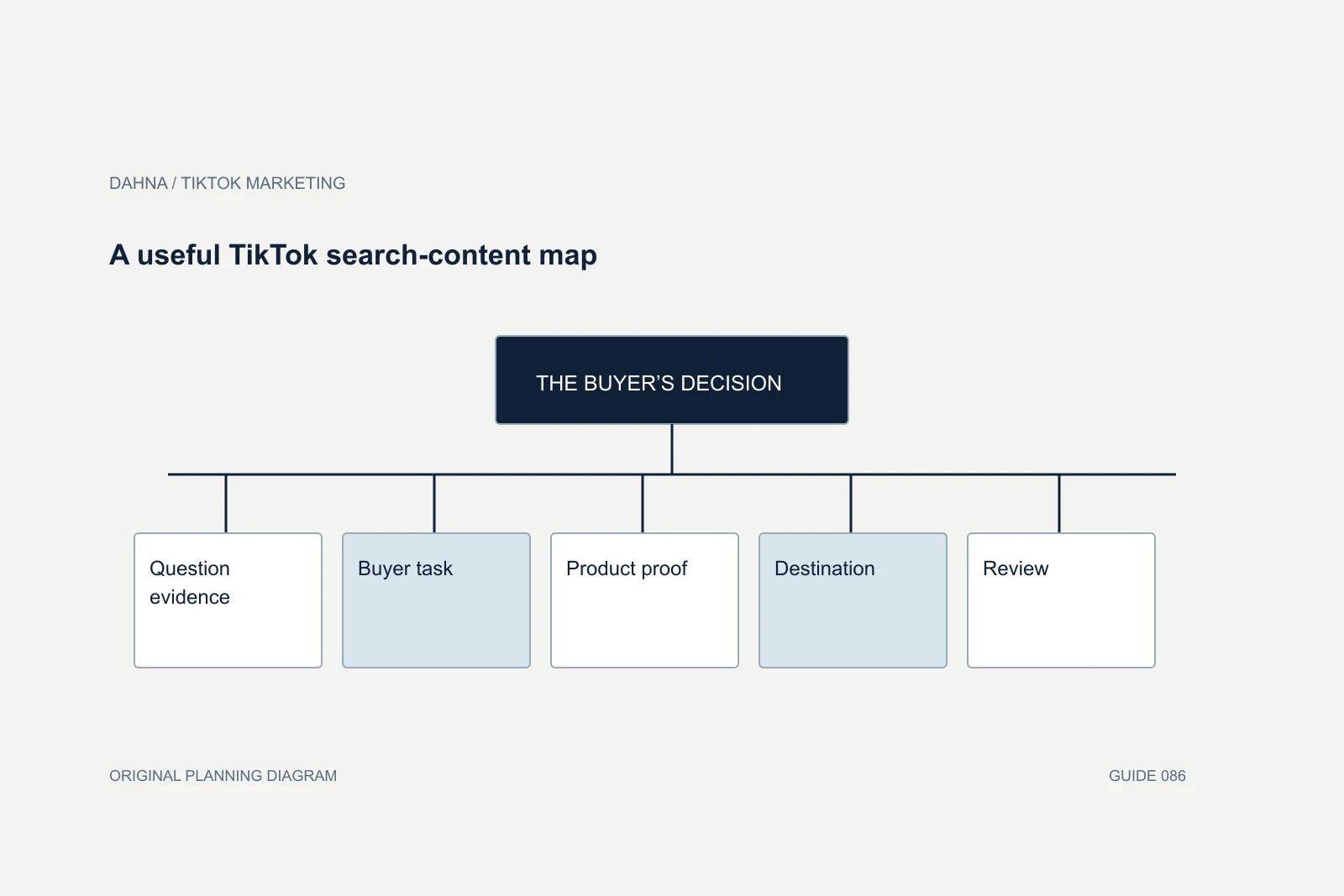
A useful TikTok search-content map
Question evidence
Preserve wording, market and source.
Buyer task
Define the decision or action.
Product proof
Choose what the video can show accurately.
Destination
Provide the relevant next step.
Review
Separate search visibility from business value.
Keep Google Trends in the right column
If the team uses Google Trends alongside TikTok research, record the country, period and exact comparison terms. Treat the result as contextual interest within that tool, not a direct count of TikTok searches. A term can rise in broader search interest while being a poor fit for the product or a different kind of question on TikTok. Do not copy one platform’s signal into another platform’s volume field.
A practical map can therefore contain a blank or unavailable value without being incomplete work. The important record is why the topic remains worth testing: a verified customer question, a relevant product demonstration and a useful next step. When the team later gains better analytics access, it can update the priority using real evidence. This avoids a polished worksheet full of invented precision and gives the brand a clear distinction between observed demand, qualitative input and editorial judgment.
What to ask an agency to build
Bring Dahna your US products, customer questions and any accessible search analytics. We can help create a prioritized video map with distinct questions, completed production briefs and a review method. The map should explain why a topic belongs to the brand and what would make the answer useful.
The first deliverable should be small enough to produce well and broad enough to test different buying tasks. Expand it after the team sees which explanations deserve more depth. That gives the brand a coherent searchable body of content instead of a large list of keywords disconnected from its products and customers.
Continue with the related decision
Use these guides when the next question goes beyond the scope of this article.
Use the editable decision sheet
Download the completed tables as a CSV, then replace the example inputs and add your evidence, owner and review date. Illustrative figures are teaching examples, not default targets.
Sources & further reading
Bring this decision to Dahna
Use this guide to prepare a focused brief. Tell Dahna what needs to change, which evidence you already have and when you need a decision.
Why consider Dahna for this work?
Dahna brings bilingual Korean and English strategy together with creator, content, and measurement work for brands growing in the US. You can review the people behind the recommendations and the kind of work we propose before starting a conversation.
Founder experience includes prior and contracted roles. Sample deliverables illustrate our approach; they are not client results or a performance promise.