How to test a repeatable TikTok series for your brand
Test a series by repeating a recognizable way of answering useful questions, then vary the question or product example deliberately. A series should make production easier and give viewers a reason to return without turning every video into the same script. Judge the format across several relevant episodes, including production effort and customer understanding, rather than declaring success or failure from one unusually large post.
Dahna, original planning diagram
In this article
Overview
Test a series by repeating a recognizable way of answering useful questions, then vary the question or product example deliberately. A series should make production easier and give viewers a reason to return without turning every video into the same script. Judge the format across several relevant episodes, including production effort and customer understanding, rather than declaring success or failure from one unusually large post.
Give the series a clear recurring promise
A useful promise might be “one product detail you can see up close” or “one routine question answered with the actual products.” It should tell the team what belongs and tell viewers what they will get. A decorative series name without a consistent benefit does little to organize either production or the audience’s expectations.
Define the elements that repeat: perhaps the opening question, camera position, evidence shot and concise answer. Then define what must change: the customer situation, product detail or comparison. This balance makes the format recognizable without requiring viewers to watch the same information repeatedly. Avoid building a series whose only variation is a different trending sound over an identical product montage.
| Stable element | Purpose | Variable element |
|---|---|---|
| Opening question | Makes the episode’s task clear | The actual customer uncertainty |
| Close product view | Creates a recognizable evidence moment | Texture, component or application detail |
| Plain-language answer | Maintains the brand’s voice | The verified product explanation |
| Useful next step | Helps the interested viewer continue | Relevant guide, product or follow-up question |
Plan enough contrast to learn something
A six-episode pilot can test two related question families with several examples each. The number is an illustrative planning choice, not an algorithm requirement. Keep the workload within the team’s capacity to produce and review accurately. If the series depends on a founder who is rarely available, that constraint belongs in the format decision before a monthly retainer is approved.
Choose episodes that differ in a way the team can explain. One family might address usage, while another addresses product selection. If every episode changes the presenter, visual style and objective, the review will struggle to identify whether the series structure helped. Save experimentation with those elements for a clearly labeled second question, or acknowledge that the first pilot evaluates the entire package.
PUMA’s example connects episodes to an event
The TikTok Shop and WGSN report describes PUMA working with creator Dawn around LIVE sessions and short videos before and after them. The example is about coordinated content activity, not proof of a universal series length or posting cadence.
A beauty brand can apply the coordination principle on a smaller scale. A series can introduce a product question, explore a demonstration and answer the follow-up after a launch. Each episode should still make sense alone because many viewers will not see them in order. The team should not hide essential product information in episode one and assume everyone arriving at episode five has watched it.
A completed six-episode pilot for a fictional brand
A fictional skincare brand tests “Show Me the Difference,” a series built around a side-by-side product view and one buying question. Episodes one through three explain size, texture and packaging. Episodes four through six compare usage situations using approved product facts. The same presenter and visual structure are retained so the team can review whether the format supports different questions.
The pilot brief records the primary purpose of each episode and the production time required. If the texture episode takes four times longer because it needs a special shoot, that cost matters even if it attracts more attention. The review may retain the format while producing that type of episode less often. A sustainable series is a production decision as well as an editorial one.
| Episode | Question | Evidence shot | Review focus |
|---|---|---|---|
| 1 | Travel size or full size? | Actual packs at the same scale | Size understanding |
| 2 | How do the textures differ? | Controlled side-by-side spread | Useful follow-up questions |
| 3 | What comes in the set? | Complete unpacked contents | Bundle clarity |
| 4 | Which step comes first? | Approved application sequence | Routine understanding |
| 5 | How much is used? | Actual labeled-use amount | Instruction clarity |
| 6 | What changed in the new pack? | Old and new packaging with facts | Transition confusion |
Compare distributions, not just the biggest episode
Record the range and typical performance across the pilot rather than allowing one breakout post to define the whole format. Include views, relevant engagement, available viewing behavior and the business next step, with clear definitions. A simple median can be helpful for describing a small set, but it does not remove the uncertainty or make the posts a randomized experiment.
Review the content itself alongside the numbers. Did the format force the presenter to rush important qualifications? Did viewers understand the comparison? Did the repeated opening become an obstacle before the answer began? Ask the production team what was easy to reproduce and what required repeated rescue. Those observations help decide whether to keep the structure, simplify it or abandon it.
Do not turn a series into an algorithm superstition
Consistent production can help a team learn, but no number of episodes guarantees distribution. TikTok’s recommendation behavior also involves the viewer and the content context; a series label does not override relevance. Avoid explanations such as “the algorithm needs exactly seven posts to understand us” unless the platform provides evidence for that precise claim.
Keep an episode-level reason to publish. If the next question is nearly identical to an existing answer, update the answer or choose a genuinely different decision. If the product cannot support another meaningful comparison, finish the series. A planned ending can be a better editorial choice than stretching a useful idea into repetitive content merely to fill a calendar.
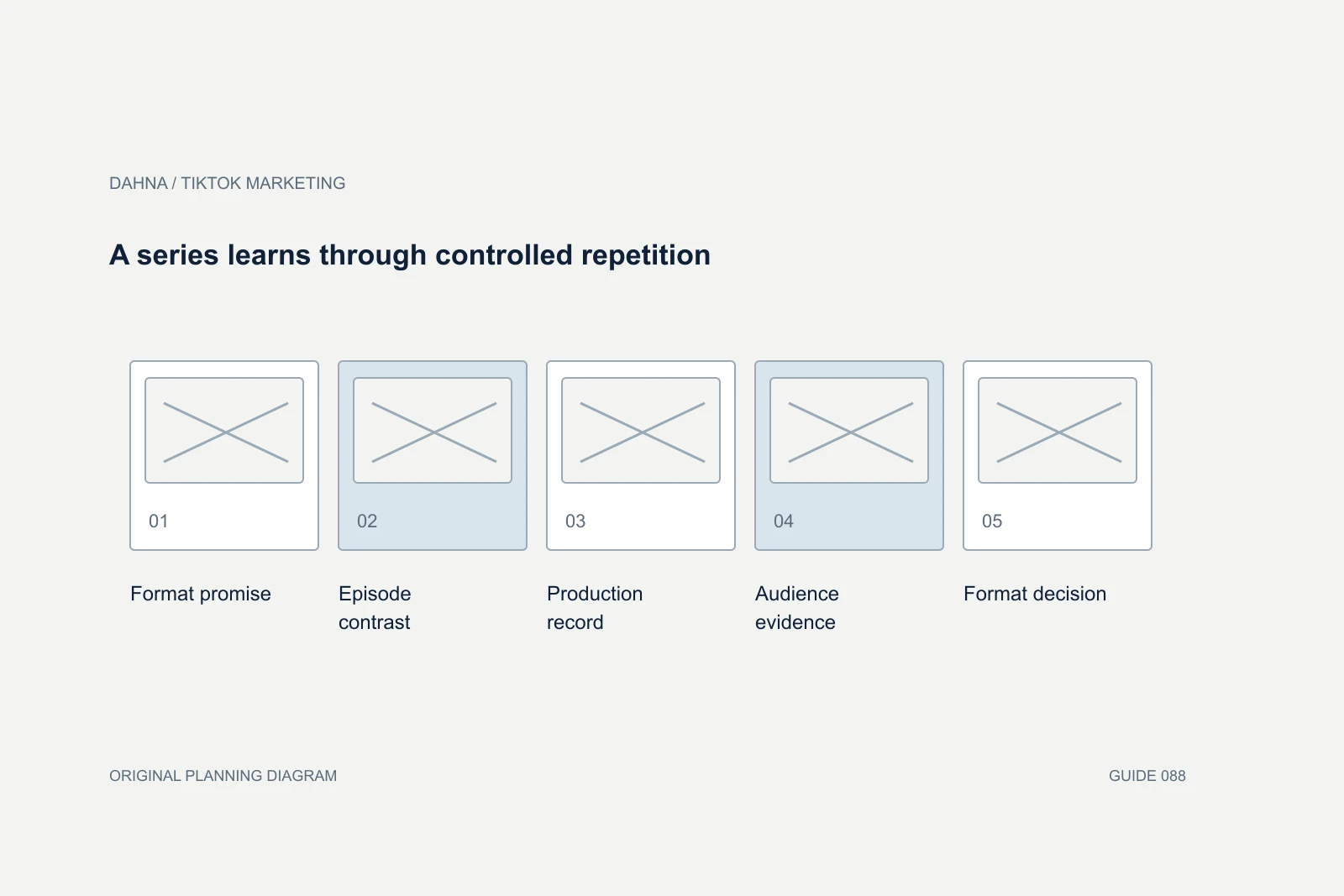
A series learns through controlled repetition
Format promise
One recognizable benefit for the viewer.
Episode contrast
Different questions within the same structure.
Production record
Time, assets and approval effort.
Audience evidence
Understanding and relevant behavior.
Format decision
Keep, refine, vary or finish.
Give each episode an independent entry point
A series can create an attractive profile grid while failing in the feed because the current episode depends on earlier context. Review each video as if it were the viewer’s first contact with the brand. Include the product identity and the question being answered without replaying a long introduction. The recurring structure should reduce explanation work, not require viewers to complete homework before understanding the point.
If an episode needs a previous comparison, briefly state the necessary fact and provide a clear route to the fuller explanation where the account permits it. Avoid numbering that implies the viewer has missed something essential when the episode actually stands alone. The pilot review should include this entry-point check alongside performance and production time. It is a practical way to preserve coherence across the series while respecting how individual posts can be discovered out of sequence.
What to ask Dahna to prepare
Bring your existing videos, recurring customer questions and the people available to appear on camera. We can help design a series pilot with completed episode briefs, a realistic production plan and a review that includes both usefulness and effort. The proposal should explain what remains consistent and what the pilot is intended to test.
After the pilot, commission the next set around the strongest question family and the changes the evidence supports. The result should be a recognizable body of useful content that your team can maintain, with enough variation to keep answering new questions rather than repeating the same product pitch.
Continue with the related decision
Use these guides when the next question goes beyond the scope of this article.
Use the editable decision sheet
Download the completed tables as a CSV, then replace the example inputs and add your evidence, owner and review date. Illustrative figures are teaching examples, not default targets.
Sources & further reading
Bring this decision to Dahna
Use this guide to prepare a focused brief. Tell Dahna what needs to change, which evidence you already have and when you need a decision.
Why consider Dahna for this work?
Dahna brings bilingual Korean and English strategy together with creator, content, and measurement work for brands growing in the US. You can review the people behind the recommendations and the kind of work we propose before starting a conversation.
Founder experience includes prior and contracted roles. Sample deliverables illustrate our approach; they are not client results or a performance promise.