How to plan credible before-and-after beauty content
Before-and-after content needs a documented capture process, truthful context and support for the claim the finished comparison implies. Keep lighting, framing and relevant conditions consistent, retain original files and obtain appropriate review before treating a visual difference as evidence of product performance.
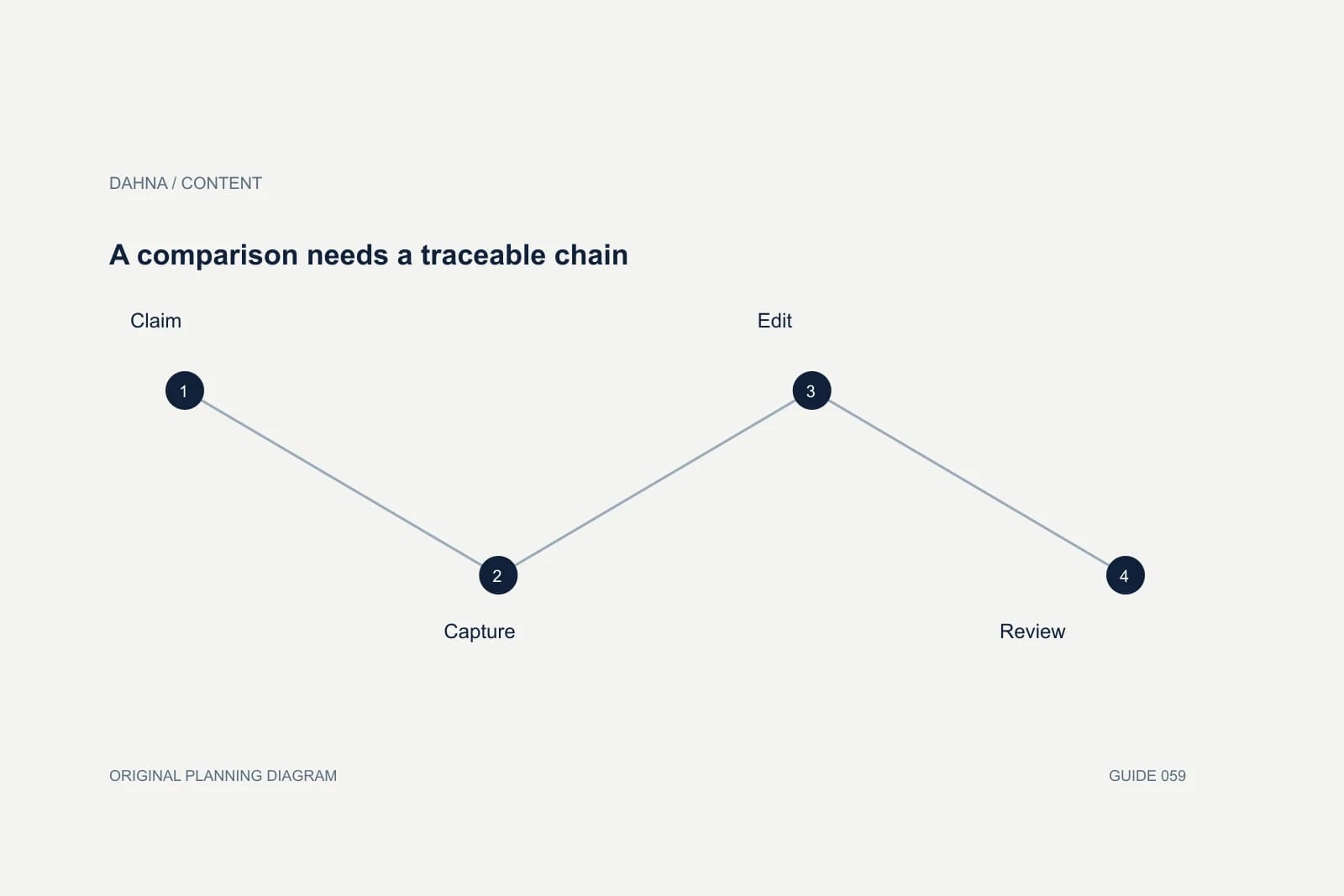
Dahna, original planning diagram
In this article
Overview
Before-and-after content needs a documented capture process, truthful context and support for the claim the finished comparison implies. Keep lighting, framing and relevant conditions consistent, retain original files and obtain appropriate review before treating a visual difference as evidence of product performance.
Define what the comparison is supposed to show
A before-and-after image is not neutral decoration. It can imply that the product caused the visible difference, that the result is typical or that it occurred within a particular time. Write down the intended message before production and ask the responsible reviewer what evidence supports it.
Distinguish an immediate cosmetic demonstration from a longer-term performance claim. Showing coverage after applying makeup is a different task from claiming a skincare product changed a condition over several weeks. The production protocol, supporting evidence and necessary context will differ. Do not use one convenient capture method for every type of claim.
Review the overall impression, including the images
The FTC’s Health Products Compliance Guidance discusses express and implied claims, including messages conveyed through imagery. The practical production implication is that a small disclaimer cannot be assumed to correct a misleading overall comparison. Have qualified reviewers assess the actual finished communication where appropriate.
Dove’s public Real Beauty Pledge provides a named brand example of explicit boundaries around digital distortion and participant approval. It is the brand’s stated policy, not an independent audit of every asset. A smaller brand can likewise write clear production rules that its photographers, creators and editors understand.
Control the conditions that can change the appearance
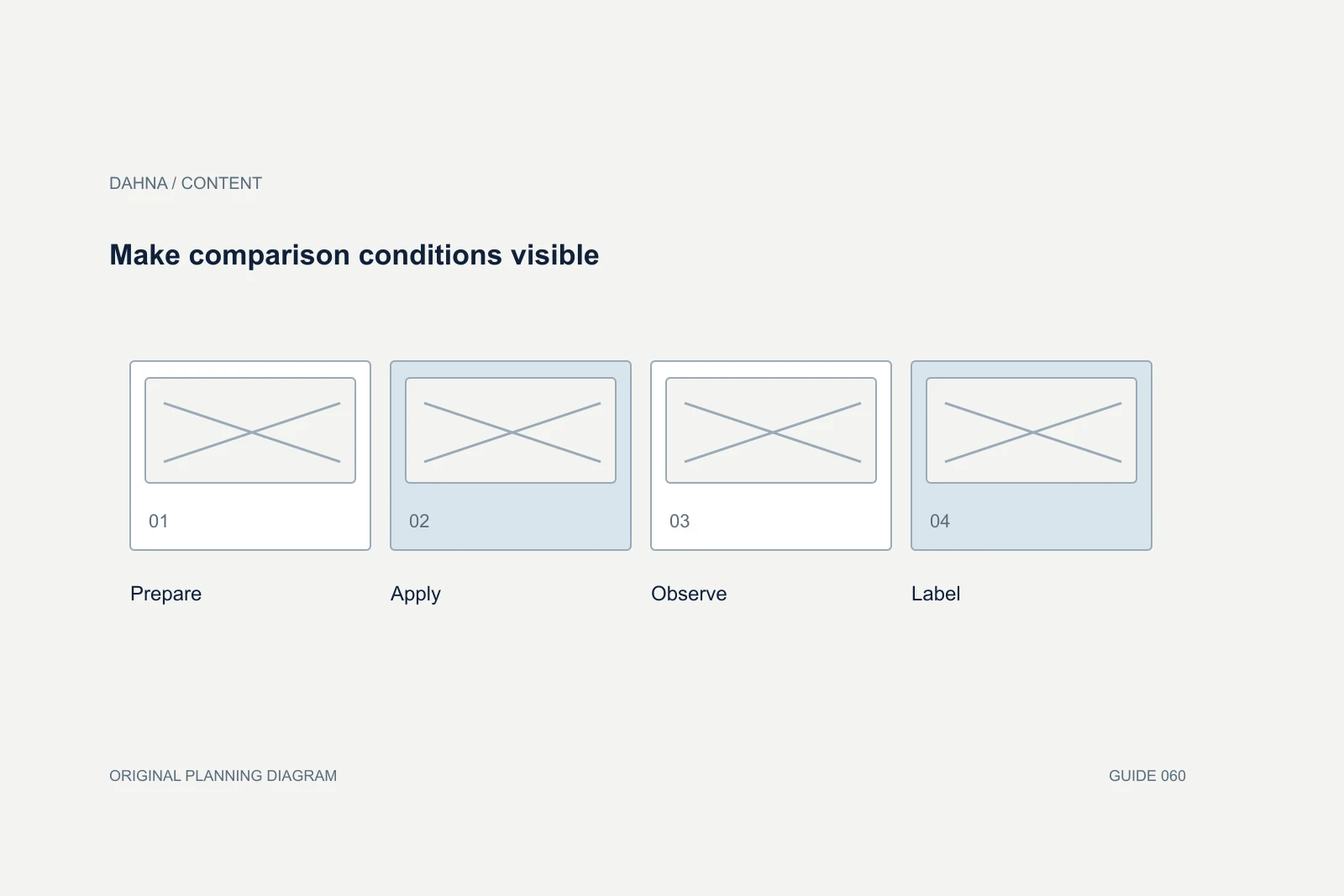
Document the camera, lens or phone settings, distance, angle, lighting, background, pose and relevant product preparation. Include the time and any other factors that affect the comparison. The goal is not to make an ordinary shoot look like a clinical study; it is to avoid an uncontrolled production change masquerading as a product result.
If the subject uses other products or changes a routine during a longer capture period, record that context. The appropriate evidence design depends on the claim and should be determined by qualified specialists. A creative team should not describe a marketing shoot as a clinical trial merely because it follows a checklist.
| Control | What to record | Why it matters |
|---|---|---|
| Lighting | Position, intensity and setup reference | Shadows and highlights can alter perceived texture |
| Camera and framing | Settings, distance and angle | Scale and perspective can change the comparison |
| Subject presentation | Pose, expression and relevant preparation | Appearance may vary independently of the product |
| Timing and use | Capture dates and documented product use | Makes the stated interval traceable |
| Editing | Permitted adjustments and original files | Allows review of whether meaning changed |
| Approval | Participant permission and specialist review where needed | Confirms the asset’s intended use and claim context |
Worked example: a lighting change that looks like improvement
Imagine a fictional skincare campaign in which the first photograph uses harsh side lighting and the later photograph uses soft frontal lighting. The later image appears smoother. Even if both files are unretouched, the comparison may attribute a lighting effect to the product.
The production lead rejects the pair for the intended claim and reviews whether a properly controlled reshoot is possible. If it is not, the team chooses a different content format, such as a product-use demonstration with supported facts. This example does not evaluate a real campaign; it shows why ‘no retouching’ is only one part of a credible comparison.
A comparison needs a traceable chain
Claim
Exact message and supporting evidence
Capture
Documented comparable conditions
Edit
Changes logged without altering the result
Review
Finished impression assessed before publication
Agree participation and use before filming
Explain the purpose of the shoot, the planned uses and the review process to participants. Obtain the appropriate permissions and allow concerns to be raised. Avoid pressuring someone to describe an experience more positively or definitively than they believe is accurate.
Keep personal and health-related information limited to what the approved process requires, with access controlled by the responsible team. A creative asset library is not the right place for unrelated sensitive records. The public story should contain only the context needed and approved for the communication, while supporting documentation is handled appropriately.
Set an explicit editing boundary
Specify which adjustments are permitted and whether they must be applied consistently to both images. Removing a dust speck on a backdrop is different from smoothing the skin feature the product claims to change. Editors need the intended claim to understand that distinction.
Retain originals and an edit log. If an AI tool or generative process changes relevant appearance, do not present the result as an unaltered record of product performance. Illustrative creative and documentary evidence have different roles. Labeling an image as illustrative may be appropriate for a concept, but it does not convert it into proof.
Keep the necessary context attached to every crop
A comparison may travel from a product page into a social cutdown or an ad. Each new version needs review because captions, timing and surrounding explanation can disappear. Record the context that must remain visible and where a longer explanation can be found.
Do not select an exceptional result and imply it is ordinary without appropriate support and review. The production team should know whether a subject’s result is being used as an individual experience, a demonstration or part of a substantiated broader statement. Those distinctions affect the wording and the way the visual is presented.
Use another format when the comparison cannot be supported
A brand does not need before-and-after content for every product. Texture demonstrations, clear instructions, packaging mechanisms, routine explanations and evidence summaries can help customers without implying an unsupported transformation. Choose the format that the available evidence can honestly support.
A useful creative review asks what the customer still needs to understand. If the question is whether a product is easy to dispense, a direct demonstration is more relevant than a dramatic result comparison. Replacing a weak before-and-after concept can improve clarity rather than merely reduce ambition.
Commission the protocol with the creative work
Dahna can help define the visual production brief and coordinate the content with the product’s approved evidence, while qualified specialists own consequential claim review. Bring the intended comparison, current substantiation and the proposed capture conditions before booking the shoot.
The deliverable should include the protocol, original-file handling, editing rules, required context and approval path. That gives the photographer and editor a clear task and gives the brand a reasoned way to decide whether the finished asset is suitable for publication.
Continue with the related decision
Use these guides when the next question goes beyond the scope of this article.
Use the editable decision sheet
Download the completed tables as a CSV, then replace the example inputs and add your evidence, owner and review date. Illustrative figures are teaching examples, not default targets.
Sources & further reading
Bring this decision to Dahna
Use this guide to prepare a focused brief. Tell Dahna what needs to change, which evidence you already have and when you need a decision.
Why consider Dahna for this work?
Dahna brings bilingual Korean and English strategy together with creator, content, and measurement work for brands growing in the US. You can review the people behind the recommendations and the kind of work we propose before starting a conversation.
Founder experience includes prior and contracted roles. Sample deliverables illustrate our approach; they are not client results or a performance promise.