How to compare ecommerce channel-budget scenarios
Build scenarios from explicit assumptions about customer additions, revenue, contribution, and operating limits. Show a conservative case as well as a base and stronger case. The model should reveal which assumptions drive the decision and what evidence would change them; it should not turn historical ROAS into a guaranteed forecast.
Dahna, original planning diagram
In this article
Overview
Build scenarios from explicit assumptions about customer additions, revenue, contribution, and operating limits. Show a conservative case as well as a base and stronger case. The model should reveal which assumptions drive the decision and what evidence would change them; it should not turn historical ROAS into a guaranteed forecast.
Name the allocation decision and its constraints
A useful model starts with a real choice: whether to add a channel, move part of a budget, increase total spending, or keep the current mix. Record the maximum cash commitment, available inventory, creative capacity, and acceptable downside. A scenario that exceeds stock or production capacity is not actionable even if the spreadsheet looks profitable.
Keep fixed commitments separate from flexible spend. A signed production contract cannot necessarily be moved next week, while a test-media budget may be adjustable. The owner needs to see which dollars are actually available for the decision rather than treating the entire marketing budget as liquid.
Choose a model the evidence can support
Google’s Meridian is an open-source marketing mix modeling framework designed to estimate channel contribution, response curves, and budget scenarios under explicit modeling assumptions. It illustrates the difference between a fitted statistical model and a simple planning spreadsheet. A small brand should not label a few manually entered ROAS assumptions as marketing mix modeling.
A transparent spreadsheet can still be useful. It can show what would need to be true for a proposed allocation to make sense. Label those assumptions and update them with experiments or observed results where appropriate. Complexity should follow the decision and the available data, not the desire to make a forecast look scientific.
Use commercial inputs beyond attributed revenue
For each channel, specify spend, assumed new customers or incremental outcomes, order value, contribution before marketing, and any additional creative or operating cost. State whether the scenario uses management ratios or causal estimates. Do not mix the two silently across rows.
Also specify the horizon. A one-month cash view and a six-month cohort-contribution view can lead to different decisions. Show observed and projected values separately, and avoid using an optimistic lifetime-value assumption to erase a near-term cash constraint.
| Input | What to record | Sensitivity to test |
|---|---|---|
| Flexible media spend | Amount available after fixed commitments | Lower and higher allocation |
| Customer additions | Assumed new or incremental customers, clearly labeled | Conservative response versus base |
| Contribution per customer | Approved cost model and horizon | Discounts, returns and product mix |
| Creative requirement | Production and adaptation cost | Capacity and delivery delay |
| Inventory | Sellable units and replenishment timing | Stockout or constrained hero product |
| Cash timing | When spend occurs and proceeds arrive | Settlement and refund timing |
Illustrative $10,000 test decision
Imagine a brand considering an additional $10,000 media test plus $2,000 in creative work. In the conservative scenario, it adds 250 customers with $35 of contribution each over the chosen observation horizon, producing $8,750 before the $12,000 test cost. The modeled balance is negative $3,250. In the base case, 350 customers produce $12,250, leaving $250. In the stronger case, 450 produce $15,750, leaving $3,750.
These are hypothetical assumptions, not expected results or market benchmarks. The model makes the key uncertainty visible: the test needs enough qualifying contribution to cover both media and creative within the chosen horizon. If the $35 includes projected repeat purchases, that projection must be shown rather than treated as cash already received.
The owner can now ask whether the possible loss is affordable and whether the test will produce useful learning. A positive base case alone is not enough. The brand should also verify that the inventory and team can support the stronger case without creating late deliveries or costly service problems.
| Scenario | Customers assumed | Contribution at $35 each | Media + creative | Modeled balance |
|---|---|---|---|---|
| Conservative | 250 | $8,750 | $12,000 | −$3,250 |
| Base | 350 | $12,250 | $12,000 | $250 |
| Stronger | 450 | $15,750 | $12,000 | $3,750 |
Do not assume the next dollar behaves like the last dollar
A channel’s historical average return does not guarantee the same return after a budget increase. The audience, auction conditions, creative demand, and product availability can change. Use a range and ask what evidence supports it. If the proposal assumes a straight line indefinitely, challenge that assumption.
Experiments can help estimate effects within a tested range, but their uncertainty remains relevant. Google’s media-experiment guidance discusses interpretation of confidence intervals and inconclusive comparisons. A model should carry uncertainty forward rather than replacing an uncertain experimental estimate with a precise single-point promise.
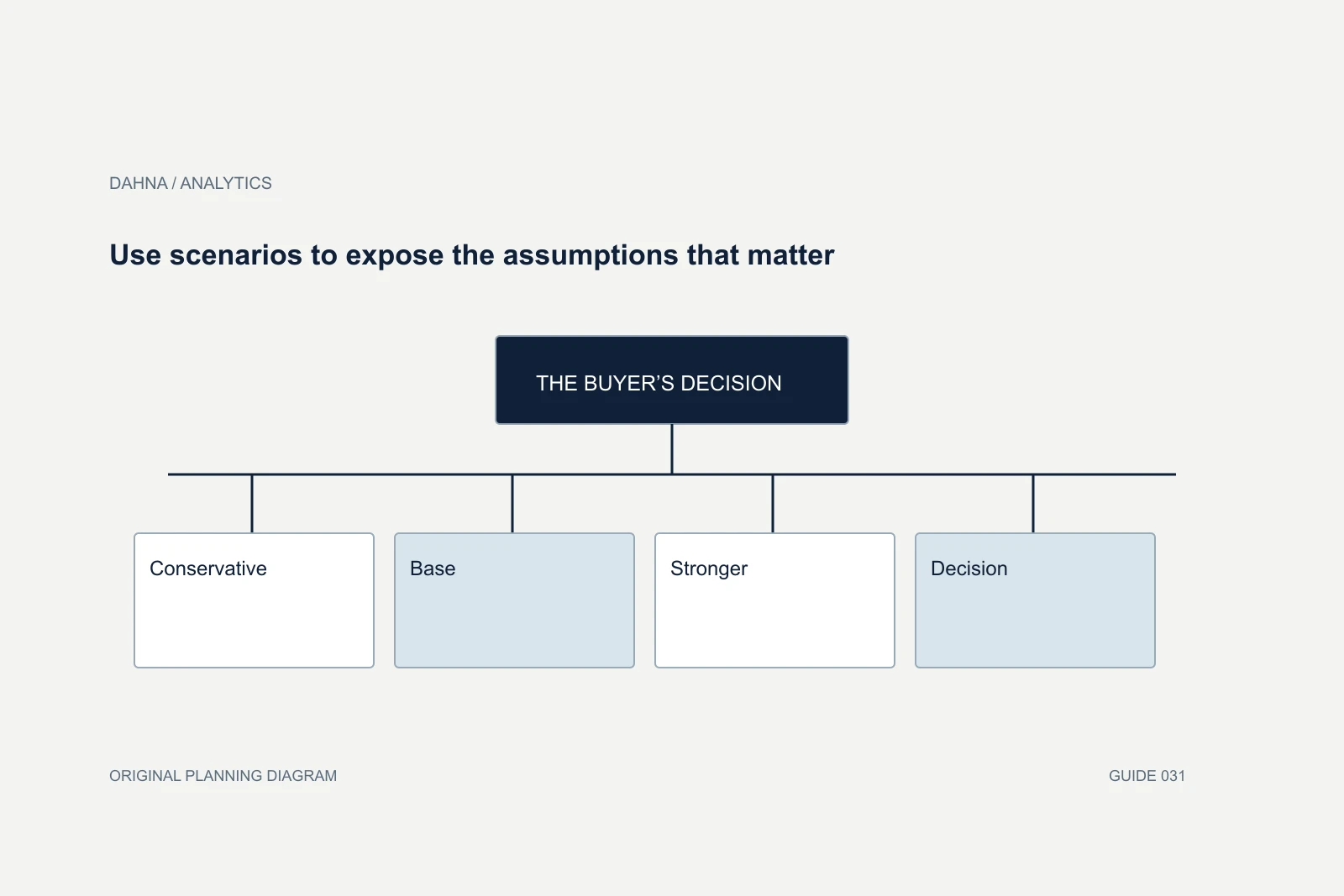
Use scenarios to expose the assumptions that matter
Conservative
Lower response or weaker contribution.
Base
The current planning assumptions.
Stronger
Higher response with capacity still checked.
Decision
Choose a bounded commitment and evidence trigger.
Model the operational dependency that could break the plan
If a campaign depends on a creator delivering content, a new landing page shipping, or inventory arriving, record that dependency and its latest useful date. The model should include what happens if it is late. A budget allocation is not a complete plan when the material needed to spend it effectively does not exist.
For US expansion, include market-specific fulfillment and support costs. A global average contribution can hide a US shipping subsidy or return cost. Use the best approved estimates available, label them, and replace them with actual records when the operation has enough history.
Set the review and stop rules before spending
Define what will be reviewed, when enough data may be available, and what would trigger a pause. A broken checkout or inaccurate offer can justify stopping immediately; ordinary day-to-day noise usually requires a different response. The rule should reflect the risk and the evidence, not a generic percentage change.
Keep the model version used for approval. When assumptions change, create a new version with the reason. This allows the owner to learn whether the initial expectation was reasonable and which part of the plan differed from reality. Quietly editing the forecast after the result removes that learning.
Show the assumption that would reverse the decision
For each proposal, identify a threshold that changes the owner’s choice: customer additions below a certain level, contribution lower than expected, or a delivery delay that removes the useful campaign window. Calculate that threshold from the stated model rather than introducing it as a universal benchmark.
This is often more informative than adding several extra scenarios. The owner can ask how plausible the threshold is and which evidence would reduce the uncertainty. If the entire recommendation depends on a narrow optimistic assumption, a smaller staged commitment may be more appropriate. Record the decision and its rationale before launch so the later review can distinguish a flawed assumption from poor execution.
Ask for a model you can inspect
A useful deliverable exposes formulas, sources, assumptions, cost scope, and scenario ranges. It should show which input has the greatest effect on the decision and what information would reduce uncertainty. A locked spreadsheet with unexplained return coefficients is difficult to evaluate responsibly.
Dahna can help build the scenario view and connect it to campaign, website, and measurement readiness. Bring the budget choice, approved margin inputs, operating constraints, and current evidence. The purpose is a better decision under uncertainty, not a claim that marketing outcomes can be predicted exactly.
Continue with the related decision
Use these guides when the next question goes beyond the scope of this article.
Use the editable decision sheet
Download the completed tables as a CSV, then replace the example inputs and add your evidence, owner and review date. Illustrative figures are teaching examples, not default targets.
Sources & further reading
Bring this decision to Dahna
Use this guide to prepare a focused brief. Tell Dahna what needs to change, which evidence you already have and when you need a decision.
Why consider Dahna for this work?
Dahna brings bilingual Korean and English strategy together with creator, content, and measurement work for brands growing in the US. You can review the people behind the recommendations and the kind of work we propose before starting a conversation.
Founder experience includes prior and contracted roles. Sample deliverables illustrate our approach; they are not client results or a performance promise.