Refresh, combine, or leave alone: how to review old ecommerce content
Review the customer decision and the page’s current usefulness before changing its date, title, or URL. Refresh inaccurate or incomplete information. Consider consolidation only when pages genuinely serve the same intent and the organization authorizes the URL changes involved. Preserve useful distinct resources even when they receive modest traffic.
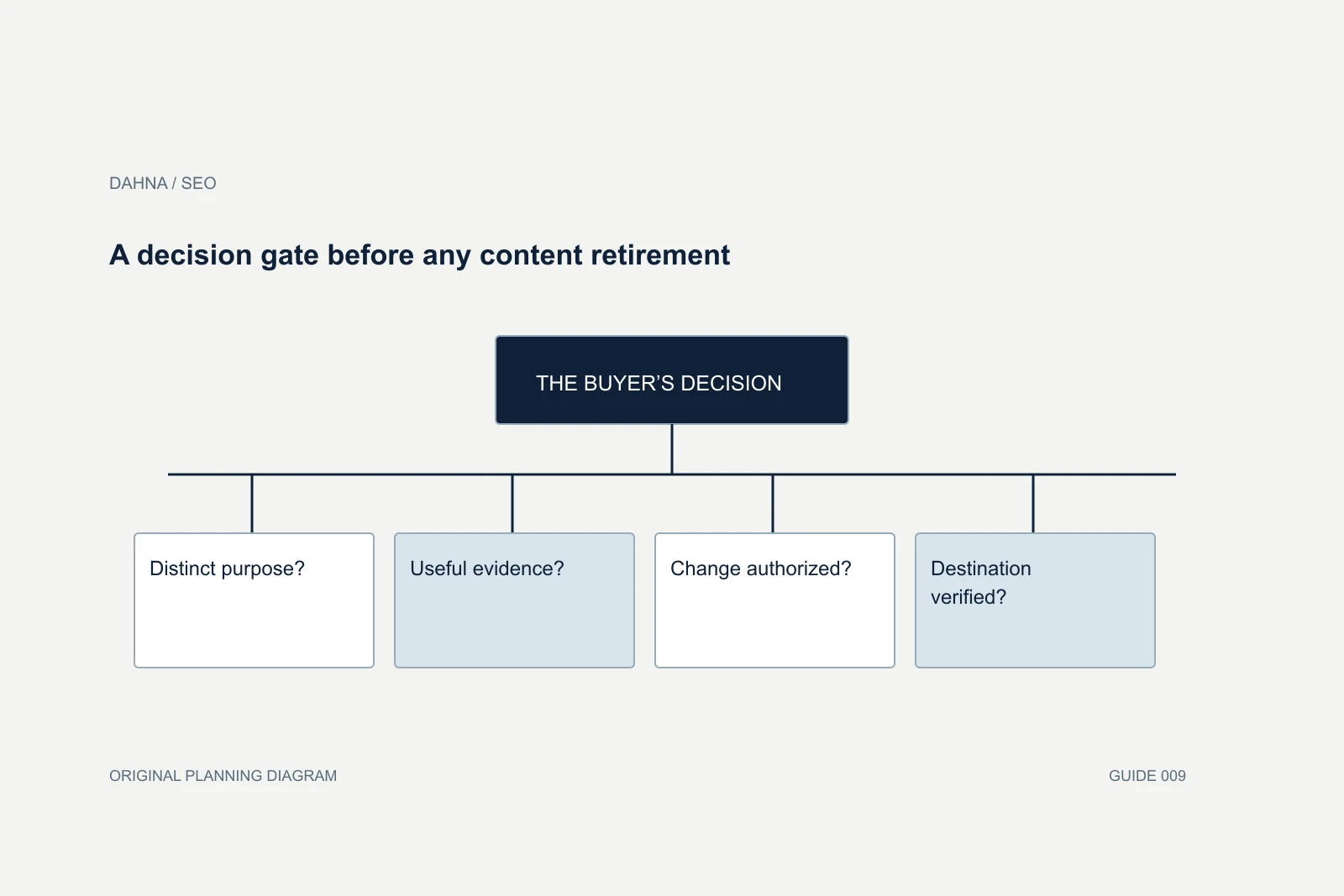
Dahna, original planning diagram
In this article
Overview
Review the customer decision and the page’s current usefulness before changing its date, title, or URL. Refresh inaccurate or incomplete information. Consider consolidation only when pages genuinely serve the same intent and the organization authorizes the URL changes involved. Preserve useful distinct resources even when they receive modest traffic.
Give each review a reason beyond age
A two-year-old explanation can remain accurate, while a two-week-old product comparison can already be wrong after a catalog change. Use triggers such as discontinued products, changed policies, repeated customer confusion, outdated evidence, or overlapping page purposes. Calendar reviews can catch these issues, but a publication date alone is not a diagnosis.
Google’s people-first content guidance asks whether information is useful and trustworthy and cautions against superficial date changes intended to make content appear fresh. The practical implication is to document what changed for the reader. A refresh should have a visible contribution: a corrected fact, a new example, clearer decision criteria, or a repaired buying path.
Review intent, evidence, and dependencies together
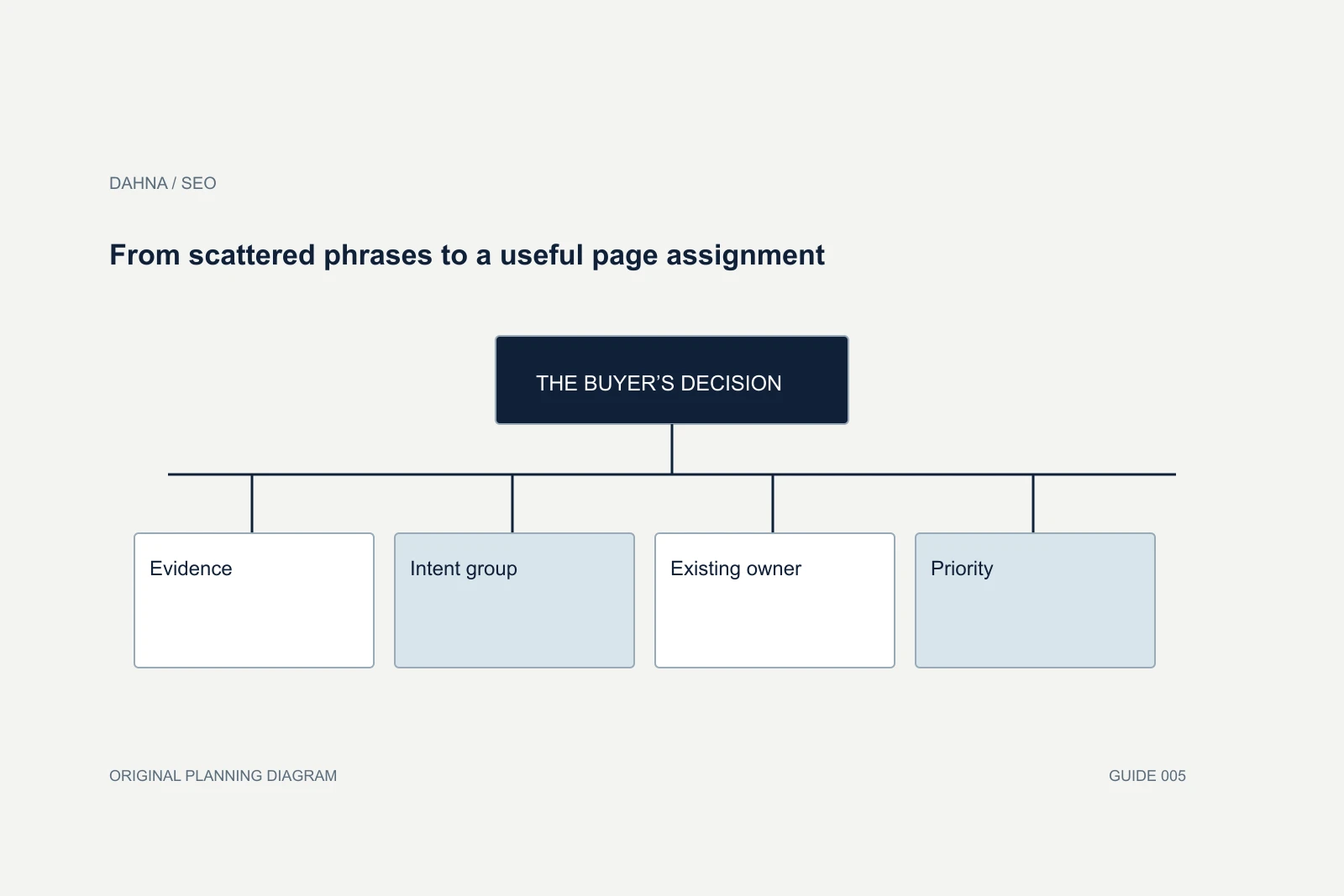
For each candidate page, write its primary question in one sentence. Then record the answer it currently gives, the evidence supporting that answer, the products or policies it depends on, and the next action it offers. This makes overlap easier to assess than comparing titles or keyword lists alone.
Add the organization’s publishing constraints. A page may have a permanently protected URL, a frozen editorial record, contractual references, or support value for existing customers. Those conditions do not prevent all useful work, but they determine what the team is authorized to change. An agency should surface the constraint before proposing a redirect.
| Observation | Likely action | Required evidence |
|---|---|---|
| Accurate and answers a distinct question | Preserve; review on a relevant trigger | Current facts and a useful next step |
| Facts changed but intent remains useful | Refresh the existing page when authorized | Verified new facts and edit scope |
| Two pages answer the same decision | Assess possible consolidation | Outline comparison, traffic context and URL permission |
| Low traffic but important support value | Improve discovery or leave intact | Customer need and support use |
| No useful purpose remains | Escalate a retirement decision | Dependencies and explicit URL authorization |
A shared keyword does not prove duplication
A guide about choosing a sunscreen and a page explaining how to read a particular product’s directions can both mention the same ingredient. They serve different decisions. Conversely, “best routine for beginners” and “how to start a simple routine” may be competing versions of the same answer if their outlines and recommendations are effectively identical.
Read the pages side by side and compare the decision, audience, evidence, and output. If one helps select a product and another helps use it correctly, preserve the distinction. If neither adds anything unique, determine whether one can be improved to own the question. Do not create a third page to summarize the two.
Consolidation is a publishing decision, not a cleanup button
Google documents redirects and canonical annotations as signals used when choosing representative URLs for similar content. That technical guidance does not grant permission to change published URLs. The owner must first decide whether consolidation is appropriate and allowed. On a site with permanent URL protections, retaining and clarifying existing pages may be the only authorized route.
Where a change is approved, the plan should preserve the useful material, account for inbound references, update relevant navigation, and test the resulting destination. It should also document what happens to the old page and why. A bulk tool that chooses winners solely by recent traffic can discard information customers still need.
A decision gate before any content retirement
Distinct purpose?
If yes, preserve its role and repair only real gaps.
Useful evidence?
Keep original material that helps the customer.
Change authorized?
Check editorial and permanent-URL constraints.
Destination verified?
Confirm the approved outcome serves the original visitor.
Illustrative review of six skincare guides
Imagine a brand reviewing six guides. Two are accurate and distinct. One needs a corrected bottle size and current product link. Two both explain how to choose between the same routine sets and contain almost identical advice. The sixth has little search traffic but answers a recurring compatibility question for existing customers.
The team preserves the two distinct guides, updates the factual error with approval, and protects the support page. It investigates whether the overlapping pair can be differentiated meaningfully. If the URLs are protected, it documents a narrow authorized copy plan rather than assuming a redirect is available. If consolidation is allowed, it selects a destination based on the complete visitor need and evidence, not a prettier slug.
This fictional review produces one immediate factual repair and one larger editorial decision. It does not produce six new articles or six refreshed dates. That is a useful outcome: maintenance effort goes where a reader would actually notice an improvement.
Evaluate the effect without inventing causality
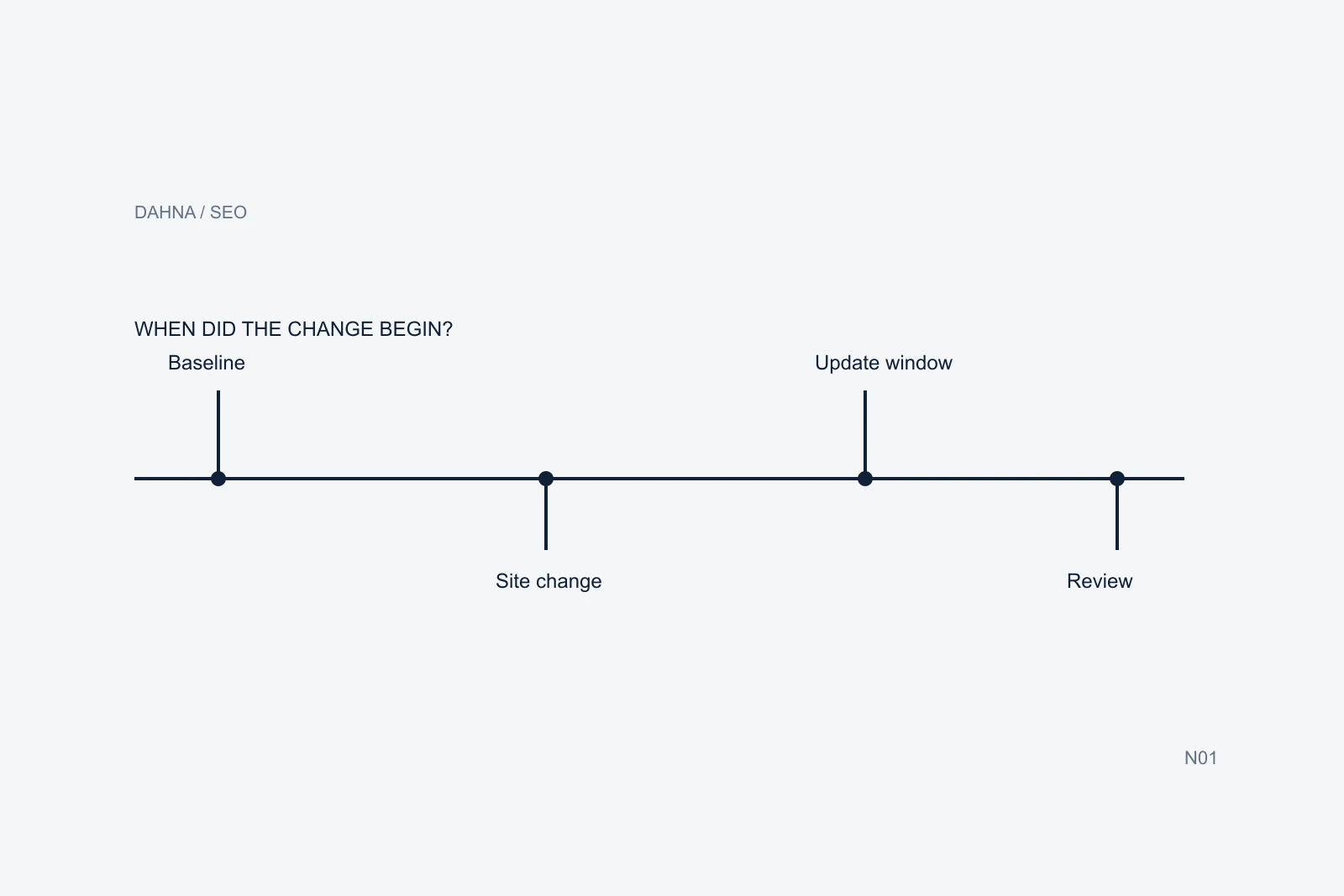
Save a before snapshot of the content and the relevant observations. Record the actual edit date separately from the original publication date where the system supports it. Then compare complete reporting windows with attention to stock, promotions, seasonality, and other changes. A traffic movement after an edit is an observation, not proof of its cause.
For an explanatory guide, useful outcomes may include more relevant product visits or fewer repeated customer questions. For a support resource, successful resolution may matter more than orders. Keep those purposes visible so the team does not optimize every page toward the same metric.
| Page role | Useful observation | Misleading shortcut |
|---|---|---|
| Selection guide | Relevant product exploration and customer clarity | Total pageviews alone |
| Support resource | Successful access to the needed answer | Immediate revenue only |
| Product explanation | Fewer factual mismatches and better buying path | A new date in the metadata |
| Consolidated resource | Original intents remain served and references work | Fewer URLs as the sole success metric |
Use a minimum-change brief for protected or sensitive pages
When a page has publication restrictions, list the exact elements that may change and the evidence supporting each proposed edit. A request to correct a bottle quantity does not automatically authorize rewriting the title, replacing the examples, or changing the URL. This matters because small factual maintenance can otherwise become an uncontrolled rewrite.
If the page must remain entirely unchanged, record the unresolved gap and consider an approved navigation surface or a genuinely distinct new resource that explains the missing decision. Do not create a near-copy solely to bypass the restriction. The new page still needs its own purpose and useful contribution.
For pages open to revision, compare the proposed text with the original before approval. Check that valuable source attributions, limitations, and customer explanations have not disappeared during the rewrite. A cleaner sentence is not an improvement if it turns a qualified observation into an absolute claim. This final comparison protects both readability and the integrity of the evidence already published.
Ask for a reviewable edit plan
Dahna can help assess an existing library, compare overlapping outlines, and prepare a prioritized edit plan. Ask for page-specific reasons, an evidence list, protected-URL checks, and the exact contribution of each proposed update. “Refresh everything for SEO” is not a sufficiently concrete scope.
If the review reveals a genuinely missing buyer question, add it to the keyword map and assess it separately. Keeping maintenance and new publishing distinct makes the budget easier to manage and reduces the risk of replacing useful existing work with repetitive content.
Continue with the related decision
Use these guides when the next question goes beyond the scope of this article.
Use the editable decision sheet
Download the completed tables as a CSV, then replace the example inputs and add your evidence, owner and review date. Illustrative figures are teaching examples, not default targets.
Sources & further reading
Bring this decision to Dahna
Use this guide to prepare a focused brief. Tell Dahna what needs to change, which evidence you already have and when you need a decision.
Why consider Dahna for this work?
Dahna brings bilingual Korean and English strategy together with creator, content, and measurement work for brands growing in the US. You can review the people behind the recommendations and the kind of work we propose before starting a conversation.
Founder experience includes prior and contracted roles. Sample deliverables illustrate our approach; they are not client results or a performance promise.