How should collections, products, and guides link together?
Give every useful product and guide a clear route from a relevant part of the store. Collections organize the assortment, product pages answer item-specific questions, and guides help visitors choose. Link these pages when the next destination advances the shopper’s decision, using an anchor that explains what they will find.
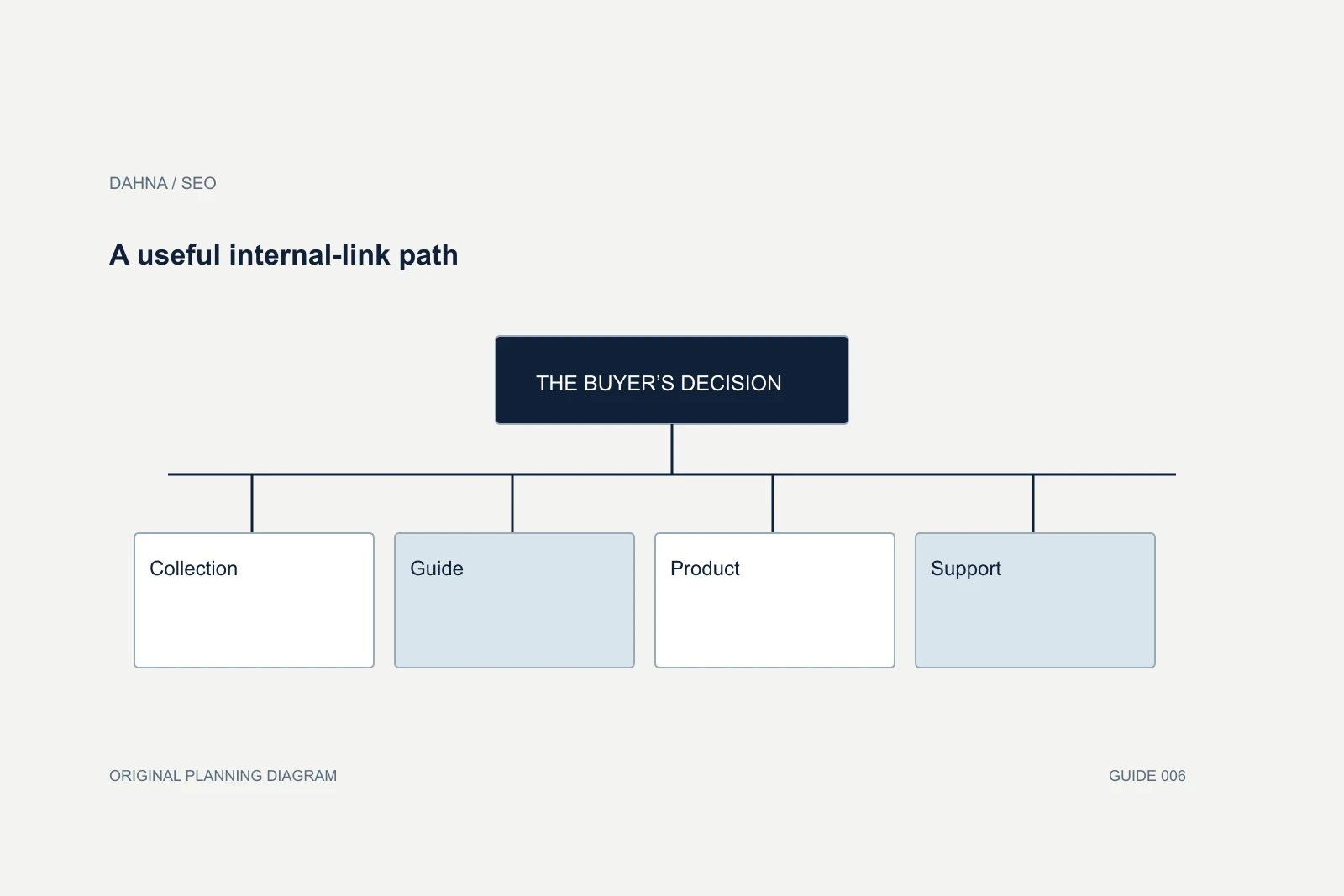
Dahna, original planning diagram
In this article
Overview
Give every useful product and guide a clear route from a relevant part of the store. Collections organize the assortment, product pages answer item-specific questions, and guides help visitors choose. Link these pages when the next destination advances the shopper’s decision, using an anchor that explains what they will find.
Start with the journey, not a link quota
A buying guide can receive traffic and still fail commercially if it never helps someone reach an appropriate product. A product can be in the catalog but difficult to discover if it is available only through the store’s search box. The internal-link project should identify these missing connections rather than adding the same block of links to every page.
Google explains that it uses relationships between linked pages to understand ecommerce site structure. Its documentation recommends reachable category and product paths and notes that Googlebot generally does not submit searches through a site search box. This gives the technical reason to check discovery paths, while the customer’s next question gives the editorial reason to choose a particular link.
Create a small map of page roles
Choose one product family and sketch its important destinations. Include the main collection, subcollections if useful, the sellable products, a selection guide, and supporting factual information such as compatibility or care. Mark where a shopper should be able to move next and why. A line without a reason probably does not belong in the map.
The map should reveal both orphans and dead ends. An orphan has no useful inbound path. A dead end may be easy to reach but offers no sensible next step. The repair can be small: a collection introduction can link to a buying guide, while that guide links to the relevant products with a short explanation of suitability.
| Starting page | Next destination | Why the link belongs |
|---|---|---|
| Cleanser collection | Cleanser selection guide | Help shoppers distinguish the available textures |
| Selection guide | Relevant product page | Let the reader inspect the option just discussed |
| Product page | Refill compatibility information | Answer an item-specific purchase question |
| Routine guide | Routine collection | Show the complete set after explaining the sequence |
| Retired product resource | Verified successor comparison | Help owners understand the change |
Use anchors that preview the destination
A useful anchor names the next information or choice. “Compare the two bottle sizes” tells a visitor more than “learn more.” It also helps an editor judge whether the destination actually fulfills the promise. Avoid forcing a long keyword phrase into every link; language should fit the surrounding sentence.
Google’s link guidance emphasizes crawlable links and descriptive anchor text. For the implementation brief, ask the developer to verify ordinary HTML links with real destinations rather than click handlers that only mimic navigation. Editorial and technical checks should meet here: a meaningful label attached to an inaccessible destination still fails.
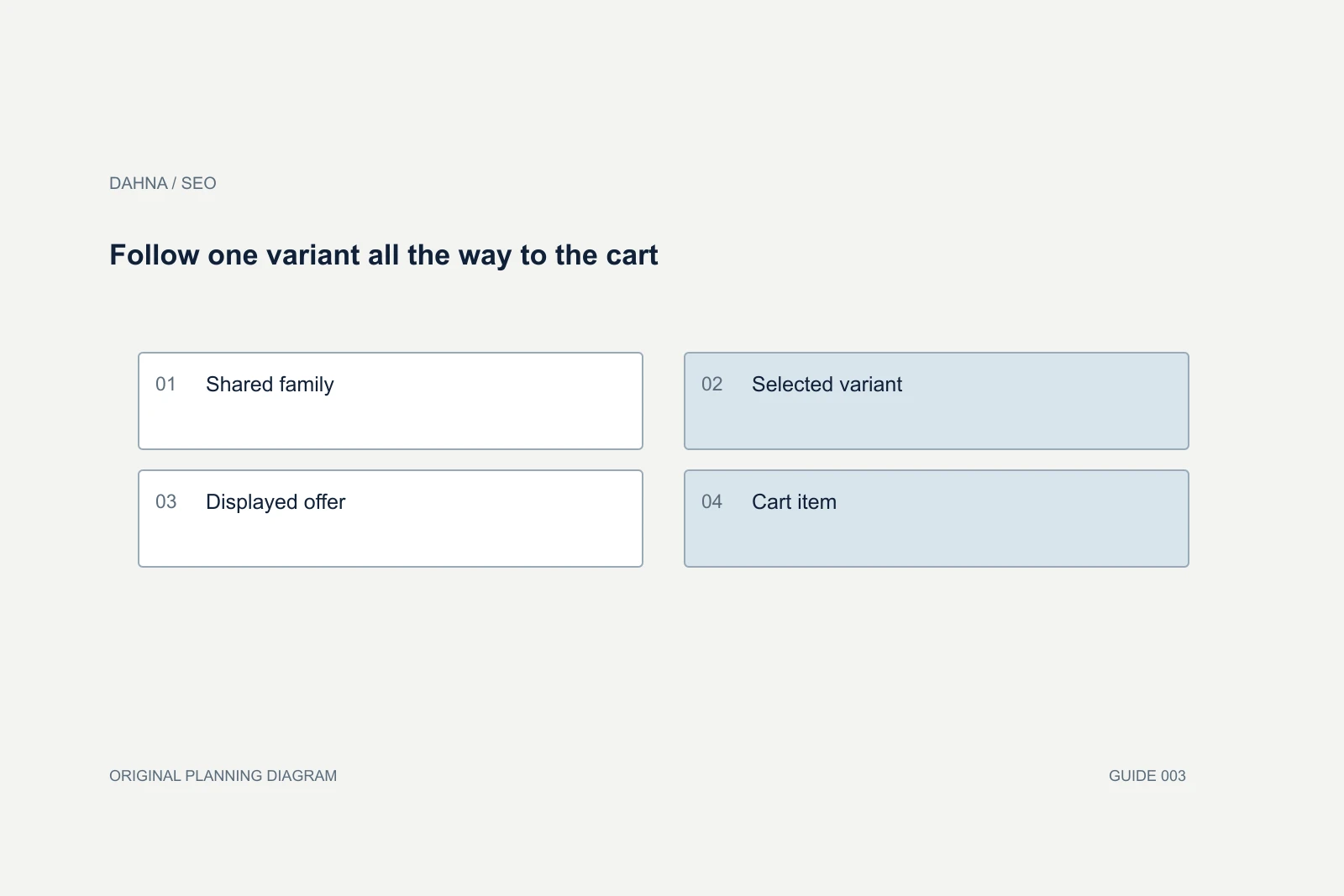
A useful internal-link path
Collection
See the relevant assortment.
Guide
Understand the differences.
Product
Check the exact offer and evidence.
Support
Resolve the remaining purchase question.
Keep related links genuinely related
Not every article needs to link to every service or product. A page about shade selection should not finish with a large block of unrelated shipping, influencer, and analytics resources merely because they are important elsewhere on the site. The reader’s task is the boundary. A small number of well-explained links usually creates a clearer journey.
Use product and editorial ownership to keep the links accurate. When a formula changes, an item retires, or a routine bundle is rebuilt, the owner should know which guides refer to it. A link register can record these dependencies without becoming a cumbersome approval system. The purpose is to prevent a helpful recommendation from becoming stale quietly.
Illustrative example: a guide with no purchase path
Imagine a haircare brand with a guide explaining three wash routines. It attracts relevant readers, but the article links only to the home page. The merchandiser identifies the exact collection and products discussed in each routine. The editor adds a short comparison table and places links next to the relevant explanation. The collection also links back to the guide for visitors who need help choosing.
The team does not create three near-identical new articles to support these links. It improves the authorized existing journey and makes the relationships explicit. If the current article is protected from edits, the team can instead add discovery through approved navigation or a new genuinely distinct resource. Publication rules still govern what can change.
In the fictional example, success is evaluated through product visits and meaningful customer actions after guide engagement, alongside search discovery. The agency should avoid claiming that any before-and-after improvement came solely from links if promotion, inventory, or page content changed at the same time.
What an agency should check and hand over
Ask for a map of important pages, a list of missing or misleading connections, and a small prioritized edit set. The list should name the source page, anchor text, destination, and reason. “Add internal links” is too vague to price or approve. A reviewer should be able to follow each proposed journey and decide whether it helps.
After implementation, test the rendered links on desktop and mobile. Confirm that destinations return the expected page, links do not pass unnecessary tracking parameters internally, and protected URLs remain intact. Check that the links remain visible and understandable when a product is unavailable.
| Check | Passing evidence |
|---|---|
| Discovery | Every priority page has a relevant inbound route |
| Meaning | Anchor accurately describes the destination |
| Technical access | Rendered link contains a working href |
| Customer journey | The next page continues the decision without surprise |
| Maintenance | An owner knows which catalog changes affect the link |
Test the journey with a person unfamiliar with the catalog
Give a reviewer a concrete task, such as finding a refill that fits a named bottle, and ask them to follow the proposed links without using the site search. Watch where the label promises something the destination does not deliver. A technically complete graph can still use internal vocabulary that makes little sense to a new customer.
Use that review to improve the specific link or destination. If the reviewer repeatedly returns to the collection because a guide never names the relevant item, the problem is the decision handoff. If they reach the right product but cannot tell whether it fits, the product explanation needs work. Keep these findings separate from crawler accessibility defects so the correct owner receives each task. Both matter, but they require different fixes.
How Dahna can structure the work
Dahna can review a service or product cluster, identify missing discovery paths, and coordinate the copy and website changes needed to connect it. Start with a commercially important area instead of demanding a site-wide link count. The proposal should explain which pages can be edited and which require another owner’s approval.
If the site lacks a useful destination for an important question, the answer may be a new page. If that destination already exists, the answer may be a better connection. Keeping those decisions separate protects the content budget and produces a store that is easier to navigate as the catalog grows.
Continue with the related decision
Use these guides when the next question goes beyond the scope of this article.
Use the editable decision sheet
Download the completed tables as a CSV, then replace the example inputs and add your evidence, owner and review date. Illustrative figures are teaching examples, not default targets.
Sources & further reading
Bring this decision to Dahna
Use this guide to prepare a focused brief. Tell Dahna what needs to change, which evidence you already have and when you need a decision.
Why consider Dahna for this work?
Dahna brings bilingual Korean and English strategy together with creator, content, and measurement work for brands growing in the US. You can review the people behind the recommendations and the kind of work we propose before starting a conversation.
Founder experience includes prior and contracted roles. Sample deliverables illustrate our approach; they are not client results or a performance promise.