How much should an ecommerce brand spend on retargeting?
Treat retargeting as a budget hypothesis: will advertising to people who already know the brand produce enough additional contribution to justify the cost? A high reported ROAS can reflect customers who were close to buying anyway. Start with the customer’s unresolved question, then choose a bounded spend and a comparison that can challenge the claim that the ads caused the orders.
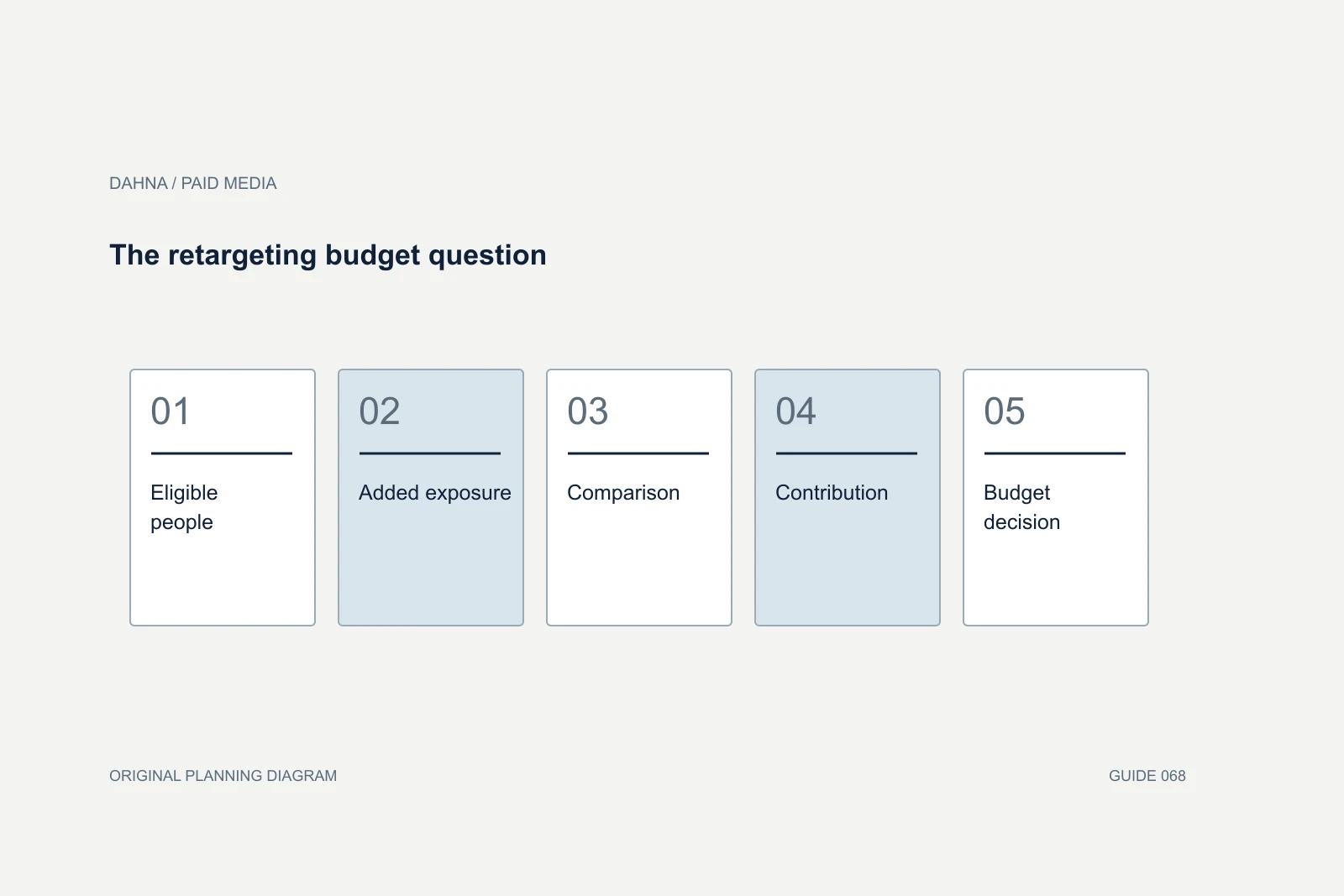
Dahna, original planning diagram
In this article
Overview
Treat retargeting as a budget hypothesis: will advertising to people who already know the brand produce enough additional contribution to justify the cost? A high reported ROAS can reflect customers who were close to buying anyway. Start with the customer’s unresolved question, then choose a bounded spend and a comparison that can challenge the claim that the ads caused the orders.
A product viewer and yesterday’s buyer need different things
Build the audience around a reason to return. A product viewer may need a clearer demonstration. A shopper who abandoned checkout may be uncertain about delivery. Someone who already purchased may need support, not another acquisition discount. Pooling these people can make reporting look efficient while wasting money and creating an awkward customer experience.
Before choosing a lookback window, examine the product’s decision cycle and available audience volume. An expensive skincare device may involve a different research period from a familiar cleanser refill. Use your own time-to-purchase observations where reliable, and record their limits. Exclusions and audience updates can have delays; do not promise that every recent buyer will immediately disappear from delivery.
| Audience situation | Useful message | Potential waste |
|---|---|---|
| Viewed a device but did not buy | Show setup and what is included | Repeating a vague benefit montage |
| Reached checkout | Clarify delivered price and timing | Discounting without knowing the objection |
| Purchased yesterday | Separate support from acquisition | Advertising the same introductory offer |
| Browsed many months ago | Reassess relevance before inclusion | Treating an old visit as current buying intent |
Why warm audiences make attribution look persuasive
Brett Gordon, Florian Zettelmeyer and colleagues compared advertising measurements with randomized Facebook experiments. Their work shows why observational estimates should not simply be assumed to reproduce experimental effects. For retargeting, the practical issue is selection: visiting the store already signals interest, so people who see these ads can be unusually likely to buy.
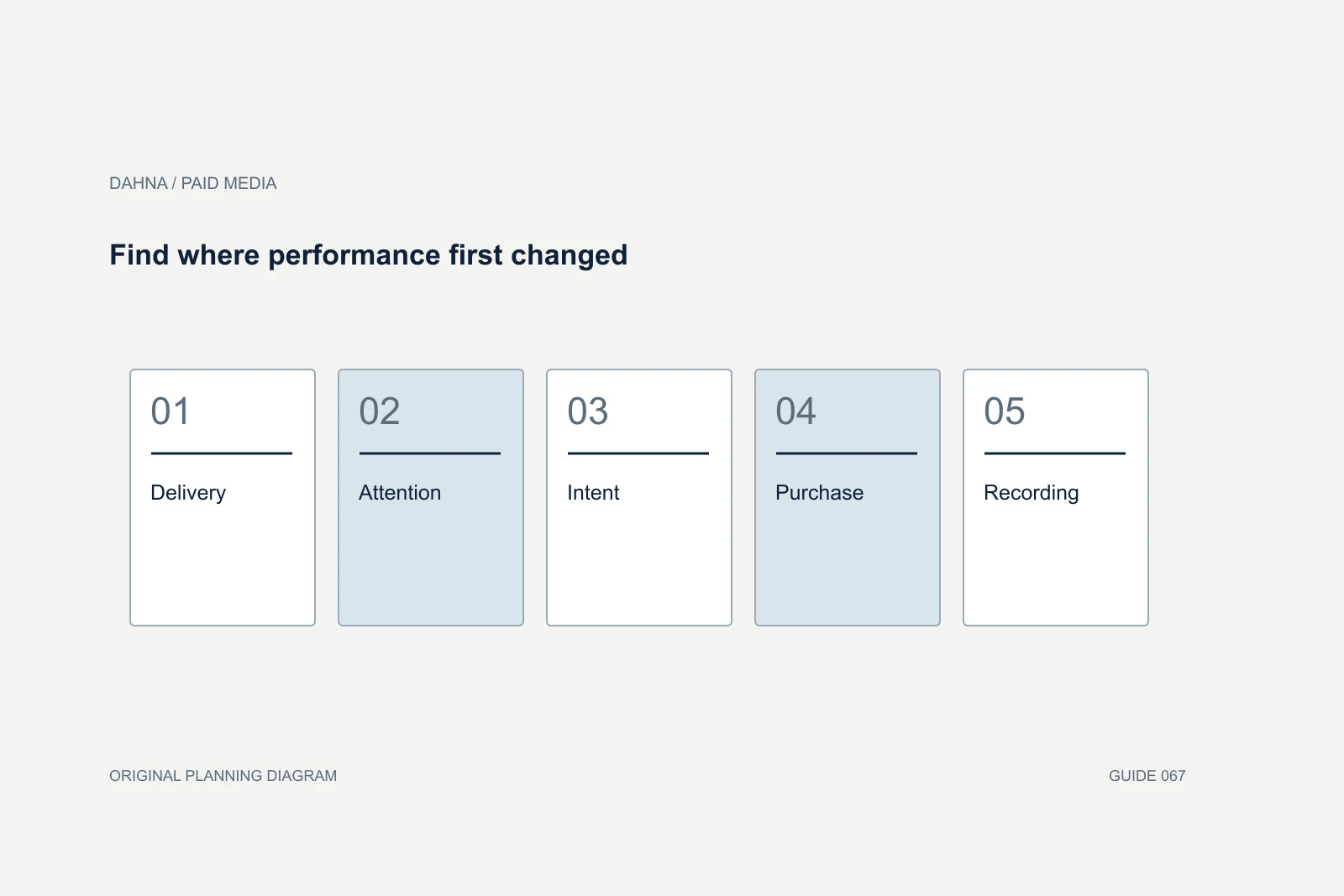
The budget question is therefore about what would happen without the extra exposure. A platform-attributed order is useful delivery information, but it does not answer that counterfactual. Keep two lines in the report: credited results under a stated attribution setting, and the best available evidence of additional business. If the latter is unknown, label it unknown rather than quietly substituting the first line.
Choose a comparison before choosing a percentage
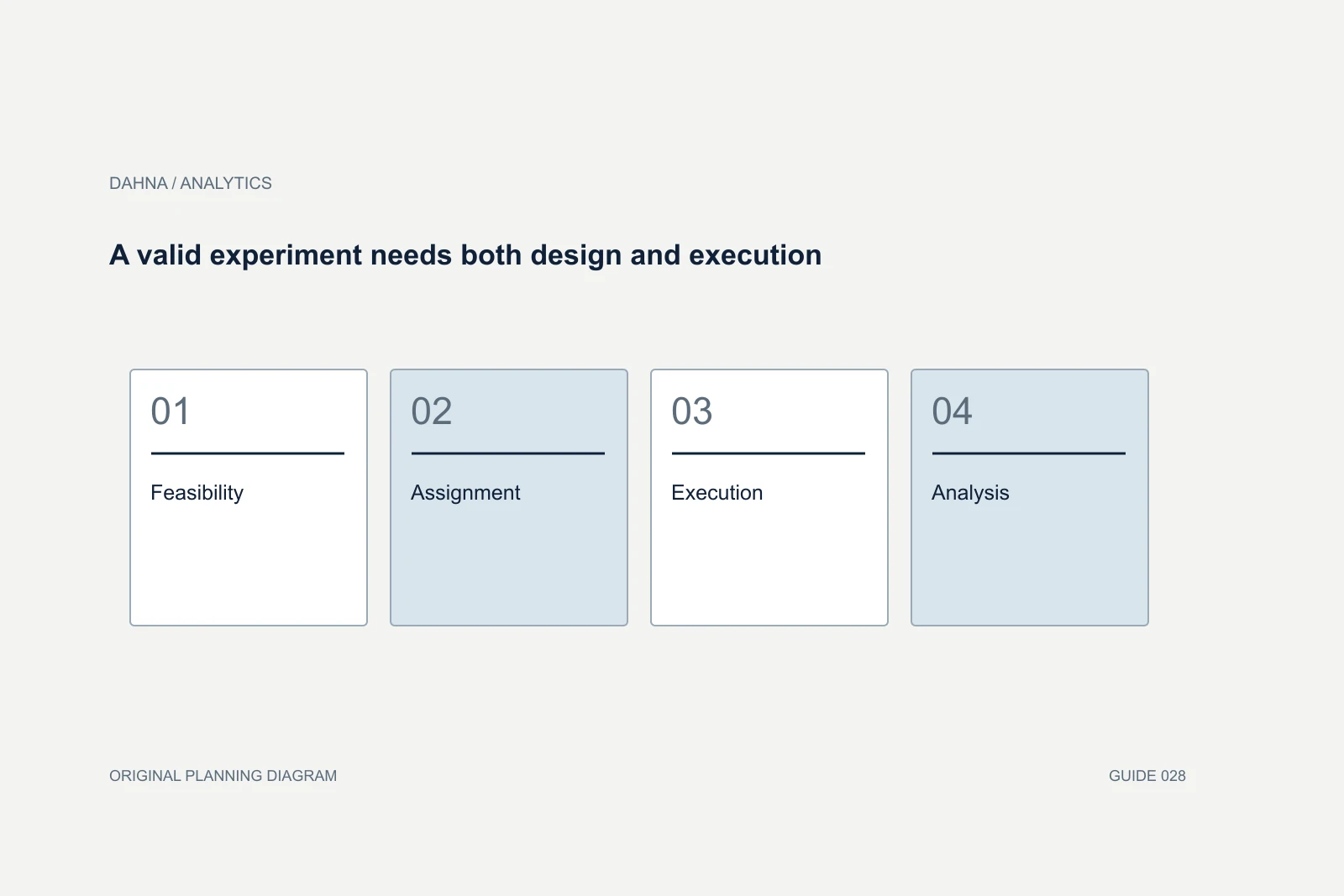
If an eligible randomized conversion-lift or holdout setup is available, ask the agency to explain the unit of assignment, the suppressed exposure and the outcome measured. The control group must remain meaningful; a nominal retargeting holdout is less informative if another campaign delivers the same message to the same people. Record the other marketing that continues during the test.
Smaller brands may lack sufficient audience or order volume. A geographic test, a carefully designed pause or a stepped budget review can still help operationally, but each introduces possible confounding. Seasonality, email, stock and customer mix need to be recorded. The honest alternative to an underpowered experiment is a limited budget with explicit uncertainty—not a confident declaration that every warm-audience dollar is incremental.
The retargeting budget question
Eligible people
Define who has a relevant reason to return.
Added exposure
Describe the ad and competing messages.
Comparison
Estimate what happens without that exposure.
Contribution
Value additional fulfilled orders after variable costs.
Budget decision
Retain, reduce, change the message or test further.
An illustrative test with a less impressive but more useful result
Suppose a fictional brand assigns 10,000 eligible shoppers to a retargeting group and 10,000 to a valid holdout. After the agreed observation period, the groups record 260 and 230 fulfilled orders respectively. The observed difference is 30 orders. If contribution before ads is $22 per order, that difference represents $660, while the retargeting group cost $900 in media.
The point estimate is therefore negative $240 before test-management costs. The platform might still report 150 attributed orders, producing a much more attractive acquisition figure. Neither the 30-order difference nor the negative result should be treated as certain without uncertainty analysis and an adequate design. The example demonstrates the decision logic; the numbers are invented and are not an expected retargeting result.
| Measure | Value | Meaning |
|---|---|---|
| Retargeting-group fulfilled orders | 260 | All relevant orders in assigned group |
| Holdout fulfilled orders | 230 | Comparison outcome without tested exposure |
| Observed additional orders | 30 | Point estimate before uncertainty analysis |
| Contribution at $22 per order | $660 | Before advertising and experiment costs |
| Retargeting media | $900 | Cost of tested exposure |
| Observed difference after media | −$240 | Insufficient contribution at this point estimate |
The next dollar can be worse than the average dollar
Even when a retargeting program appears useful, increasing its budget can push exposure toward people who are less responsive or already heavily reached. Track audience size, frequency and contribution as the budget changes. A fixed rule such as “always reserve a quarter of spend” ignores how many relevant people are entering the audience and what the product needs to explain.
A useful budget review separates message improvement from exposure expansion. If customers still ask the same delivery question, repair the explanation. If the available audience is small, do not force spending merely to maintain a channel percentage. If prospecting creates a larger pool of interested shoppers, revisit the retargeting allowance after the quality of that new audience becomes clearer.
What if retargeting mainly reaches repeat buyers?
Inspect whether the audience contains customers returning on their normal replenishment schedule. A reminder may be useful, but the business question differs from persuading a first-time visitor. The brand should decide whether that activity belongs in acquisition, retention or a separately evaluated customer program. Otherwise a low apparent acquisition cost can be created by counting familiar repeat buyers as if advertising introduced them to the brand.
A fictional cleanser brand sees excellent retargeting ROAS during the period when many customers usually reorder. The team can separate recent purchasers from unconverted visitors where the available data and permissions support it, then review the message and measurement for each. It should not assume perfect customer matching or instant exclusion. Any limitations in the audience definition belong in the conclusion, especially when the proposed budget depends on the claim that only new customers are being reached.
Also consider what another marketing channel is already doing. If a customer receives a replenishment email, an SMS offer and a retargeting ad in the same period, platform reports may each claim part of the same order. The right operating response is not necessarily to remove one channel immediately. It is to map the overlap, decide which additional contact is being tested and evaluate the customer experience as well as the credited revenue.
Ask for a retargeting decision, not a flattering chart
The agency should provide audience definitions, exclusions, message ownership, the attribution convention and a proposed incrementality review. Include what happens when stock runs out, the offer changes or the customer buys. A reporting screenshot without these conditions is difficult for a brand owner to evaluate and difficult for a new agency to inherit.
Dahna can help connect the retargeting brief with the objections on the store and the broader paid-media budget. Bring the current audience rules, creative, product margins and recent promotion calendar. The first useful output is a bounded decision: where another exposure is plausibly helpful, which customers should be treated differently, and what evidence would justify spending more.
Continue with the related decision
Use these guides when the next question goes beyond the scope of this article.
Use the editable decision sheet
Download the completed tables as a CSV, then replace the example inputs and add your evidence, owner and review date. Illustrative figures are teaching examples, not default targets.
Sources & further reading
Bring this decision to Dahna
Use this guide to prepare a focused brief. Tell Dahna what needs to change, which evidence you already have and when you need a decision.
Why consider Dahna for this work?
Dahna brings bilingual Korean and English strategy together with creator, content, and measurement work for brands growing in the US. You can review the people behind the recommendations and the kind of work we propose before starting a conversation.
Founder experience includes prior and contracted roles. Sample deliverables illustrate our approach; they are not client results or a performance promise.