How to build an ecommerce paid-creative testing plan
A useful creative test changes an idea that could affect the purchase, keeps the comparison interpretable and names the decision before spending begins. Test a customer objection, demonstration or offer explanation before producing dozens of cosmetic variations. The deliverable is not simply more ads: it is a record of what the team learned and what should be made next.
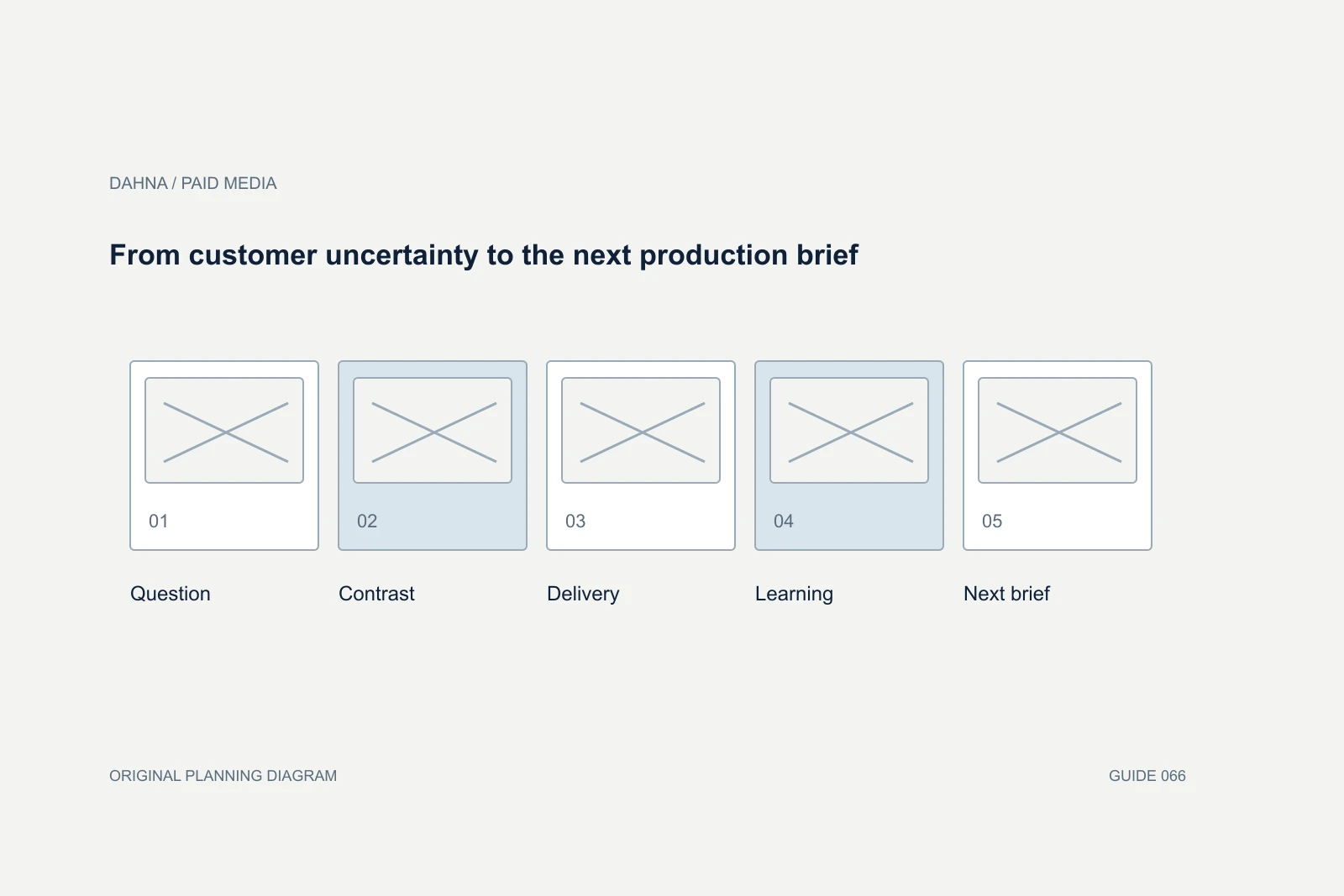
Dahna, original planning diagram
In this article
Overview
A useful creative test changes an idea that could affect the purchase, keeps the comparison interpretable and names the decision before spending begins. Test a customer objection, demonstration or offer explanation before producing dozens of cosmetic variations. The deliverable is not simply more ads: it is a record of what the team learned and what should be made next.
Give every concept a reason to exist
Start with a sentence a customer might say: “I cannot tell whether this texture will feel heavy,” or “I do not understand why this tool belongs in my routine.” The test hypothesis connects that uncertainty to something the ad can show. A texture demonstration might increase qualified product-page visits because it resolves a sensory question. A setup demonstration might reduce hesitation about the work involved in using a device.
Avoid hypotheses that merely rename a format. “Test UGC” leaves the writer without an argument and the analyst without a learning question. Specify the person, obstacle, evidence and next action. Keep the product claim within what the brand can support. For a skincare device, an attractive before-and-after sequence cannot substitute for appropriate evidence about the result being implied.
| Buyer uncertainty | Creative difference | What to inspect |
|---|---|---|
| Will it feel heavy? | Close view of amount and spread versus talking-head description | Qualified visits, purchase behavior and texture questions |
| How much should I use? | One application sequence versus a benefit list | Watch progression and product understanding |
| Why this price? | Explain size and usage context versus discount-led opening | Order contribution and price objections |
Separate a concept test from an edit test
A concept test compares different arguments. An edit test compares treatments of the same argument, such as the first shot or the order of proof. Both are useful, but they answer different questions. If one ad changes the presenter, price, promise, length and page, the result describes the whole package. It does not establish that the new opening caused the difference.
TikTok’s split-test documentation lists creative and creative assets among supported variables, with compatibility limits by campaign type. Use the available experiment tools when they fit the buying destination and objective. Do not promise that a website split-test setup also applies unchanged to TikTok Shop. Record whether delivery was randomized, platform-optimized or simply observed; that distinction belongs in the conclusion.
From customer uncertainty to the next production brief
Question
Identify one obstacle to purchase.
Contrast
Create two meaningful ways to answer it.
Delivery
Record the experiment design and spend.
Learning
Explain which claim the evidence supports.
Next brief
Retain the lesson and change the next uncertainty.
CeraVe used more than one context for its message
TikTok’s CeraVe case describes work with Mutato to reach beyond familiar skincare audiences, including creator content in contexts outside routine skincare instruction. Kantar supplied brand-lift measurement. This is a platform-published campaign account from Brazil, not a controlled comparison of individual creative ideas for a US storefront.
It illustrates why a brand can keep a product message recognizable while testing how that message enters a conversation. A smaller team can apply that principle without copying the campaign: compare a routine demonstration with a relevant everyday situation, while keeping the product, destination and basic promise stable. The point is to create a useful contrast, not to borrow an unrelated entertainment trend merely because a larger brand used one.
A test that can survive an inconclusive result
A fictional cleanser brand has $2,400 for media and four approved videos. It chooses two concepts, each with two executions, rather than four unrelated ideas. The first explains residue removal; the second shows the amount needed for a typical use. Both send shoppers to the same available product at the same price. Production costs are tracked separately so the team can later judge whether the winning approach is economical to repeat.
Before launch, the buyer and analyst agree on the primary outcome, review window, minimum detectable change and feasible sample size. If the budget cannot distinguish a small purchase-rate difference, the test must not promise one. It can still reveal a broken message, misleading click response or production issue. Stop early for harm or a broken buying path; otherwise avoid repeatedly declaring a winner whenever a daily result changes.
| Field | Decision |
|---|---|
| Primary question | Does visible residue removal explain the cleanser better than a usage demonstration? |
| Main business outcome | Purchase contribution, with consistent attribution reporting |
| Held stable | Product, offer, destination, geography and review window |
| Diagnostic evidence | Landing-page visits, comments and viewing progression |
| If evidence is weak | Keep uncertainty explicit; narrow the next contrast |
| Production output | A revised brief containing the actual observation, not “make more winners” |
Low delivery does not prove a bad idea
Automated delivery may allocate very different amounts of spend to the ads. The one with two purchases from little spend can look spectacular, while the ad carrying most of the budget faces a broader audience. Report spend and outcome counts beside rates. Do not rank a lightly delivered asset as a reliable winner without considering uncertainty and how the platform selected its viewers.
Read the journey as well. A strong opening with weak product-page behavior may attract curiosity without purchase relevance. Good checkout behavior with low click volume may suggest the argument works for a narrower audience. Comments can explain confusion, but their authors are self-selected. Use those observations to write the next hypothesis rather than treating every comment as a representative customer survey.
When the test changes the product mix
A creative can appear to improve return because it sells a different item. Suppose a routine video encourages a two-product bundle while the control promotes a single cleanser. The bundle may produce higher revenue per order but also different product and fulfillment costs. That is a legitimate offer-and-creative comparison if it is the intended question. It is not a clean test of the video’s opening or presenter. Label the contrast correctly before the report turns a merchandising change into a creative rule.
The production record should therefore identify the featured product, linked product and actual purchased mix. If one video consistently attracts questions about an item shown only as a prop, the team may need to clarify the offer. If viewers buy a different product after arriving, that behavior can be commercially useful, but the reported learning should acknowledge it. The winning creative may be a gateway into the assortment rather than an efficient seller of the featured SKU.
For a small test, avoid constructing an elaborate analysis that the order count cannot support. Inspect a few redacted journeys and the aggregate product mix, then state what remains uncertain. The next brief can test a clearer product focus or an explicit bundle proposition. That is more actionable than claiming that the camera angle increased profit when the offer and basket changed at the same time.
Make the agency’s learning usable next month
The creative report should link the actual file, script, product promise, delivery conditions and result. Preserve the failed ideas too, including whether they were truly tested. Without that context, a new editor can recreate an already rejected message and the team can mistake a change in offer for a creative breakthrough. A compact archive of reasoned decisions is more useful than a slide full of thumbnails and green arrows.
Ask Dahna to scope the test backlog, production responsibilities, launch checks and review decisions together. Bring existing ads and the questions customers ask before purchasing. The work should end with specific next assignments: reshoot the amount demonstration, clarify the price context, repeat a promising concept under a stronger comparison, or retire an unsupported promise. Each assignment should follow from an observation the brand can inspect.
Continue with the related decision
Use these guides when the next question goes beyond the scope of this article.
Use the editable decision sheet
Download the completed tables as a CSV, then replace the example inputs and add your evidence, owner and review date. Illustrative figures are teaching examples, not default targets.
Sources & further reading
Bring this decision to Dahna
Use this guide to prepare a focused brief. Tell Dahna what needs to change, which evidence you already have and when you need a decision.
Why consider Dahna for this work?
Dahna brings bilingual Korean and English strategy together with creator, content, and measurement work for brands growing in the US. You can review the people behind the recommendations and the kind of work we propose before starting a conversation.
Founder experience includes prior and contracted roles. Sample deliverables illustrate our approach; they are not client results or a performance promise.