Should your brand keep paying for its own name in Google Ads?
Do not keep or cancel branded-search advertising solely because it reports a high ROAS. Customers typing your name may already intend to buy from you. The useful question is whether the ads protect or create enough additional value compared with the traffic and sales you would receive without them. Test that question while accounting for competitors, retailers, organic visibility and the customer’s exact query.
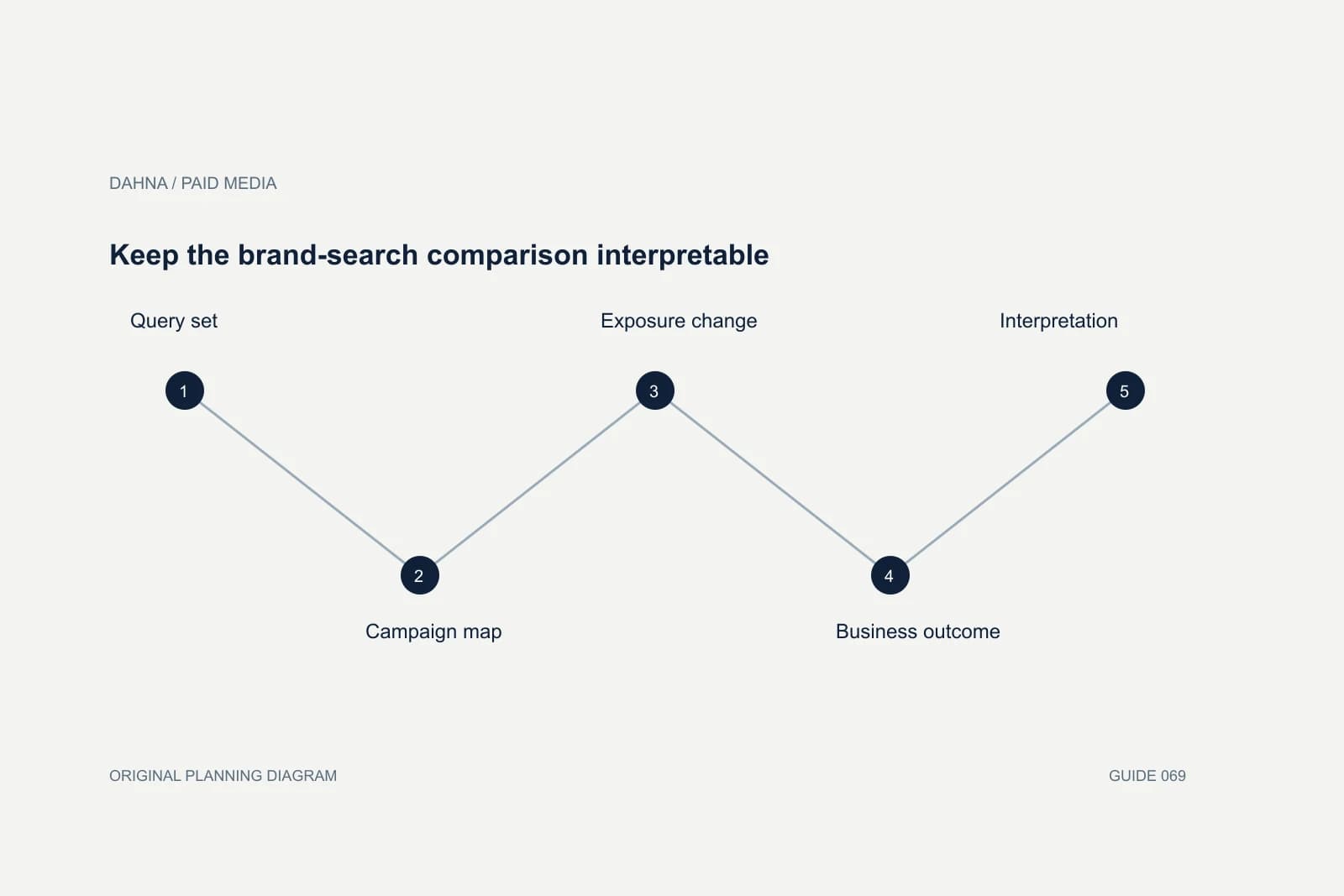
Dahna, original planning diagram
In this article
Overview
Do not keep or cancel branded-search advertising solely because it reports a high ROAS. Customers typing your name may already intend to buy from you. The useful question is whether the ads protect or create enough additional value compared with the traffic and sales you would receive without them. Test that question while accounting for competitors, retailers, organic visibility and the customer’s exact query.
Separate navigational queries from real comparison questions
A search for the exact brand name can be mainly navigational. A search for the brand plus a product concern, retailer or competitor can involve a different decision. Export the actual query evidence available in the account and classify it before judging performance. Include spelling variations and product names that function like brands, while recognizing that platform reports may not expose every query.
Inspect the US search experience on mobile and desktop, recording date, location and any personalization limitations. Which official page appears? Are retailers or competitors prominent? Does the result lead to an available product or a generic homepage? A Korean or European brand may have a home-market site competing with its US store. Paid brand traffic can mask that navigation problem without fixing it.
| Query type | Potential customer job | Budget question |
|---|---|---|
| Exact brand name | Find the official destination | Does the ad add visits or replace organic navigation? |
| Brand plus product | Reach a particular item | Is the relevant product result clear and available? |
| Brand plus reviews | Reduce purchase uncertainty | Does the landing page answer the concern? |
| Brand plus retailer | Find a preferred purchase location | Is the direct-store offer actually relevant? |
| Brand versus competitor | Compare alternatives | Can the page make a fair, useful comparison? |
What the eBay experiments actually contribute
Thomas Blake, Chris Nosko and Steven Tadelis studied paid search through large-scale eBay experiments. Their findings distinguish branded and nonbranded searches and different customer groups. The historical eBay result is not a universal rule to turn off brand ads; it is strong motivation to test whether attributed demand would have arrived anyway.
A young beauty brand with poor organic navigation is not eBay. Neither is a company whose distributors and competitors dominate results for its name. Use the research to ask a better question and design a comparison, not to copy a conclusion from a much larger business. A responsible agency should be comfortable discussing both the possible value of protection and the possibility of unnecessary spend.
Keep the tested traffic from moving into another campaign
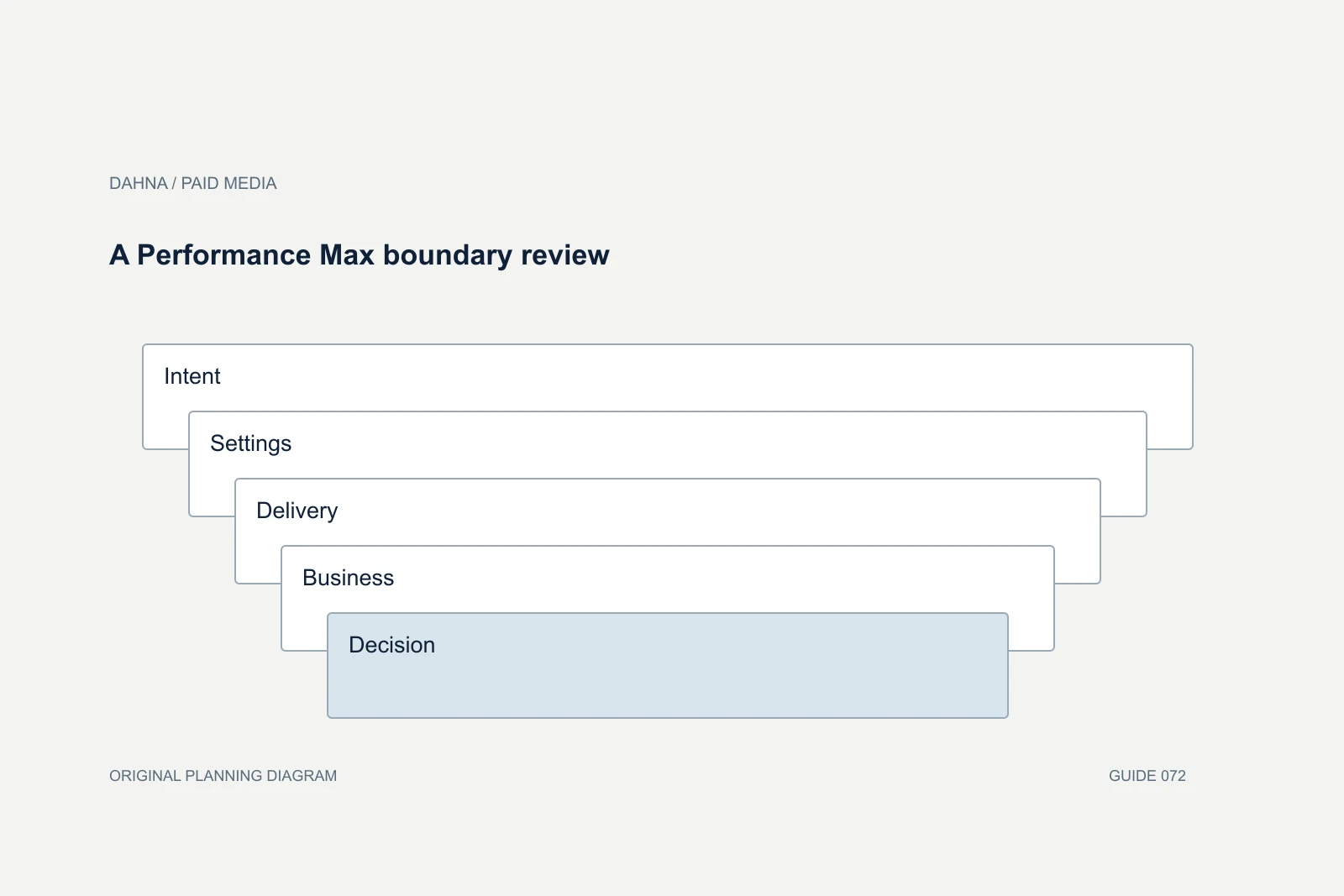
Map where brand queries can enter the account before changing anything. Standard Search, Shopping and Performance Max can create overlapping routes to the same demand. Pausing one brand campaign does not create a clean test if another campaign immediately serves the same queries. The test plan should state exactly which inventory and query class are being changed.
Google’s current Performance Max guidance distinguishes brand exclusions from negative keywords and describes different Search and Shopping handling. Review those controls with the person who manages the account, then preserve a dated settings record. Do not assume that a list named “brand excluded” proves the intended boundary is operating. Inspect the available query and channel evidence after launch as well as the configuration itself.
Keep the brand-search comparison interpretable
Query set
Define the own-brand searches being tested.
Campaign map
Find every route serving that demand.
Exposure change
Apply the agreed boundary across relevant routes.
Business outcome
Observe total relevant visits and fulfilled orders.
Interpretation
Account for organic substitution and uncertainty.
A fictional budget reduction with two possible conclusions
Imagine a US skincare brand spending $1,200 a month on exact-name ads. It reports $12,000 in attributed revenue, which looks like a 10× ROAS. The agency proposes a valid comparison of reduced brand exposure in selected comparable markets, after checking sample size, market differences and competing campaigns. The target outcome is total brand-related business, not only paid-search conversions.
If the tested markets lose paid clicks but gain roughly corresponding organic visits with no detectable business decline, the evidence may support reducing spend within the limits of the test. If total fulfilled orders fall enough to outweigh the savings, some protection may be valuable. An inconclusive result is also possible. The decision should state the range of effects compatible with the data instead of claiming that a flat sales line proves zero impact.
| Possible finding | Next action | Remaining question |
|---|---|---|
| Organic navigation replaces paid visits; effect remains small | Reduce the tested spend cautiously | Would competitor activity change the result? |
| Lost contribution exceeds media savings | Retain useful protection | Can targeting or message make it cheaper? |
| Business outcome too noisy | Keep a bounded allowance or improve the design | Is the test capable of detecting a meaningful effect? |
| Traffic migrates into PMax | Repair the comparison before interpreting | Which route actually delivered the exposure? |
Brand ads should still earn their place
If you retain branded search, make its destination useful. A customer looking for the official US store should see accurate shipping context and local availability. A query about a particular product should reach that product. A genuine temporary offer should match the page and end when promised. The ad’s usefulness can be assessed even when causal measurement is difficult.
Avoid using a large branded ROAS to hide weak acquisition elsewhere. Report own-brand and nonbrand activity separately, then explain how they work together. A campaign that captures demand created by creators, retail or public relations should not receive sole credit for generating that demand. This separation helps the owner decide where the next dollar belongs rather than rewarding whichever channel appears last.
Handle retailer and regional queries deliberately
A brand-name query that includes a retailer may indicate a preference for that retailer’s loyalty program, delivery terms or local availability. Sending every such query to the direct store can be wasteful if the brand cannot offer a relevant reason to switch. The query review should distinguish navigation to the brand from navigation to a specific seller. An agency should explain whether it is excluding those terms, serving a useful alternative or testing their value under a separate hypothesis.
Regional ambiguity creates another edge case. A European brand may have several official sites, while a US customer searches for the name without specifying a country. If organic results repeatedly lead to the wrong market, brand ads can temporarily help route shoppers, but the underlying website and search configuration still needs attention. Record that dependency rather than treating perpetual paid navigation as the only available solution.
Do not broaden the experiment to every brand-related phrase at once merely to obtain a larger sample. An exact-name query and a detailed comparison query can respond differently. A smaller, well-defined test may produce a narrower but more useful conclusion. The final budget decision can retain support for a particular query family while reducing another, with the reasoning and limits visible to the owner.
What to ask for in the agency review
Ask for a query inventory, campaign map, organic-navigation review, test design and decision memo. The memo should say what was changed, what was measured, what remains uncertain and when the decision should be revisited. Competitor changes, a website migration or a major launch can change the value of brand protection, so the answer need not be permanent.
Bring Dahna your current branded-query report, campaign settings and official US destinations. We can scope the analysis around the actual budget decision and coordinate any page or campaign work it reveals. That makes the engagement reviewable: you can see which searches require support, which spending is difficult to justify and which conclusion still needs stronger evidence.
Continue with the related decision
Use these guides when the next question goes beyond the scope of this article.
Use the editable decision sheet
Download the completed tables as a CSV, then replace the example inputs and add your evidence, owner and review date. Illustrative figures are teaching examples, not default targets.
Sources & further reading
Bring this decision to Dahna
Use this guide to prepare a focused brief. Tell Dahna what needs to change, which evidence you already have and when you need a decision.
Why consider Dahna for this work?
Dahna brings bilingual Korean and English strategy together with creator, content, and measurement work for brands growing in the US. You can review the people behind the recommendations and the kind of work we propose before starting a conversation.
Founder experience includes prior and contracted roles. Sample deliverables illustrate our approach; they are not client results or a performance promise.