Meta, Google or TikTok ads: which should your brand test first?
Choose the first advertising channel around the customer’s buying situation and the assets your team can sustain. Google can be useful when shoppers already describe what they need. Meta and TikTok can help demonstrate a product people have not searched for yet. Those are starting hypotheses, not permanent roles: each platform contains several placements and buying behaviors. A smaller brand usually learns more from one adequately supported test than from dividing a limited budget among three incomplete launches.
Dahna, original planning diagram
In this article
Overview
Choose the first advertising channel around the customer’s buying situation and the assets your team can sustain. Google can be useful when shoppers already describe what they need. Meta and TikTok can help demonstrate a product people have not searched for yet. Those are starting hypotheses, not permanent roles: each platform contains several placements and buying behaviors. A smaller brand usually learns more from one adequately supported test than from dividing a limited budget among three incomplete launches.
Start with the buying question, not the platform ranking
Write down what the next customer knows before seeing your ad. Someone searching for a replacement cleanser may already understand the category and need a suitable price, size and delivery promise. Someone discovering a new applicator may need to see it used before the product name means anything. A brand with several products can have both situations at once.
Then identify what evidence you actually have. Search Console queries describe existing organic visibility, not the entire market. Customer interviews reveal language, not search volume. Platform keyword and audience estimates describe modeled opportunities, not guaranteed sales. Put the source and market beside each observation. For a Korean brand entering the US, home-market awareness should not be treated as established American demand.
| Situation | Plausible starting test | What must already work |
|---|---|---|
| Recognized category; shoppers compare products | Google Search or Shopping | Accurate feed, relevant page, competitive offer |
| Benefit is easiest to understand in a demonstration | Meta or TikTok video | Repeatable production and credible product proof |
| Existing creator community discusses the product | TikTok creator-content amplification | Permissions, buying path and useful follow-up |
| Audience recognizes the brand but hesitates | Bounded remarketing test | Reason for hesitation and incrementality question |
Compare the weekly work each choice creates
A media fee buys campaign management; it does not automatically buy all the material a campaign needs. Search requires useful query grouping, exclusions and landing-page relevance. Shopping requires dependable product data. Video advertising needs demonstrations, different customer problems and enough production capacity to replace weak ideas. An agency proposal should say who supplies those inputs and how quickly they can change.
The practical constraint is often an approval queue. If every product statement waits a week for the US distributor, adding another video channel creates another queue. If the catalog has inconsistent variant prices, an extra Shopping campaign makes the inconsistency more visible. Choose a channel your current operation can support, then put the missing capability in the project scope. The preferred platform may become viable after that dependency is fixed.
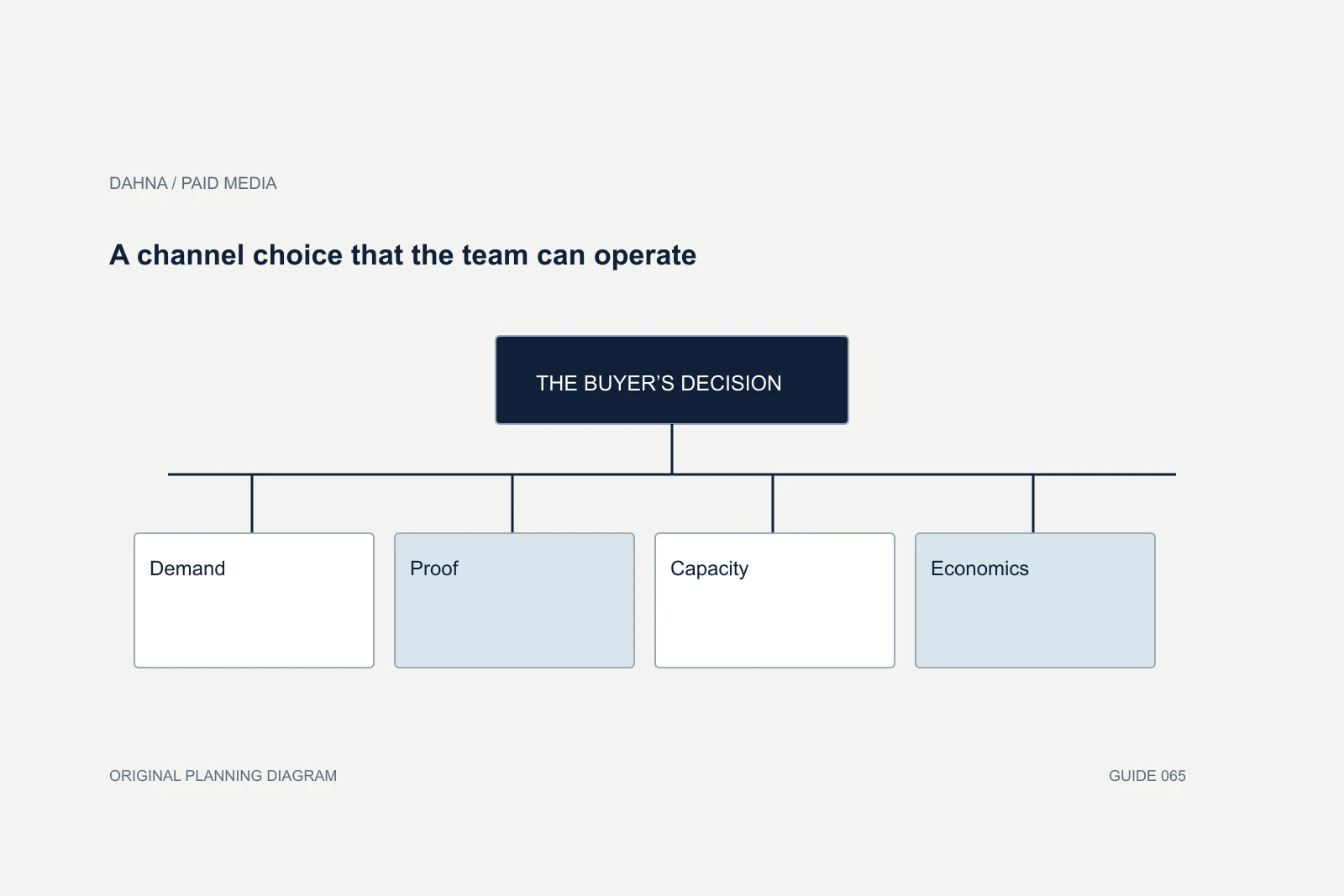
A channel choice that the team can operate
Demand
What does the customer already know or search for?
Proof
Which format can explain the purchase honestly?
Capacity
Who keeps creative, data and pages current?
Economics
Can the test produce affordable incremental orders?
What e.l.f. shows about a connected advertising program
TikTok’s historical e.l.f. case describes work with Tinuiti across in-feed and catalog advertising. Patrick O’Keefe, then VP of Integrated Marketing Communications, discussed continued testing. The published acquisition-cost improvement concerns an add-to-cart strategy; it should not be presented as a purchase-profit result.
The useful lesson for a smaller brand is organizational: creative, distribution and the next buying step need a shared objective. It is not a reason to reproduce e.l.f.’s spending pattern or assume the same response. A known brand, an unfamiliar importer and a newly launched skincare device start with different awareness, evidence and production resources. Compare the conditions behind a case study before accepting its headline as a channel-selection argument.
A completed example: a US launch with $6,000 available
Consider a fictional European body-care brand with $6,000 for a four-week learning project, including production and management. It has a functional US store, two reliable demonstration concepts and limited brand search. The team could reserve $1,500 for adaptation and measurement work, $1,000 for management and review, and $3,500 for one media test. These are planning assumptions, not Dahna prices or market averages.
Suppose each fulfilled first order leaves $24 after product, payment, fulfillment and expected return costs, before advertising. A $3,500 media test would require about 146 additional orders to cover media alone. Covering the entire $6,000 project would require 250 at that contribution. The team can now decide whether the learning budget is acceptable. Splitting $3,500 into three platforms would also split the evidence while leaving many setup costs intact.
| Item | Allowance | Decision it supports |
|---|---|---|
| Creative adaptation and measurement | $1,500 | Can the product promise and purchase recording be trusted? |
| Campaign management and review | $1,000 | Can the team act on what the test reveals? |
| One channel’s media | $3,500 | Can this buying situation produce viable orders? |
| Total project | $6,000 | Approved learning exposure; no forecasted return |
Make the comparison fair before declaring a winner
Do not compare Google purchases with TikTok video views and call one channel more efficient. Record the destination, conversion definition, attribution window, geography, customer mix and offer for every result. Even two purchase ROAS figures can describe different credit rules. The store’s net sales and contribution provide a common business reference, while platform reporting remains useful for delivery decisions.
Brett Gordon and colleagues’ advertising-measurement research compares observational methods with large randomized Facebook experiments. It is a reason to separate credited conversions from causal lift. In a small pilot, a formal lift study may not be feasible. Say that plainly and use the pilot to eliminate broken paths, test messages and estimate a plausible range. A channel ranking based on a few orders should remain provisional.
When two channels look equally plausible
If both search and social look reasonable, compare the cost of learning rather than asking for an abstract winner. A search pilot may require a feed repair and new collection page; a social pilot may require a demonstration shoot and creator permission. Estimate those dependencies alongside media. The cheaper advertising click can sit inside the more expensive project. The brand should know which assets remain useful if the first test disappoints and which costs must be incurred again for another attempt.
Consider a device with a familiar category name but an unfamiliar setup process. Search may reach people already comparing devices, while video may help explain why this one deserves consideration. The first test could reasonably be either, depending on the quality of the page and demonstration assets. Write the alternative in the decision memo: “We chose video first because the product needs explanation and the search destination is not yet ready.” That makes the recommendation revisable when the missing condition changes.
Keep the test market explicit. A low acquisition cost driven by orders from a country the brand cannot serve reliably is not a useful result for a US launch. Inspect actual delivery and orders, not only the campaign’s geographic settings. Record unexpected traffic and customer-service questions so the next channel decision reflects the business the brand is trying to build.
What should unlock the second channel?
Add a second channel when it answers a different buying problem and the first program has become understandable. That might mean using search to serve customers who discovered the product through video, or using demonstrations to explain a category that search demand alone cannot grow. Set a separate hypothesis and budget; do not assume the second channel inherits the first channel’s measured performance.
Ask an agency for a written channel decision with an alternative it considered, the missing inputs, the maximum test exposure and the evidence that would change the recommendation. Bring Dahna your US product pages, current sales mix, contribution assumptions and available creative. A useful paid-media scope connects channel choice to those constraints, then gives the team one clear decision to make at the first review.
Continue with the related decision
Use these guides when the next question goes beyond the scope of this article.
Use the editable decision sheet
Download the completed tables as a CSV, then replace the example inputs and add your evidence, owner and review date. Illustrative figures are teaching examples, not default targets.
Sources & further reading
Bring this decision to Dahna
Use this guide to prepare a focused brief. Tell Dahna what needs to change, which evidence you already have and when you need a decision.
Why consider Dahna for this work?
Dahna brings bilingual Korean and English strategy together with creator, content, and measurement work for brands growing in the US. You can review the people behind the recommendations and the kind of work we propose before starting a conversation.
Founder experience includes prior and contracted roles. Sample deliverables illustrate our approach; they are not client results or a performance promise.