How to review brand traffic and budget controls in Performance Max
Start a Performance Max review by defining the job the campaign is supposed to do. If the brand wants new demand, own-brand searches and returning customers need to be visible in the discussion. Brand exclusions, negative keywords and reporting can help establish boundaries, but no setting by itself proves that all remaining sales are new or incremental. The owner needs both a configuration record and a business interpretation.
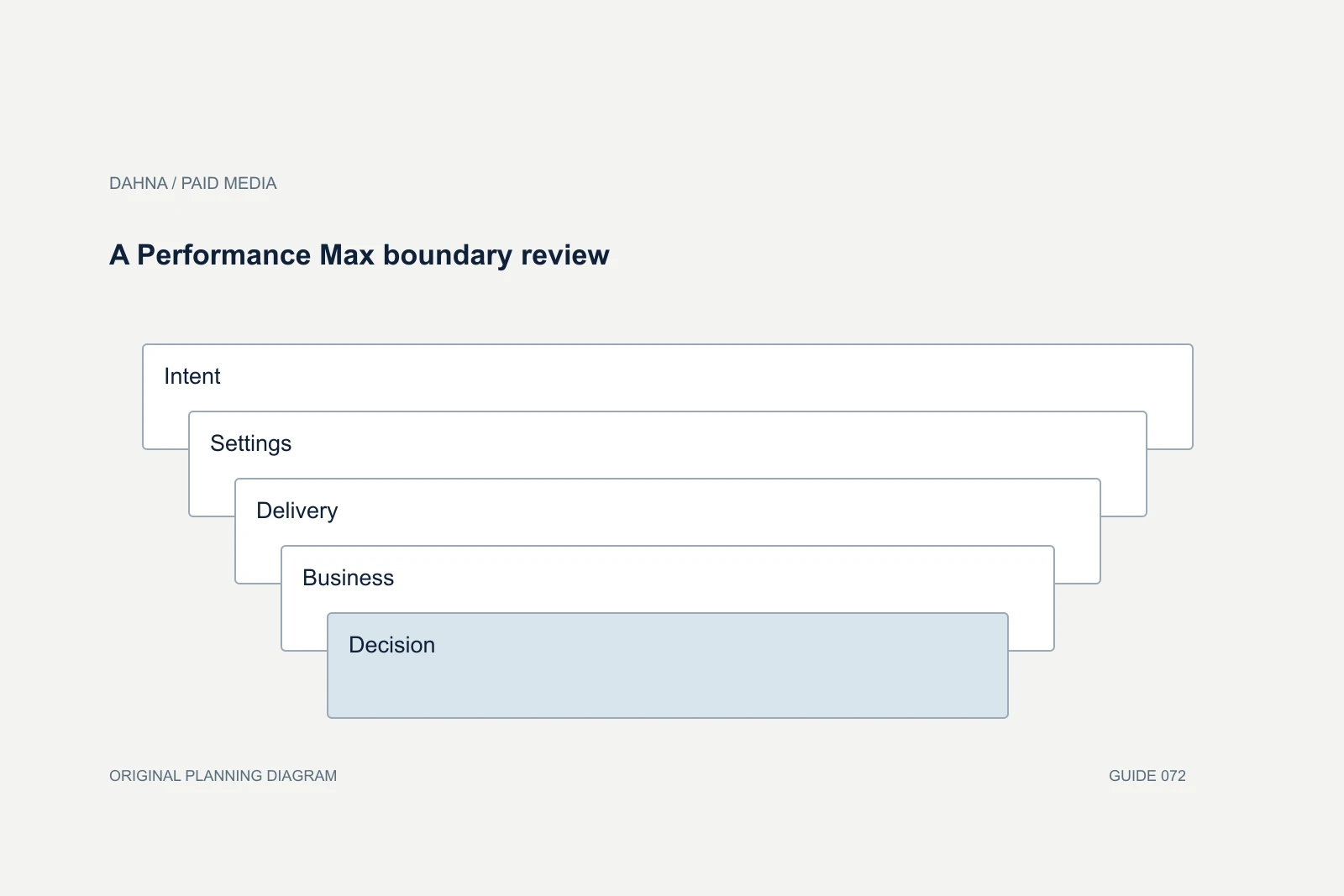
Dahna, original planning diagram
In this article
Overview
Start a Performance Max review by defining the job the campaign is supposed to do. If the brand wants new demand, own-brand searches and returning customers need to be visible in the discussion. Brand exclusions, negative keywords and reporting can help establish boundaries, but no setting by itself proves that all remaining sales are new or incremental. The owner needs both a configuration record and a business interpretation.
Name the campaign’s commercial job
“Improve ROAS” is incomplete when the campaign can find easy existing demand. State whether the campaign should acquire customers, move a particular assortment, support a launch or provide broad coverage at an acceptable contribution level. Those goals can require different product selection and different interpretations of the same reported revenue.
Write down which demand the brand expects other campaigns to handle. A dedicated exact-name Search campaign, a retailer promotion and a new-product launch can all influence the demand PMax encounters. The account map should show the intended relationships without pretending that channels operate in isolation. This is especially important when an agency inherits an account whose campaign names no longer match their behavior.
| Campaign job | Boundary to inspect | Business evidence |
|---|---|---|
| Acquire beyond known brand demand | Own-brand exposure and customer mix | New-customer contribution with limitations |
| Promote selected products | Included item groups and availability | Product-level spend and fulfilled orders |
| Support a launch | Overlap with branded Search and other promotion | Total launch outcomes, not summed platform credit |
| Maintain broad profitable coverage | Budget, goals and unsuitable inventory controls | Contribution after returns and variable costs |
Brand exclusions and negative keywords are different tools
Google’s current guidance says brand exclusions can address brand traffic across Search and Shopping, including relevant misspellings and foreign scripts. It also describes an option for retail advertisers to exclude brand traffic from Search text ads while keeping branded Shopping traffic. Negative keywords serve a different query-control role and do not behave exactly like brand exclusions.
Treat those distinctions as configuration requirements to verify in the live account. Google also specifies that PMax negative keywords apply to Search and Shopping inventory. A brand-safety or demand-boundary decision may therefore need several controls. Record the scope of each setting; avoid describing a single list as if it governs every placement, customer or route to conversion.
Inspect what changed after the control was applied
Save the previous state and the reason for the change. Then review the available query, channel and product evidence after a suitable observation period. Some reporting is aggregated or incomplete, so the review should state what it can see. A screenshot of a settings panel proves configuration, not the complete absence of branded demand from the campaign.
Look for movement into other campaigns as well. A lower PMax ROAS may occur because a profitable-looking source of existing demand moved elsewhere, while total business stayed stable. That can be a successful boundary change. Equally, a fall in total contribution may reveal useful exposure was removed. Judge the change using the intended business question and the limitations of the comparison.
A Performance Max boundary review
Intent
Document the demand and products the campaign should serve.
Settings
Record brand, query and inventory controls.
Delivery
Inspect available reporting after the change.
Business
Compare total contribution and customer mix.
Decision
Keep, adjust or investigate the boundary.
Why eBay’s research still matters to this modern campaign
Blake, Nosko and Tadelis’s eBay research predates Performance Max and does not evaluate it. Its relevance is the measurement problem: paid search can receive credit for customers whose existing intent matters to the outcome. That distinction remains useful when reviewing any automated campaign’s reported return.
Do not stretch the paper into a claim that automation is inherently wasteful. Automation can execute a well-defined commercial objective while still requiring good inputs and scrutiny. The owner’s job is to decide what the system should pursue and how success will be judged. The agency’s job includes making those choices visible enough that the brand can challenge them.
A fictional campaign whose ROAS falls after a useful change
A fictional cosmetics brand spends $5,000 and reports $25,000 in PMax revenue. After an agreed brand-traffic boundary change, PMax reports $18,000 at the same spend, while another search route and organic navigation account for more of the store’s sales. The team initially worries about a drop from 5× to 3.6× reported ROAS.
That before-and-after pattern alone cannot establish the effect. The review checks total store contribution, changes in promotions and stock, and whether the intended query boundary operated. If business value remained stable, the lower PMax ratio may simply be a more useful view of the campaign’s role. If business value declined, the next decision is to investigate why. Neither outcome should be concealed to protect the dashboard’s appearance.
| Observation | Interpretation to test | Evidence needed |
|---|---|---|
| PMax attributed revenue declines | Some existing demand may have moved | Query/channel evidence and other routes |
| Total orders appear stable | Possible substitution, not proof of no effect | Comparable windows and uncertainty |
| New-customer share rises | Mix may better fit acquisition objective | Consistent customer definitions |
| Stock changed during the period | Comparison may be confounded | Product availability timeline |
Do not confuse a customer label with a causal result
An account can classify a purchaser as new under its available customer data while the purchase still comes from demand created elsewhere. Conversely, an existing customer may make an additional purchase because of the campaign. Customer status and incrementality answer different questions. The review should explain both definitions rather than presenting “new customer” as a synonym for “caused by this campaign.”
A fictional brand excludes own-brand search traffic and sees a higher share of orders labeled new. That is relevant to the campaign’s acquisition objective, but it does not establish that every remaining order would disappear without PMax. The product could already be receiving attention from creators or retail publicity. Record those concurrent activities and avoid adding together each channel’s claimed sales as if they were unique orders.
The practical decision can still be made under uncertainty. If the campaign is serving the intended assortment, reaching a more appropriate mix and producing acceptable contribution under a consistent definition, a bounded continuation may be reasonable. State what the evidence supports and what it does not. The agency can then propose a stronger comparison when the business has enough volume, rather than delaying all action or overstating what a settings change proved.
Buy an explanation you can audit
The final review should include the campaign objective, product scope, settings record, visible query behavior and a decision about the next budget. Ask the agency to distinguish observations from inferences. “We added brand exclusions” is an implementation statement. “Every sale is incremental” is a much stronger claim that the setting cannot support.
Dahna can help connect the account controls with the brand’s actual acquisition question. Bring the campaign map, Merchant Center assortment, branded-search setup and contribution assumptions. The scope should end in a clear operating choice: keep the boundary, change which inventory it covers, run a better comparison or repair the product inputs before increasing spend. That is more useful than treating one automated-campaign ratio as the entire marketing strategy.
Continue with the related decision
Use these guides when the next question goes beyond the scope of this article.
Use the editable decision sheet
Download the completed tables as a CSV, then replace the example inputs and add your evidence, owner and review date. Illustrative figures are teaching examples, not default targets.
Sources & further reading
Bring this decision to Dahna
Use this guide to prepare a focused brief. Tell Dahna what needs to change, which evidence you already have and when you need a decision.
Why consider Dahna for this work?
Dahna brings bilingual Korean and English strategy together with creator, content, and measurement work for brands growing in the US. You can review the people behind the recommendations and the kind of work we propose before starting a conversation.
Founder experience includes prior and contracted roles. Sample deliverables illustrate our approach; they are not client results or a performance promise.