Is your product feed ready for Google Shopping ads?
A feed is ready for advertising when the products you intend to promote are eligible, accurately represented and purchasable under the conditions the ad displays. Uploading a catalog is only the beginning. Check the exact variants, price, availability, landing pages and shipping experience, then decide which products deserve spend. Feed quality and commercial suitability are related but separate decisions.
Dahna, original planning diagram
In this article
Overview
A feed is ready for advertising when the products you intend to promote are eligible, accurately represented and purchasable under the conditions the ad displays. Uploading a catalog is only the beginning. Check the exact variants, price, availability, landing pages and shipping experience, then decide which products deserve spend. Feed quality and commercial suitability are related but separate decisions.
Start with the products the campaign will actually sell
Export the proposed advertised assortment, including variants rather than only parent product names. For each item, record its margin assumptions, available stock, destination and commercial role. A complete catalog may contain discontinued packaging, low-stock shades, accessories with poor standalone economics and bundles whose contents are unclear. None should enter a campaign by accident.
A small launch assortment can be easier to inspect and explain than a full-catalog rollout. This is a merchandising choice, not a claim that smaller feeds always perform better. If the brand needs broad coverage, expand the acceptance review accordingly. An agency should explain whether excluded products are ineligible, temporarily unavailable or simply unsuitable for the current budget objective.
| Product | Commercial decision | Readiness issue |
|---|---|---|
| Hero moisturizer, 50 ml | Include once verified | Check US price and delivery promise |
| Travel moisturizer, 15 ml | Use only if economics support it | Low order contribution after shipping |
| Discontinued holiday box | Exclude from this launch | Old contents and unavailable stock |
| Routine bundle | Inspect components before inclusion | Bundle image and destination must match |
Match the feed to the real buying experience
Google’s product-data specification requires accurate information about identifiers, price, availability and relevant variants. Treat the feed, visible page, structured data and checkout as different representations of the same offer. A correct spreadsheet does not help if the destination selects another size or if checkout adds an unexpected condition to the advertised price.
Build a source-of-truth map. Which system controls stock? Which controls prices and promotions? Who creates product titles and identifiers? Google’s high-quality-data guidance recommends coordinating updates between the site and the data source. Turn that principle into an operating schedule with a named owner, especially when a US store is maintained by a team in another time zone.
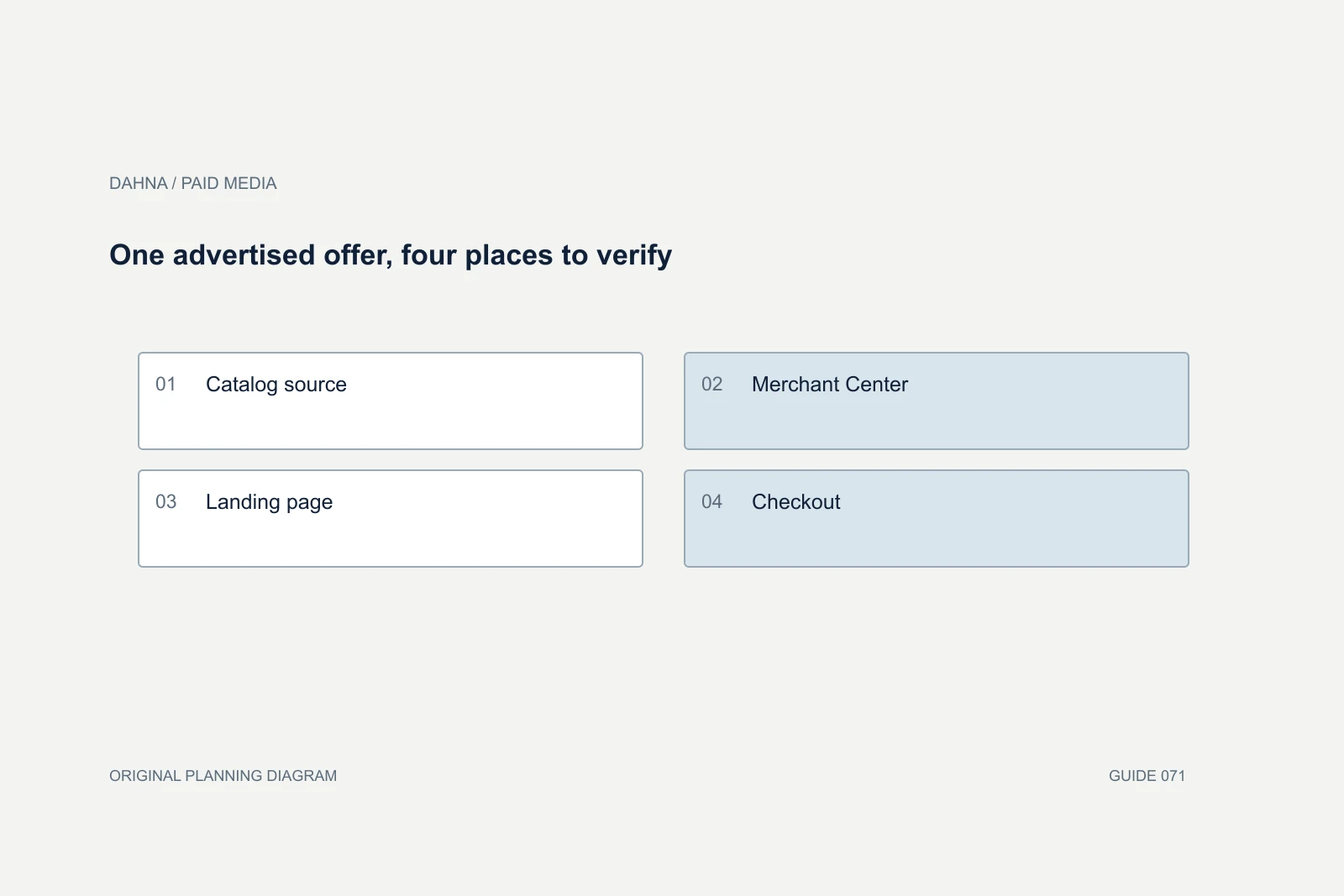
One advertised offer, four places to verify
Catalog source
SKU identity, attributes and current offer.
Merchant Center
Processed item and eligibility feedback.
Landing page
The same purchasable variant and conditions.
Checkout
The price and delivery experience the shopper receives.
Read historical Shopping examples with the right boundary
Google’s 2021 APAC retail guide describes Sephora SEA using Smart Shopping campaigns. That is a historical example of product-led advertising in a large beauty catalog; Smart Shopping is not the current setup recommendation. The reported result does not show that any feed change alone caused the outcome.
For an emerging brand, the practical question is much smaller: can the intended shopper understand and buy this particular item? A luxury retailer’s catalog strategy cannot answer whether your travel-size cleanser covers fulfillment costs or whether your imported shade names are clear to US customers. Use named examples to understand possible channel roles, then build the acceptance criteria from your own assortment.
A price mismatch discovered before launch
A fictional Korean skincare brand plans to advertise a $32 serum. The feed shows $32, the page initially displays $32, and the promotion changes the selected size to a $48 bottle after the visitor arrives. A reviewer checking only the feed status could miss the customer problem. The acceptance test selects the exact advertised variant and follows it into checkout using a US destination.
The repair is to align the item, destination and promotion behavior, then recheck processing. Do not merely change the title to hide the discrepancy. The same exercise should cover out-of-stock variants, a changed bundle and the end of a sale. Record the timestamp because a correct state today does not guarantee that tomorrow’s automated update will remain correct.
| Check | Observation | Action |
|---|---|---|
| Advertised item | 30 ml serum at $32 | Keep as intended offer |
| Destination behavior | Promotion selects 50 ml at $48 | Fix variant-specific destination |
| Availability | 30 ml is in stock in US warehouse | Confirm source updates correctly |
| Shipping | US delivery terms visible before payment | Retain and verify checkout consistency |
| After repair | Feed, page and checkout agree | Save evidence before campaign activation |
Eligibility is necessary, but it is not a sales forecast
A product can be technically eligible and still be a weak advertising choice. The price may be difficult to explain, the image may hide the useful detail, or the product may require education that a compact listing cannot provide. Conversely, a commercially promising product can be blocked by a fixable data issue. Keep technical defects and merchandising judgments in separate columns.
Prioritize repairs by the affected business opportunity and the confidence in the diagnosis. Fix a wrong price on a hero product before rewriting every description for style. Inspect a disapproval’s actual reason rather than repeatedly resubmitting unchanged data. If the issue involves a product policy or category qualification, assign it to the appropriate brand owner; the media buyer should not invent evidence to make the feed pass.
Review bundles and variants as separate offers
A bundle is not just several product names joined in a title. Confirm the sellable item’s identifier, contents, image and destination under the applicable product-data rules. A gift shown in campaign photography can create confusion if it is not part of the advertised item. The feed reviewer should compare the actual offer with the customer’s likely interpretation rather than assuming that a technically populated field is sufficient.
Variant behavior deserves the same attention. If an ad displays one shade but the page defaults to another, the shopper must repair the journey. That can create abandonment or a wrong order even when both shades are in stock. Test direct destinations on mobile, including whether a visitor’s prior selection or regional setting changes the initial state. Record the conditions used in the test so a developer can reproduce a mismatch.
For a launch with dozens of variants, prioritize a representative set that includes the unusual cases: an out-of-stock option, a different price, a bundle and a product with separate shipping conditions. Then define how automated checks or ongoing review cover the rest. Sampling is a practical inspection method, not a claim that every untested item is correct. The final acceptance record should identify the coverage and any remaining limits.
What a feed-readiness project should deliver
Ask for the advertised SKU list, issue log, ownership map, acceptance evidence and a maintenance plan for price, stock and promotion changes. Include an escalation path for problems during weekends or US launch hours. The work should identify what can be corrected in the connector and what requires a product, website or fulfillment decision.
Bring Dahna your Merchant Center access, catalog source, planned assortment and US purchase path. A useful paid-media engagement connects feed repair to the campaign’s economics and message. Once the launch set is verified, review actual product-level spending and fulfilled-order contribution. The feed makes accurate advertising possible; the campaign still has to demonstrate that the next order is worth buying.
Continue with the related decision
Use these guides when the next question goes beyond the scope of this article.
Use the editable decision sheet
Download the completed tables as a CSV, then replace the example inputs and add your evidence, owner and review date. Illustrative figures are teaching examples, not default targets.
Sources & further reading
Bring this decision to Dahna
Use this guide to prepare a focused brief. Tell Dahna what needs to change, which evidence you already have and when you need a decision.
Why consider Dahna for this work?
Dahna brings bilingual Korean and English strategy together with creator, content, and measurement work for brands growing in the US. You can review the people behind the recommendations and the kind of work we propose before starting a conversation.
Founder experience includes prior and contracted roles. Sample deliverables illustrate our approach; they are not client results or a performance promise.