How to plan a seasonal ecommerce ad campaign
Plan a seasonal campaign backward from the last promise you can reliably keep to the customer. Confirm the offer, available products and delivery conditions before assigning media dates. Then build the creative, feed, landing-page and support work around that promise. The campaign should have a start, a truthful end and a post-event review that includes returns and contribution, not only the busiest day’s revenue.
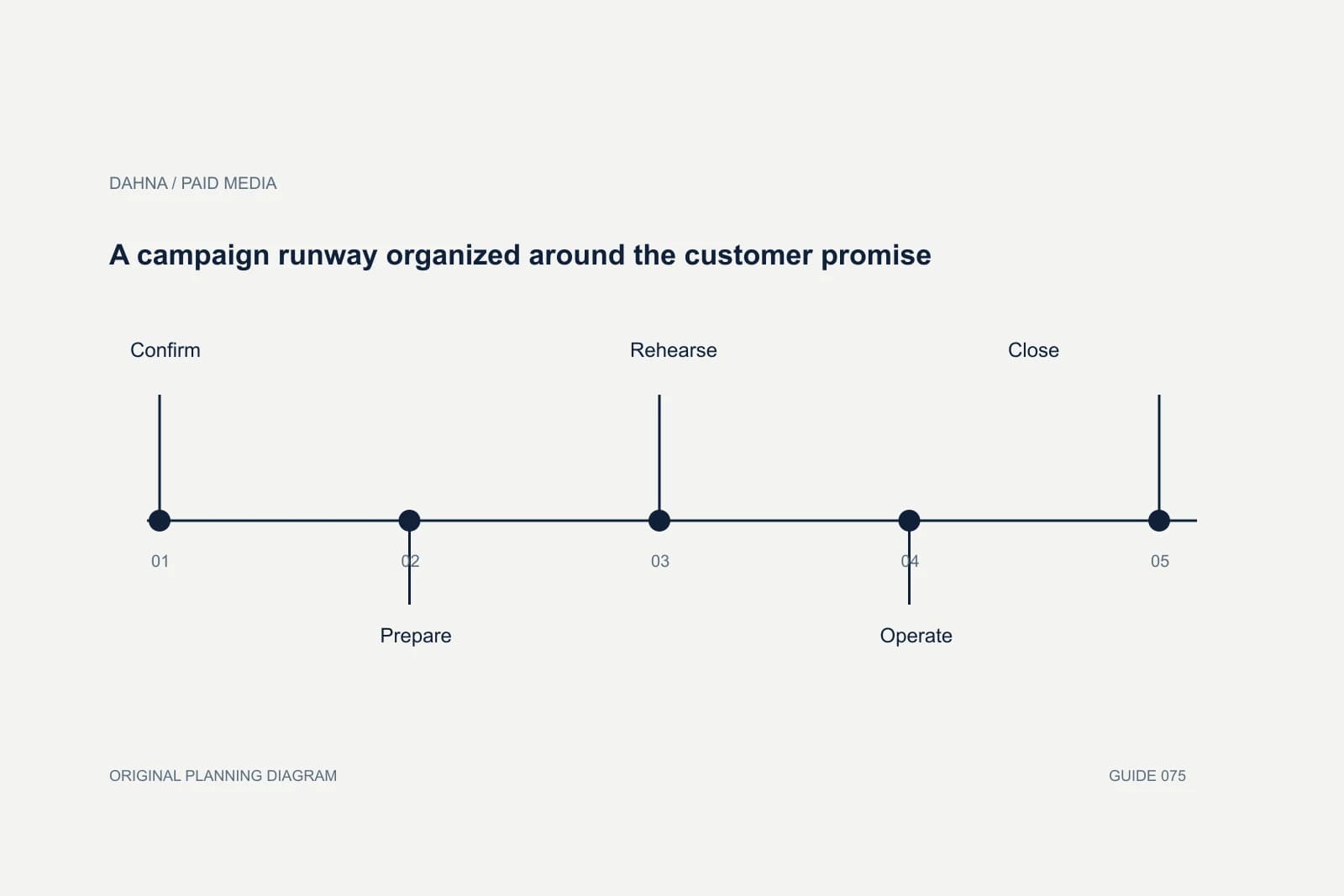
Dahna, original planning diagram
In this article
Overview
Plan a seasonal campaign backward from the last promise you can reliably keep to the customer. Confirm the offer, available products and delivery conditions before assigning media dates. Then build the creative, feed, landing-page and support work around that promise. The campaign should have a start, a truthful end and a post-event review that includes returns and contribution, not only the busiest day’s revenue.
Choose the offer the operation can support
Begin with the assortment and the customer reason to buy now. A seasonal bundle should have clear contents, a meaningful use case and enough stock in every component. A discount should leave an acceptable contribution after the costs it changes. Free shipping, a gift and a percentage reduction can affect economics differently even when they sound similarly attractive in the ad.
Write the exact terms in one approved record: eligible products, dates, time zone, exclusions, price and delivery limitations. The creative team, feed manager and support team should work from that record. For international brands, specify the US offer separately from home-market promotions so a translated asset does not accidentally promise a discount or shipping condition that the US store cannot provide.
| Field | Illustrative decision | Dependency |
|---|---|---|
| Offer | Cleanser and moisturizer bundle at $54 | Both component SKUs available |
| Market | US storefront only | US destination and support coverage |
| Timing | Friday 00:00 to Monday 23:59 Pacific | All systems use the same boundaries |
| Shipping message | Use current verified delivery estimate | Warehouse and carrier confirmation |
| End state | Restore ordinary offer and remove urgency | Media, page and feed owners |
Schedule the dependencies before the ad launch
The media start date is the end of several preparation tasks. Product data needs to be correct, creative permissions need to cover the event, landing pages need a tested purchase path and customer support needs the offer details. Assign each dependency an owner and a date that leaves room for a failed check. A campaign cannot be rescued reliably by discovering a broken coupon ten minutes before launch.
Build a contingency for missing inventory or delayed approvals. Which approved product can replace the hero item? Which asset works without a date-specific discount? Who can pause delivery if the page becomes inaccurate? These decisions reduce rushed improvisation during the event. They also make agency proposals easier to compare because the brand can see whether the fee covers coordination or only ad operations.
A campaign runway organized around the customer promise
Confirm
Approve assortment, margin and offer terms.
Prepare
Produce assets and update product data.
Rehearse
Test coupon, checkout, tracking and handoffs.
Operate
Monitor stock, spend and customer questions.
Close
End the offer consistently and review contribution.
Magnifiscience entered Black Friday with an existing program
TikTok’s Magnifiscience case describes the French brand and Adopterz continuing an existing campaign through Black Friday, using affiliate content and a Hydration Pack. It is a vendor-published account.
The transferable planning lesson is to reduce the number of untested dependencies at the peak moment. If the product explanation, creator permissions and buying path are already understood, the event can focus on the offer and demand. Launching a new store, new measurement, unfamiliar creative and a major promotion simultaneously makes it harder to know which part caused any problem.
Seasonality settings are not a holiday switch
Google describes seasonality adjustments as an advanced tool for expected major short-term changes in conversion rate. Its guidance notes that Smart Bidding already handles ordinary seasonal patterns. An upcoming holiday therefore does not automatically justify an adjustment, and a forecast of more traffic is not the same as a forecast of a higher conversion rate.
Ask the buyer to document the assumption behind any adjustment and the evidence supporting it. A short exceptional promotion may differ from an entire shopping season. Keep the configuration tied to the actual event window and preserve a record for the post-event review. The owner should be able to distinguish a platform setting from the broader commercial plan rather than seeing it presented as a guaranteed performance improvement.
A fictional bundle with a disappointing headline result
A fictional skincare campaign generates 400 orders at $54, or $21,600 in gross merchandise revenue before refunds. Assume $18 in product cost, $7 in fulfillment and shipping subsidy, $2 in payment/platform costs and $3 in expected returns per order. That leaves $24 per order, or $9,600, before advertising and fixed campaign costs. With $7,000 in media and $2,000 in production and management, the modeled remainder is $600.
A revenue-to-media ratio of about 3.09× can sound strong while leaving little room for errors in the assumptions. If return costs are higher or the bundle displaces full-price orders that would have happened anyway, the result changes. The example is illustrative, not a benchmark. Its purpose is to make the post-event review ask about contribution and incremental demand instead of celebrating revenue alone.
| Line | Calculation | Amount |
|---|---|---|
| Gross merchandise revenue | 400 × $54 | $21,600 |
| Variable costs | 400 × $30 | −$12,000 |
| Contribution before campaign | 400 × $24 | $9,600 |
| Media | Recorded campaign spend | −$7,000 |
| Production and management | Assumed project costs | −$2,000 |
| Modeled remainder | Before overhead and causal adjustment | $600 |
Protect the period after the shipping cutoff
The customer’s reason to buy can change sharply after a holiday delivery cutoff. A gift campaign that was relevant yesterday may become misleading if its creative still implies arrival before the occasion. Plan an alternate message in advance: an appropriate later-use benefit, an actually available digital option or simply ordinary product education. Do not invent a delivery assurance to keep a high-performing ad running.
The cutoff should come from the operations team’s current evidence and the actual destination, not a generic national date copied into every asset. Different regions, products and shipping services can require different handling. The media plan should identify which assets need to stop, which can continue and who confirms the change during the campaign’s operating hours. Save the approved wording so support can answer customers who saw an earlier version.
After the event, separate demand pulled forward from genuinely additional demand where the evidence permits. A large sale week followed by an unusually weak ordinary week may deserve investigation, though it does not prove cannibalization by itself. Compare a broader period and account for stock, other promotions and customer mix. The seasonal review should help the next event improve total business value, not merely repeat the biggest short-term revenue spike.
End the event as carefully as you launch it
Remove expired urgency, stop the relevant ads, confirm the feed reflects the new price and brief support on late questions. Keep an exception log for delayed orders, unavailable products and coupon failures. Those issues are part of the campaign’s cost and the next event’s planning evidence. Review returns after enough time has passed for the ordinary pattern to emerge.
Bring Dahna the offer, inventory forecast, delivery cutoff and previous event results. We can help build a paid-campaign scope that includes the handoffs and acceptance checks behind the launch. The final deliverable should tell the brand which message and offer to reuse, which operating limit mattered and what must change before the next seasonal increase in spending.
Continue with the related decision
Use these guides when the next question goes beyond the scope of this article.
Use the editable decision sheet
Download the completed tables as a CSV, then replace the example inputs and add your evidence, owner and review date. Illustrative figures are teaching examples, not default targets.
Sources & further reading
Bring this decision to Dahna
Use this guide to prepare a focused brief. Tell Dahna what needs to change, which evidence you already have and when you need a decision.
Why consider Dahna for this work?
Dahna brings bilingual Korean and English strategy together with creator, content, and measurement work for brands growing in the US. You can review the people behind the recommendations and the kind of work we propose before starting a conversation.
Founder experience includes prior and contracted roles. Sample deliverables illustrate our approach; they are not client results or a performance promise.