When is your ecommerce brand ready to increase ad spend?
Increase spend when the next increment has a credible path to profitable contribution and the business can fulfill the resulting demand. A strong historical ROAS is useful context, but it does not establish the return on the next dollar. Review customer mix, product economics, creative capacity, inventory and cash exposure together, then choose an increase small enough to learn from without exceeding the brand’s operating limits.
Dahna, original planning diagram
In this article
Overview
Increase spend when the next increment has a credible path to profitable contribution and the business can fulfill the resulting demand. A strong historical ROAS is useful context, but it does not establish the return on the next dollar. Review customer mix, product economics, creative capacity, inventory and cash exposure together, then choose an increase small enough to learn from without exceeding the brand’s operating limits.
Ask what the extra budget must earn
Separate the current program from the proposed increase. A campaign can have an attractive average return while the newest spending reaches more expensive or less responsive customers. Estimate the contribution available from an additional fulfilled order after product cost, payment fees, shipping subsidy, fulfillment and expected returns. Use the actual product mix rather than applying the hero product’s margin to every sale.
If the brand intends to accept a first-order loss in exchange for repeat purchase, show that assumption separately. A hoped-for lifetime value is not cash already earned. Use observed repeat behavior with a clear cohort window when available, and include a conservative case. The owner should be able to approve the risk without needing to accept an optimistic retention forecast as fact.
| Scenario | Extra media | Additional fulfilled orders | Contribution at $28/order | After extra media |
|---|---|---|---|---|
| Low response | $3,000 | 80 | $2,240 | −$760 |
| Middle response | $3,000 | 120 | $3,360 | $360 |
| High response | $3,000 | 160 | $4,480 | $1,480 |
Keep the measured outcome consistent
Write down whether the campaign’s return uses gross revenue, net sales, platform-attributed sales or contribution. A budget review becomes misleading when the current period includes tax and shipping but the comparison period does not, or when one channel includes view-through credit and another uses only clicks. Record the attribution window and allow enough time for ordinary conversion delay.
Inspect the share of new and existing customers and the proportion of own-brand demand where the available data permits it. Growing by repeatedly reaching the same buyers can be a valid retention activity, but it is different from the acquisition claim often used to justify higher spend. The report should make the distinction visible instead of hiding it behind a blended result.
Topicals shows why the measurement boundary matters
TikTok’s Topicals case describes using Fospha to assess activity across TikTok Shop, Amazon and the direct store. Helena Youhana, identified as Head of Growth, discusses the resulting budget confidence. The account is a vendor-published modeling case; it is not a randomized proof of the reported cross-channel effect.
The useful question for another brand is whether its measurement boundary excludes commercially relevant outcomes. That does not justify adding an arbitrary “halo” multiplier to platform revenue. It justifies investigating the missing routes with appropriate methods and documenting uncertainty. A brand should understand the assumptions behind an expanded measurement view before committing cash on the strength of it.
Check whether growth makes the operation weaker
Ask the inventory owner how many units are genuinely available after existing commitments, creator samples and other channel demand. Ask customer support what happens if order volume increases faster than staffing. Ask production how many new ad concepts can be delivered without recycling the same promise. A profitable-looking media increase can still create cancellations, slow delivery or rushed creative that damages the next month.
For a Korean or European brand selling into the US, cash and time zones can make these dependencies sharper. Inventory may need to be paid for before the campaign produces cash, and the person who can resolve a stock issue may be offline during US delivery hours. Put an escalation owner and an operating ceiling in the budget decision, rather than treating fulfillment as a separate conversation after the ads work.
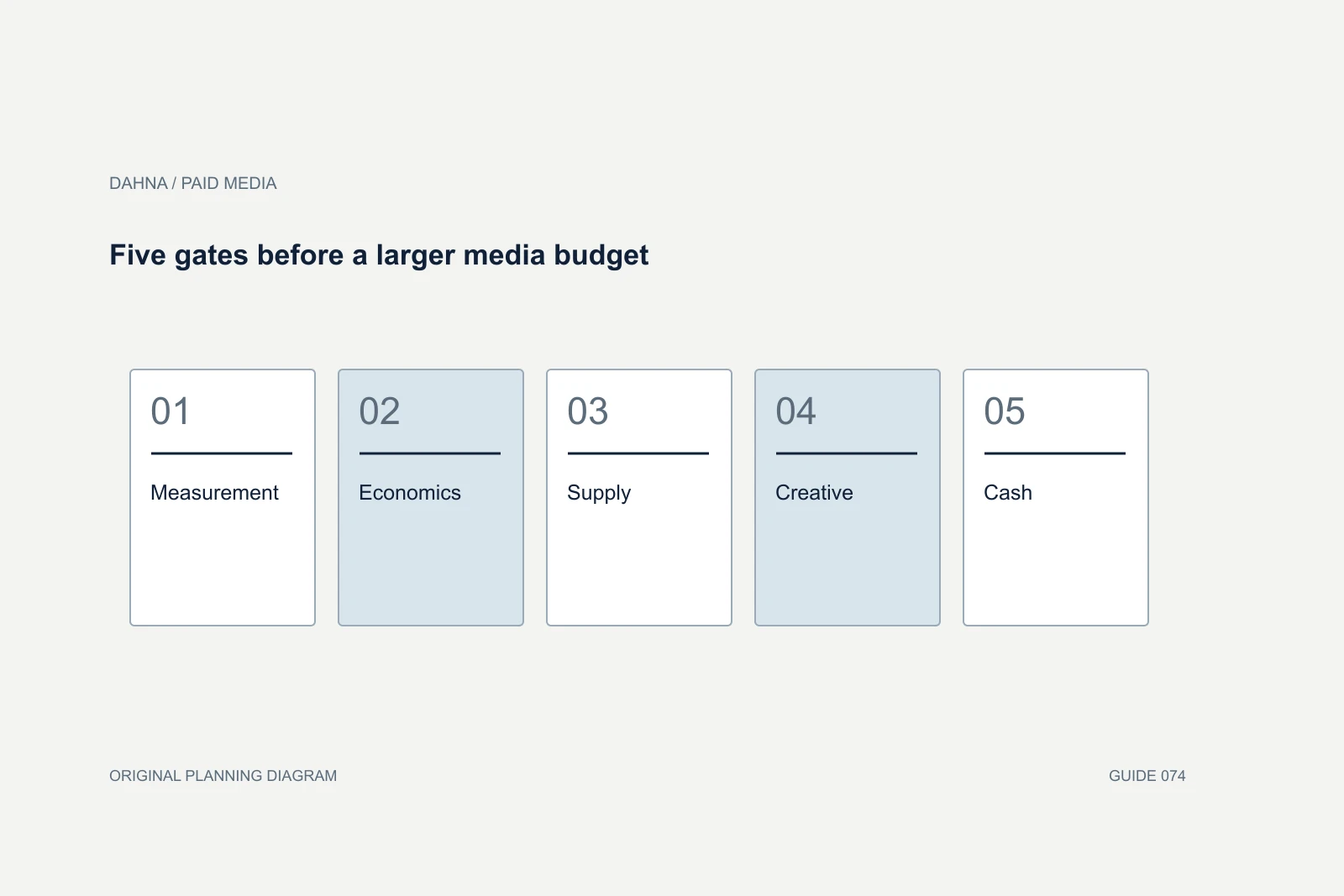
Five gates before a larger media budget
Measurement
The purchase and value definitions are understood.
Economics
The next orders have a plausible contribution range.
Supply
Stock and replenishment can support the test.
Creative
Fresh useful messages can be produced.
Cash
The owner accepts the timing and downside exposure.
Turn the scenario into a reversible operating choice
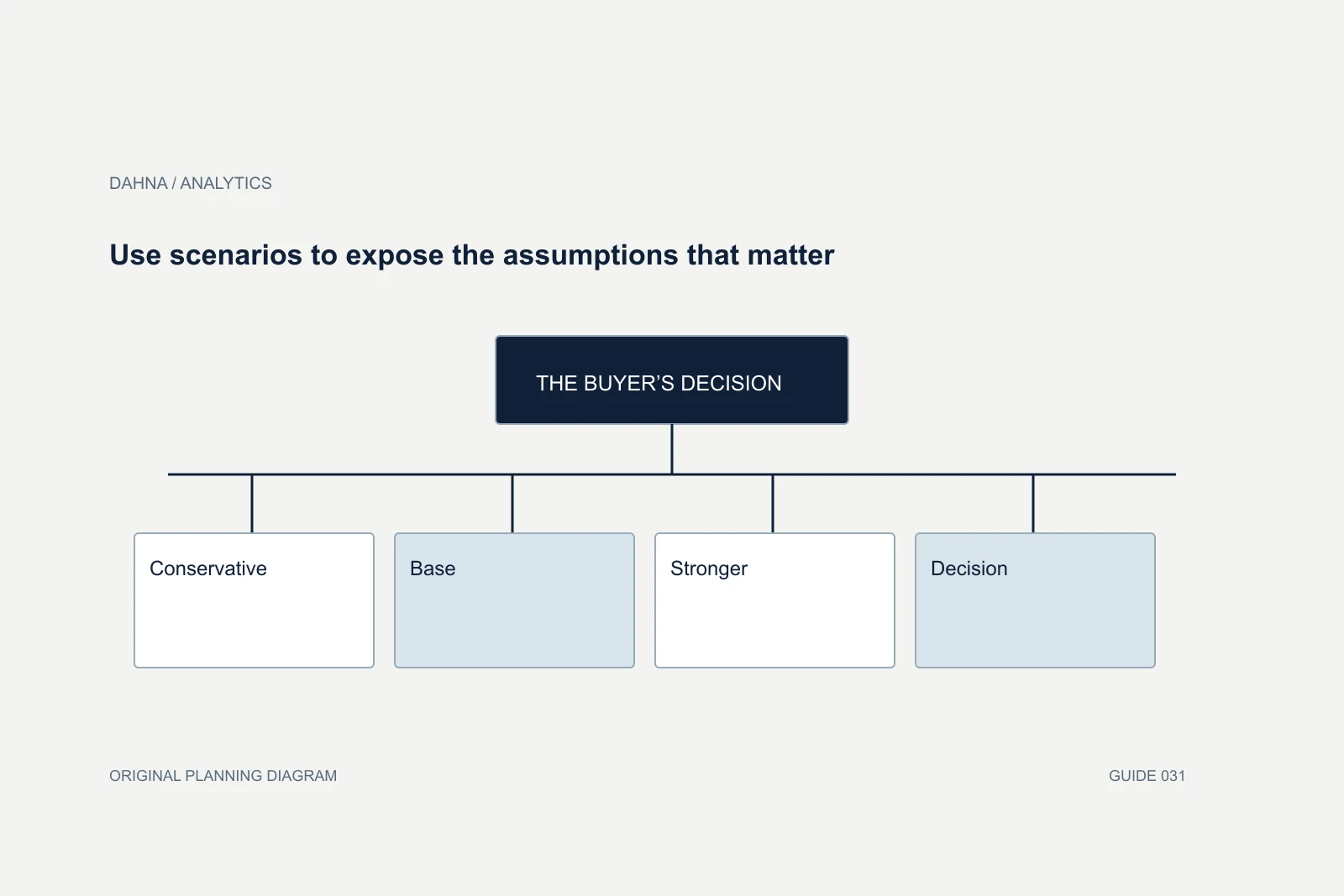
Using the fictional $3,000 increase above, suppose the brand has only 130 additional units available before replenishment. The high-response case would exceed that capacity if each order required one unit. The team can reduce the test allowance, shift the promoted assortment or wait for stock. Choosing a smaller increase is not a lack of ambition; it makes the decision consistent with what the business can deliver.
Set the review conditions before launch. Examples include contribution falling below the approved floor, an unexpected rise in cancellations, a stock buffer being reached or a measurement outage. Avoid claiming that one fixed daily percentage increase is universally safe across platforms and accounts. The appropriate pace depends on the campaign, available volume and the business’s ability to observe and absorb change.
| Constraint | Decision | Owner |
|---|---|---|
| Only 130 extra units available | Cap exposure or broaden an approved assortment | Inventory and media |
| Return rate still uncertain | Use a conservative contribution scenario | Finance/operations |
| One creative carries most delivery | Prepare another meaningful concept | Creative lead |
| US weekend coverage missing | Assign a pause/escalation contact | Brand owner |
| Reporting changed last week | Stabilize definitions before comparison | Measurement lead |
Cash can constrain a profitable-looking increase
A positive contribution estimate does not mean the brand has the cash to fund the next campaign. Inventory may be paid for well before an order, media charges can arrive before marketplace payouts, and returns can reduce receipts later. Put the expected timing beside the proposed increase. The owner should understand the maximum cash exposure if demand arrives quickly but settlement or replenishment takes longer than expected.
For a fictional brand, an extra $3,000 in ads may also require purchasing several thousand dollars of stock. If the replenishment order is shared with other channels, identify which portion is truly caused by the proposed campaign. Avoid counting the same stock commitment in several channel budgets or leaving it out of all of them. The finance or operations owner should review the cash assumptions separately from the media buyer’s delivery estimate.
A useful scaling decision can therefore be “the economics justify another test, but we will stage it around available cash and receiving dates.” That is a more precise conclusion than calling the channel unscalable or automatically increasing the budget. Revisit the constraint when the underlying timing changes, and preserve the distinction between a media-performance limit and a financing or inventory limit in the report.
What a scaling recommendation should contain
Ask the agency for the current evidence, the proposed incremental spend, the expected range, the operating limits and the conditions that would reverse the decision. The recommendation should make clear which figures are observed and which are assumptions. A single upward arrow next to a ROAS screenshot is not an adequate explanation for a cash commitment.
Bring Dahna your recent paid results, product contribution, inventory plan and creative backlog. We can connect the media proposal with those operating facts and define a reviewable next step. The goal is to expand a program the brand understands, preserving enough visibility to notice when the next dollar behaves differently from the last one.
Continue with the related decision
Use these guides when the next question goes beyond the scope of this article.
Use the editable decision sheet
Download the completed tables as a CSV, then replace the example inputs and add your evidence, owner and review date. Illustrative figures are teaching examples, not default targets.
Sources & further reading
Bring this decision to Dahna
Use this guide to prepare a focused brief. Tell Dahna what needs to change, which evidence you already have and when you need a decision.
Why consider Dahna for this work?
Dahna brings bilingual Korean and English strategy together with creator, content, and measurement work for brands growing in the US. You can review the people behind the recommendations and the kind of work we propose before starting a conversation.
Founder experience includes prior and contracted roles. Sample deliverables illustrate our approach; they are not client results or a performance promise.