When should you judge an ecommerce SEO project?
Judge an SEO project in stages. First verify that the agreed work shipped correctly. Then check whether important pages can be discovered and whether relevant search activity changes. Evaluate commercial outcomes only after considering the available data, buying cycle, and other changes in the business. A single calendar deadline cannot replace those checks.
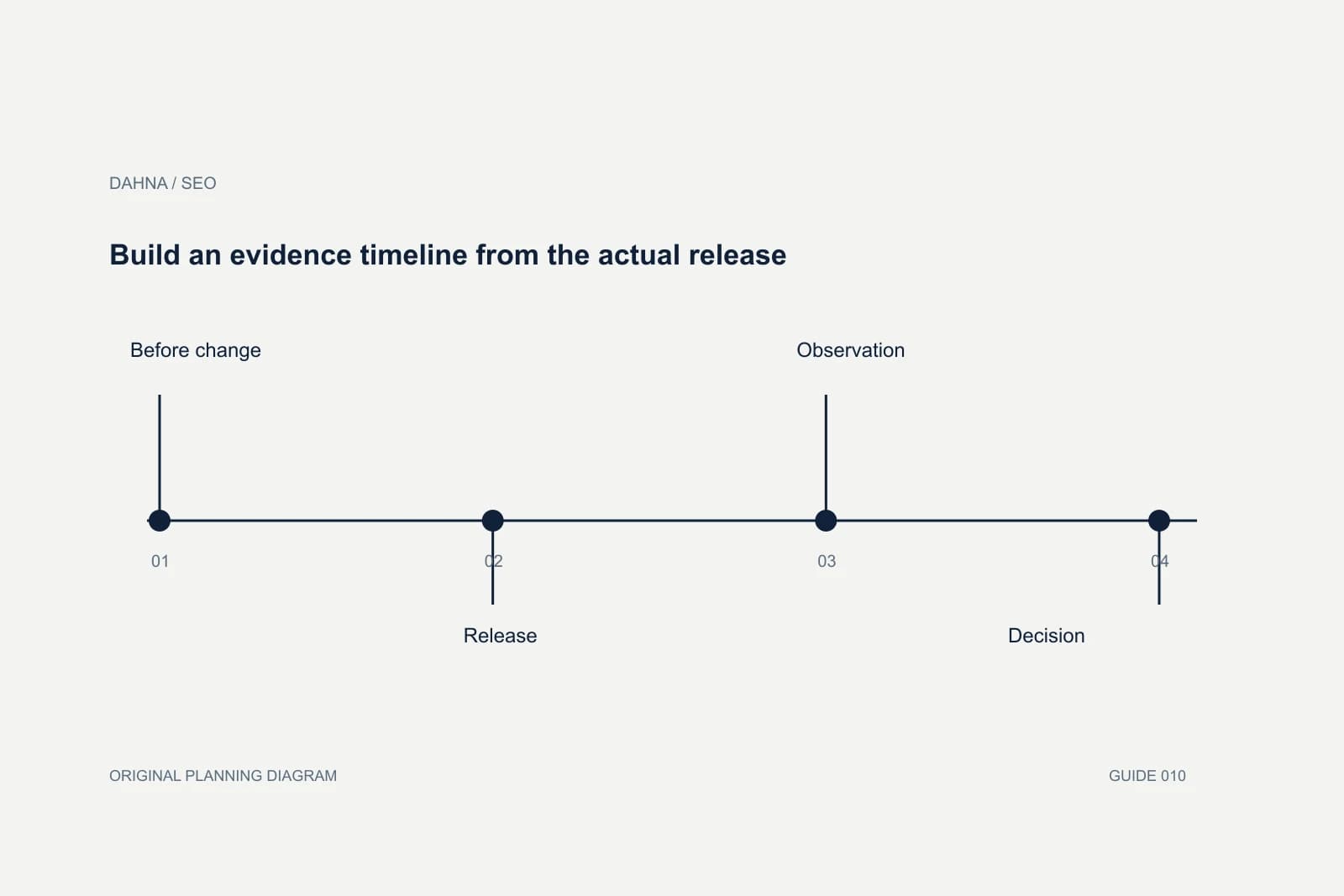
Dahna, original planning diagram
In this article
Overview
Judge an SEO project in stages. First verify that the agreed work shipped correctly. Then check whether important pages can be discovered and whether relevant search activity changes. Evaluate commercial outcomes only after considering the available data, buying cycle, and other changes in the business. A single calendar deadline cannot replace those checks.
Separate controllable delivery from uncertain outcomes
An agency can commit to an audit, a reviewed content brief, a tested technical change, and a clear report. It cannot responsibly guarantee that a particular search result will appear by a fixed date. The agreement should distinguish those categories so the brand can hold the team accountable without asking for certainty the channel does not provide.
Google’s hiring guidance recommends asking an SEO what results they expect, how long they may take, and how success will be measured. The useful version of that conversation includes assumptions: the current site condition, implementation capacity, competition, inventory, and the quality of available evidence. A timeline without assumptions is difficult to evaluate.
Use four review stages
Implementation, discovery, relevant demand, and business value are related but different. A content project cannot be judged fairly as if all articles had been live since the contract started. A technical project should not be excused indefinitely if agreed fixes have not actually shipped. Record the completion date for each meaningful change.
The table below is a review sequence, not a forecast of how long Google will take. Some problems become visible immediately, while commercial evidence can take longer or remain inconclusive in a small sample. Define what the team will do when a stage fails instead of waiting passively for the next report.
| Stage | Evidence | Decision |
|---|---|---|
| Delivery | Approved work is live and verified | Accept implementation or correct defects |
| Discovery | Relevant pages are accessible and observed by search tools | Investigate access, indexing or page-purpose issues |
| Relevant demand | Useful queries and target-market visits show a meaningful pattern | Continue, refine intent or investigate changes |
| Commercial value | Customer actions and business outcomes are understood | Adjust scope or investment with the brand owner |
Agree on the comparison before reviewing the result
Capture a baseline for the pages and market being worked on. Separate brand-name demand from nonbrand discovery, and keep US observations visible when the US is the primary market. Record promotions, outages, major product launches, and measurement changes. These can affect the same metrics the SEO report uses.
Compare complete periods of equal length and consider seasonality where the business has enough history. A partial month compared with a full month can create an avoidable false alarm. A new page with no historical counterpart needs a different interpretation from an established page with several years of demand.
Build an evidence timeline from the actual release
Before change
Save the baseline and assumptions.
Release
Record what shipped and verify it.
Observation
Check discovery and relevant customer activity.
Decision
Continue, refine, or stop a defined workstream.
A disappointing chart should produce a diagnosis
Google’s traffic-drop guidance separates possible technical, algorithmic, seasonal, and other causes. Use that as a reminder to investigate before assigning blame. If all channels fell after a stockout, a search-only explanation is incomplete. If one template lost access after a deployment, more article production is unlikely to solve the immediate issue.
Ask the agency to state the leading explanation, the evidence supporting it, the evidence against it, and the next check. “SEO takes time” is not a diagnosis. Neither is “the algorithm changed” without a matching pattern and review. The team should be able to say that a cause remains unresolved when the evidence is insufficient.
Illustrative review at two checkpoints
Imagine a skincare brand commissions repairs to product discovery and four substantial buying guides. At the first checkpoint, three guides are live, one awaits product approval, and a developer change has not shipped. The correct conclusion is that delivery is incomplete. It would be misleading to call the whole program successful or unsuccessful based on traffic since the kickoff date.
At a later checkpoint, all work is live and verified. The new guides receive relevant US visits, but the sample of orders is small. One product is out of stock for half the observation period. The team can report evidence of relevant discovery while stating that commercial impact is still uncertain. It can also prioritize fixing the stock-related buying path rather than celebrating impressions alone.
This scenario is fictional. Its purpose is to show what a candid report sounds like: specific progress, explicit limits, and a next decision. The same discipline applies when the numbers look strong. A promotion or a creator campaign may have increased brand search at the same time as the SEO work.
Decide whether to continue a workstream, not merely a contract
A brand may continue technical maintenance while pausing new content, or expand a successful product cluster while deferring a broad topic. Break the retainer into understandable workstreams so the decision is not all-or-nothing. Ask what the next increment of spending will accomplish and which uncertainty it is intended to resolve.
If implementation has repeatedly stalled, the bottleneck may be access or internal approval rather than strategy. If pages are accessible but serve weak buyer needs, the content direction may need to change. If relevant visits arrive but the offer disappoints, website and product work may deserve more attention than publishing volume.
| Pattern | Useful response |
|---|---|
| Agreed changes repeatedly remain unshipped | Resolve ownership, access and implementation capacity |
| Pages work but target weak buyer questions | Revise the intent map before producing more |
| Relevant visitors encounter buying friction | Coordinate conversion and product presentation work |
| Positive early signals but little commercial data | Continue a bounded observation period with stated limits |
| Workstream lacks a plausible next contribution | Reduce or stop that workstream rather than filling activity quotas |
Separate waiting for evidence from waiting for implementation
A review schedule should show the dependency that currently limits learning. If a collection-page fix is awaiting a developer, the next action is an implementation decision. If the fix is live but has little observed exposure, the next action is a discovery check. If relevant visits are arriving but orders are sparse, the next action may be a longer bounded commercial observation or a buying-path review.
Give each unresolved item a date for the next useful check and a named owner. That prevents “too early to tell” from becoming an indefinite status. It also protects the agency from being judged on work the brand has not yet approved or implemented.
At the review meeting, ask what new information became available since the previous checkpoint. If the answer is only another week of the same incomplete data, reconsider whether the current report is the right instrument. A focused customer interview, technical test, or product-page inspection may resolve the uncertainty more efficiently than another chart.
Ask Dahna for a decision-oriented review
Bring the original scope, actual release dates, reporting exports, and relevant business changes. Dahna can help separate delivery problems from discovery, demand, and conversion questions, then define the next useful work. The report should make it possible for the owner to approve, change, or stop a specific activity.
The goal is an accountable relationship in which progress can be inspected. A credible agency earns continued investment through clear reasoning and useful work, not through an indefinite request to wait or a promise of guaranteed rankings.
Continue with the related decision
Use these guides when the next question goes beyond the scope of this article.
Use the editable decision sheet
Download the completed tables as a CSV, then replace the example inputs and add your evidence, owner and review date. Illustrative figures are teaching examples, not default targets.
Sources & further reading
Bring this decision to Dahna
Use this guide to prepare a focused brief. Tell Dahna what needs to change, which evidence you already have and when you need a decision.
Why consider Dahna for this work?
Dahna brings bilingual Korean and English strategy together with creator, content, and measurement work for brands growing in the US. You can review the people behind the recommendations and the kind of work we propose before starting a conversation.
Founder experience includes prior and contracted roles. Sample deliverables illustrate our approach; they are not client results or a performance promise.