How to test an international brand name with US customers
Test an international brand name for recognition, pronunciation, meaning and the ability to find it again. A name does not need to sound American to work in the US; the useful question is whether the intended audience can understand and use it with the explanation the brand plans to provide.
Dahna, original planning diagram
In this article
Overview
Test an international brand name for recognition, pronunciation, meaning and the ability to find it again. A name does not need to sound American to work in the US; the useful question is whether the intended audience can understand and use it with the explanation the brand plans to provide.
Define what the test is allowed to change
Start by deciding whether you are testing a new name, an existing name’s presentation or the explanation around it. An established Korean or European name may carry valuable history and recognition. The project should not assume that unfamiliarity requires replacement. Sometimes pronunciation guidance or a plain category descriptor solves the practical problem.
Record the business decision the study will inform. Options might include retaining the name unchanged, adjusting its visual spacing, adding a descriptor or investigating new candidates. This prevents a research session from becoming an open-ended popularity contest in which every participant invents a different brand.
Sulwhasoo shows how a name can carry a story
In Amorepacific’s interview with GaYoon Jung, Sulwhasoo’s origin is connected to the idea of a flower blooming in snow. The example illustrates that a name can carry a cultural and symbolic explanation. It does not tell us how every US customer pronounces or interprets it.
For your brand, decide how much explanation a customer needs at each touchpoint. A product card may need a simple descriptor, while an about page can tell a richer story. Do not force the full origin narrative into every caption. Test whether the short version helps a new customer remember and find the brand.
Test reading, hearing and searching separately
Show the written name without coaching and ask how the participant would say it. Then play an approved pronunciation and ask how they would spell or search for it. These are different tasks. A name can be easy to read but difficult to reconstruct after hearing it in a creator video.
Ask what category or qualities the name suggests before revealing the brand story. Record unexpected associations without treating one person’s reaction as a universal cultural fact. Use qualified language and cultural reviewers for sensitive concerns, and sample the audiences that matter rather than assuming the US is one homogeneous group.
| Task | Prompt | Decision it can inform |
|---|---|---|
| Read | How would you say this name? | Pronunciation guidance or presentation |
| Hear | How would you search for the brand you heard? | Audio delivery and spelling support |
| Interpret | What would you expect this company to sell? | Need for a category descriptor |
| Recall | What name do you remember after another task? | Memorability under the study conditions |
| Explain | What does the short story tell you? | Clarity and relevance of the origin explanation |
Worked example: a name remembered but spelled three ways
Imagine a fictional Korean skincare brand whose name participants can pronounce after hearing it once, but spell in several ways. The team should not immediately conclude the name has failed. It examines the proposed video end card, profile name and product packaging to see whether the written form is available when customers need it.
The next test adds a clear name card and a short spoken spelling cue in a creator introduction. If the task becomes easier, presentation may be the appropriate intervention. This is an illustrative research sequence, not a result from a real brand. It keeps the decision tied to observable customer behavior rather than a founder’s fear that the name sounds too foreign.
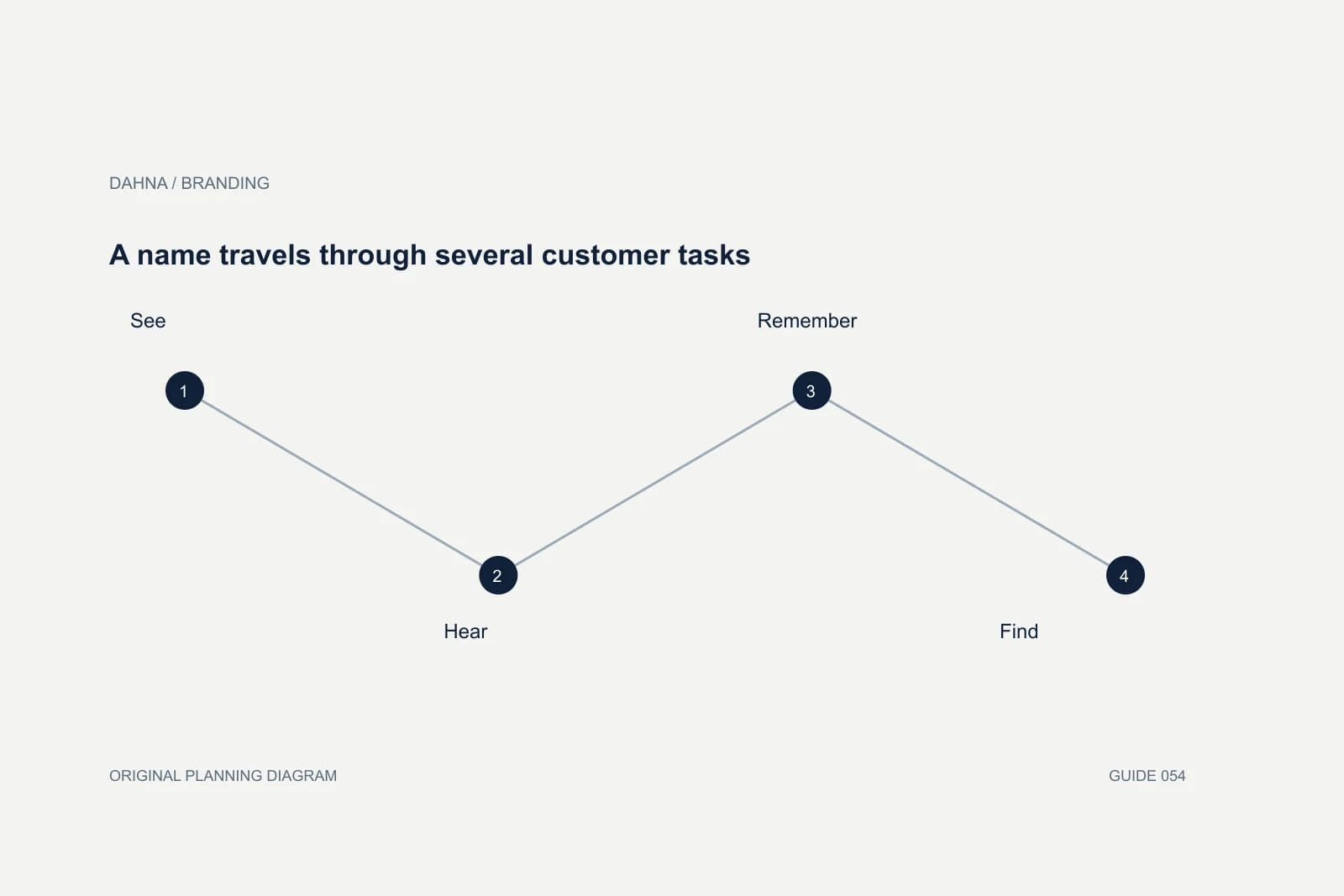
A name travels through several customer tasks
See
Read the written form
Hear
Understand the spoken name
Remember
Retain it after a distraction
Find
Reach the intended brand again
Recruit beyond colleagues and existing fans
Employees already know the correct pronunciation and backstory. Existing fans may have learned them through repeated exposure. Include unfamiliar people who resemble prospective customers, and keep existing-customer feedback separate. If the name will be spoken by creators, test it with people who will actually use it in that context.
Small sessions can reveal practical problems, but do not report their results as a national preference estimate. Document the number and type of participants, the order of tasks and what information they received. A name shown beside beautiful packaging may receive different reactions from the same name in plain text; both contexts can be useful if you know which question each answers.
Keep audience testing separate from clearance
A name that customers understand may still raise trademark, domain or other commercial issues. Have qualified specialists perform the relevant checks. Availability of a social handle or a quick search result is not a complete clearance process. The agency should record those dependencies without claiming the research resolves them.
Likewise, a spelling change can affect established URLs, retail records and existing recognition. Do not alter public routes or historical product identifiers casually. If the decision is to change a name, create a separate implementation plan that preserves customer access and explains the transition accurately.
Test the name inside the formats that will introduce it
A plain-text name test is useful, but it does not represent every encounter. Test the name in a creator’s spoken introduction, a mobile product card, a social profile and a small package label. A spacing or typography choice can make letters easier or harder to distinguish, while a rushed spoken line can create confusion that is absent in print.
Keep the underlying name constant when comparing presentation options. Otherwise the team may not know whether a better result came from the name, the descriptor or the design. Ask participants to find the brand again after a short unrelated task using the information they would realistically have. Observe the process rather than coaching them toward the intended spelling.
For a name with cultural meaning, verify the explanation with people qualified to assess that language and context. The US audience test can reveal comprehension, but it should not become an authority on what the original name truly means. Preserve the distinction between the brand’s intended story, linguistic accuracy and customer interpretation. This gives an international team a respectful way to improve introduction and recall without treating cultural difference itself as a defect to remove.
Deliver a decision, not a pile of reactions
The final report should show task observations, recurring patterns, important exceptions and the recommended next step. Include candidate presentation changes and what remains uncertain. Keep direct participant quotations consented and anonymized. The most useful conclusion may be that the name is workable with clearer presentation.
Dahna can connect this research to US-facing copy, creator pronunciation guidance and ecommerce presentation. Bring the name’s intended meaning, the markets where it is established and the formats where new customers encounter it. That creates a respectful, practical test of how the brand can introduce itself clearly.
Continue with the related decision
Use these guides when the next question goes beyond the scope of this article.
Use the editable decision sheet
Download the completed tables as a CSV, then replace the example inputs and add your evidence, owner and review date. Illustrative figures are teaching examples, not default targets.
Sources & further reading
Bring this decision to Dahna
Use this guide to prepare a focused brief. Tell Dahna what needs to change, which evidence you already have and when you need a decision.
Why consider Dahna for this work?
Dahna brings bilingual Korean and English strategy together with creator, content, and measurement work for brands growing in the US. You can review the people behind the recommendations and the kind of work we propose before starting a conversation.
Founder experience includes prior and contracted roles. Sample deliverables illustrate our approach; they are not client results or a performance promise.