How to write a fair cross-brand product comparison
Choose the buyer decision, compare the exact products under the same criteria, and make the brand’s commercial interest clear. Separate verified specifications from hands-on observations and from interpretation. A comparison is useful when it explains who each option may suit and what the evidence cannot establish.
Dahna, original planning diagram
In this article
Overview
Choose the buyer decision, compare the exact products under the same criteria, and make the brand’s commercial interest clear. Separate verified specifications from hands-on observations and from interpretation. A comparison is useful when it explains who each option may suit and what the evidence cannot establish.
Pick a decision narrower than “which is best?”
A shopper may be choosing between a travel-size set and a full-size routine, two device formats, or two refill systems. Those choices involve different criteria. A single universal score often hides the tradeoffs that matter to the actual buyer. State the use case, market, and budget context before building the table.
Use exact product names, versions, and quantities. If one item is a bundle and another is a single product, explain that difference before comparing price. If a competitor changes the product after publication, the page needs a review trigger. A fair comparison is an ongoing factual responsibility, not a one-time promotional asset.
Google’s review guidance favors evidence and useful distinctions
Google’s high-quality review guidance emphasizes the user’s perspective, evidence of relevant experience, meaningful measurements where available, and explanations of advantages and drawbacks. For a brand-authored comparison, that means avoiding the appearance of an independent laboratory review when the work is only a desk comparison of public specifications.
Name the method plainly. “We compared the manufacturers’ published specifications on this date” is different from “we tested both products.” If the team has not used the products, do not imply that it has. The reader should understand the basis of every important comparison before reaching the recommendation.
Use the same evidence standard for both sides
Create criteria before filling in the brand column. Otherwise it is easy to choose only the fields that make the sponsor look favorable. Include the attributes that could reasonably lead a customer to prefer the other option. That honesty makes the page more useful and prevents a table from becoming a decorative sales pitch.
For claims requiring specialist interpretation, cite the exact supporting material and retain its limits. A feature difference does not automatically prove a better outcome. A larger number on a specification sheet can matter, but the article must explain why it matters to this decision rather than treating every larger number as a win.
| Criterion | Product A evidence | Product B evidence | Permitted conclusion |
|---|---|---|---|
| Included quantity | Current manufacturer page | Current manufacturer page | A factual quantity comparison |
| Compatibility | Approved compatibility documentation | Approved compatibility documentation | Which specified accessories fit |
| Ease of setup | Observed under a documented protocol | Same protocol if tested | A bounded observation, not universal ease |
| Performance claim | Relevant study and conditions | Comparable evidence if available | Only what the evidence actually supports |
| Price | Same market and observation date | Same market and observation date | A dated offer comparison |
Make ownership and relationships obvious
The FTC’s endorsement and review guidance addresses truthful representation and material relationships. A brand’s own comparison should not masquerade as an independent review site. Clearly identify the publisher and explain any sponsorship, affiliate relationship, or product access arrangement that affects how a reader should interpret the page.
When a claim raises a legal or scientific question, involve the relevant qualified reviewer. The editorial team can improve clarity and source alignment, but that is not equivalent to legal clearance or clinical validation. Record the review that actually occurred and avoid a vague “expert approved” badge.
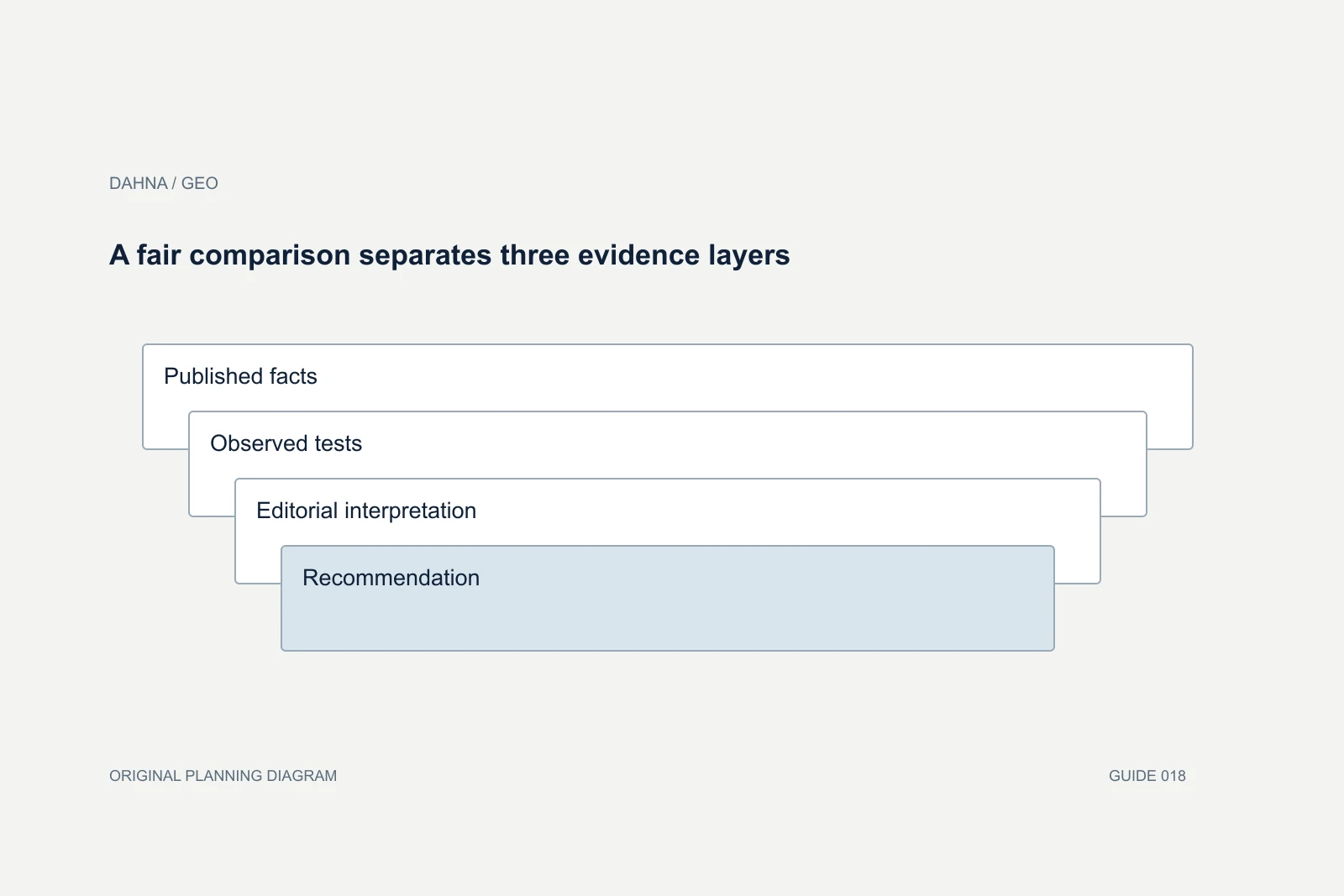
A fair comparison separates three evidence layers
Published facts
Specifications and offers with dated sources.
Observed tests
What was actually done under a stated method.
Editorial interpretation
The tradeoff inferred for a particular buyer.
Recommendation
A conditional choice with visible limitations.
Illustrative comparison of two discovery sets
Imagine a fragrance brand comparing its discovery set with a competitor’s. The brand’s set contains six smaller samples; the competitor’s contains four larger samples. A fair table shows the count and total volume rather than declaring six automatically better than four. It also explains redemption conditions if either purchase includes a later credit.
The writer has not tested longevity or scent preference, so the article does not score those qualities. It can still offer useful decision guidance: one set may suit someone who wants to sample more compositions, while another may suit someone who wants more wears from fewer options. Prices are recorded for the same market and date.
The example is fictional. It shows how a brand can advocate for its own offer without pretending every buyer should choose it. The strongest recommendation is often conditional: choose this if this particular tradeoff matters to you.
Review the table as products change
Assign an owner to check important offer and version changes. Keep a dated source record so a reviewer can reconstruct why the comparison said what it did. If a fact becomes uncertain, mark it for review rather than leaving a confident but unsupported statement live.
Also inspect the comparison’s customer journey. Links should lead to the exact products or sources described, and the brand’s call to action should fit the stated recommendation. A page that acknowledges a competitor’s advantage but silently links that name to the sponsor’s product breaks the reader’s trust.
| Check | Passing evidence |
|---|---|
| Same decision | Criteria match a defined buyer use case |
| Exact items | Versions, quantities and markets are clear |
| Consistent standard | Both sides use comparable evidence |
| Honest method | Desk research and testing are distinguished |
| Commercial context | Publisher and relevant relationships are visible |
| Maintenance | Source dates and review triggers are recorded |
Decide what to do when comparable evidence is unavailable
A competitor may publish a specification that your brand does not, or your brand may have a study whose conditions differ from the competitor’s study. Do not fill the empty cell with a negative judgment. “Not found in the public materials reviewed” describes the evidence access; “does not have this capability” is a stronger product claim that may be unsupported.
Use separate rows for published specifications and observed tests. If both products were not tested under the same method, avoid presenting the results as a controlled head-to-head comparison. A reader should not have to infer that one column comes from a laboratory report and the other from marketing copy.
When a missing fact is important, seek clarification through an appropriate channel or narrow the comparison to what can be verified. The page can still help a buyer understand which questions to ask before purchasing. A fair “unknown” is more informative than a fabricated score.
Also define the update trigger when a product changes. If the competitor launches a new version, retain the exact version previously reviewed and decide whether a new comparison is justified. Do not silently replace the product name while leaving old evidence in place. That turns a once-accurate comparison into an unsupported claim about a different item.
What to ask Dahna to produce
Dahna can help define the buyer question, build a source-backed comparison matrix, and turn it into a readable page with useful tables and diagrams. Bring the approved facts for your product and the named alternatives customers already consider. The scope should identify any hands-on testing or specialist review that requires additional work.
The result should be a resource worth reading even before the visitor decides which brand to buy. That is a stronger foundation for search and AI-assisted discovery than a page that declares a winner before presenting evidence.
Continue with the related decision
Use these guides when the next question goes beyond the scope of this article.
Use the editable decision sheet
Download the completed tables as a CSV, then replace the example inputs and add your evidence, owner and review date. Illustrative figures are teaching examples, not default targets.
Sources & further reading
Bring this decision to Dahna
Use this guide to prepare a focused brief. Tell Dahna what needs to change, which evidence you already have and when you need a decision.
Why consider Dahna for this work?
Dahna brings bilingual Korean and English strategy together with creator, content, and measurement work for brands growing in the US. You can review the people behind the recommendations and the kind of work we propose before starting a conversation.
Founder experience includes prior and contracted roles. Sample deliverables illustrate our approach; they are not client results or a performance promise.