What should a Shopify website proposal include?
A useful Shopify proposal explains what the team will build, what your brand must supply, how the work will be checked and what happens after launch. The number of pages and the visual concept are only part of that agreement.
Dahna, original planning diagram
In this article
Overview
A useful Shopify proposal explains what the team will build, what your brand must supply, how the work will be checked and what happens after launch. The number of pages and the visual concept are only part of that agreement.
The decision in context
Before comparing prices, give each provider the same product range, customer tasks and operating requirements. A lower quote may cover a smaller job; a higher quote may include work you do not need. The point is to make the difference visible before the project begins.
Separate templates from the content that fills them
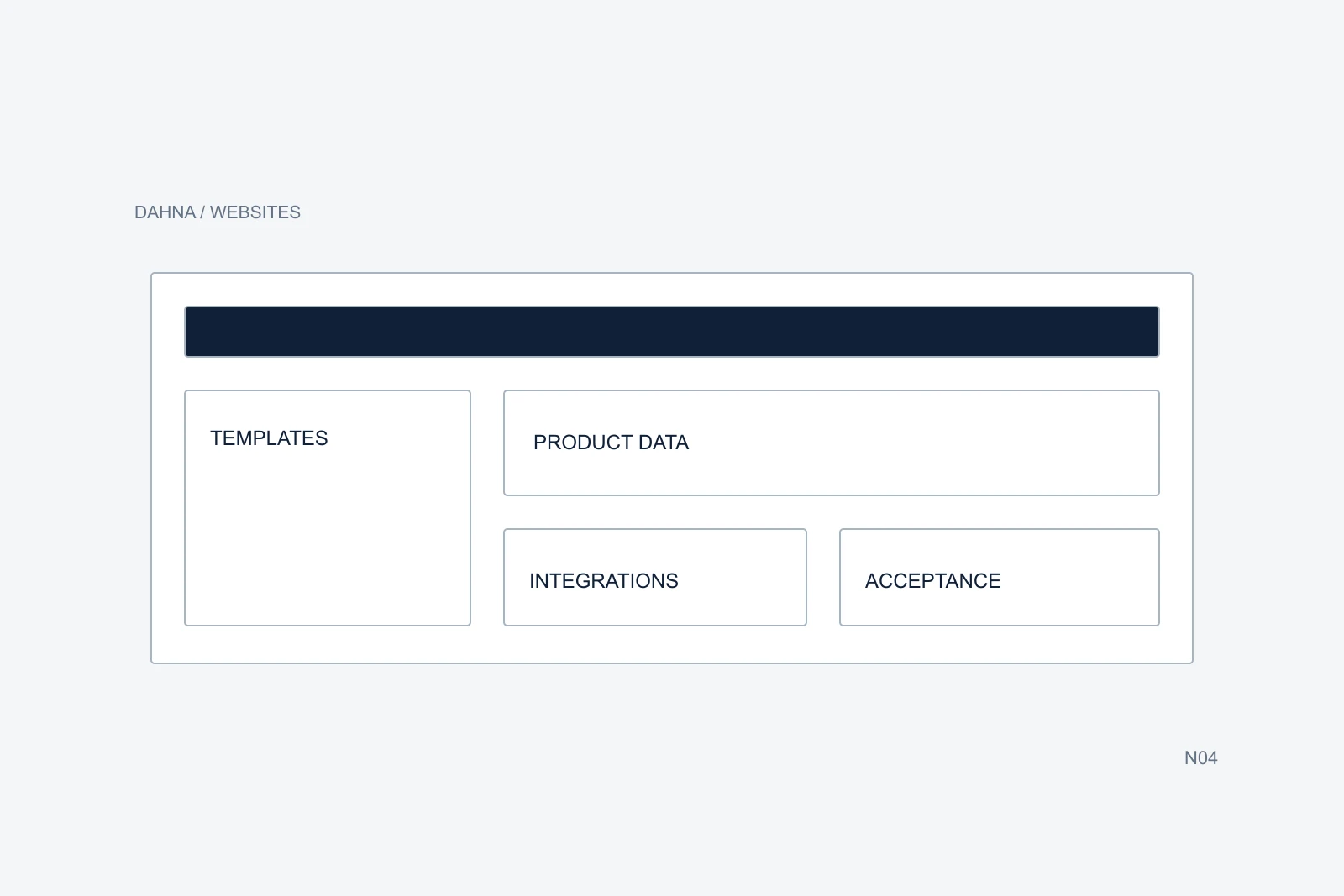
A proposal for ten pages can mean ten unique designs or ten pages using one reusable template. Those are different amounts of design and implementation work. Ask which layouts are included, how many variants they support and who enters the product information.
For an ecommerce store, list the actual buying paths: product page, collection, cart, search, account and relevant informational pages. Identify unusual requirements such as bundles, subscriptions, device kits or market-specific product versions. Do not assume a theme demonstration proves that every required combination will work in your store.
Content migration deserves its own line. Product names, variant relationships, images, instructions and existing URLs may need careful handling. A proposal that excludes data preparation may still be appropriate, but the brand needs an owner and budget for that work.
| Deliverable | Quantity or scope | Acceptance question |
|---|---|---|
| Product template | One template supporting the agreed variants and kit information | Can a shopper identify, select and buy the correct item? |
| Collection experience | Named collections and a defined comparison need | Can a new shopper find the relevant product? |
| Catalog preparation | Agreed SKU and asset list | Are names, variants, images and market facts accurate? |
| Supporting information | Delivery, returns, contact and approved product guidance | Can customers find the facts needed to commit? |
| Migration | Existing destination inventory and approved handling | Do established links and intended canonicals still work? |
Write requirements as behaviors you can test
Replace “mobile optimized” with a task-based check. For example, a shopper can choose the relevant size on a phone, see the correct price, add it to the cart and confirm the selected variant before payment. The design should also handle unavailable stock and meaningful error states.
Do the same for internal work. Can your team update product instructions without editing code? Can it add an approved image, change a collection description or correct a stock message without breaking the layout? A store that looks finished but cannot be maintained creates ongoing cost.
Record the browsers, device sizes and market settings that matter. Avoid a vague promise to support every possible environment. The goal is a clear, reasonable verification scope tied to the people and tasks your store serves.
A requirement becomes useful when it can be checked
Customer task
Choose the correct device kit on mobile.
Required behavior
Contents, price, variant and stock remain consistent.
Acceptance check
Complete the agreed test path and inspect the order.
Maintenance
The brand can update the approved facts afterward.
Ask who owns integrations and recurring costs
List the applications and services that the proposal assumes: reviews, subscriptions, email, fulfillment, analytics, product feeds and any custom integration. For each, identify the account owner, recurring charge, setup responsibility and support boundary. An attractive project price can conceal a difficult ongoing operating model.
Shopify collaborator accounts let a merchant review partner access and permissions. Use that kind of scoped access instead of treating a shared owner login as the default working arrangement. Ask who retains access after launch and how it can be removed when the engagement ends.
An integration is not complete because a connection screen says “connected.” Define the business action it must support: an order reaches the right fulfillment process, an inventory change updates the intended destination, or an approved event appears with the correct values. Test the relevant handoff.
A fictional comparison of two proposals
Imagine one provider offers a theme refresh, two templates and a handoff session. Another includes catalog preparation, a variant-selection repair, measurement validation and a launch check. Comparing only their headline prices would miss the difference in responsibility.
Normalize the scope before negotiating. Ask the first provider to quote the missing work or confirm that your team will own it. Ask the second to separate optional work from the essential buying path. The result may still favor either provider, but the decision will be based on a comparable project.
Avoid assuming that a longer proposal is more complete. A concise proposal can be clear if it names the deliverables, exclusions and acceptance criteria. A long document can remain vague if every difficult task is described as “optimization.”
| Workstream | Proposal A | Proposal B | Decision before signing |
|---|---|---|---|
| Templates | Two named templates | Two named templates | Confirm actual variant and kit requirements |
| Catalog preparation | Brand supplies final content | Provider prepares agreed SKU set for approval | Assign the work and approval owner |
| Tracking validation | Not included | Agreed purchase/refund checks | Add scope or give it a separate owner |
| Launch | Theme publication | Publication plus defined route/order checks | Specify the acceptance procedure |
| Maintenance | One handoff session | Handoff plus a defined support period | Compare response scope and exclusions |
Protect search destinations and measurement during the project
Inventory existing destinations before changing the information architecture. Public URLs may be linked from search results, ads, creator content, packaging and retailer materials. Decide how each will be handled before implementation. A prettier page does not compensate for sending customers to the wrong product.
Google’s ecommerce guidance provides a reference for crawlable site structure and product information. Ask the provider to identify the technical checks relevant to the project rather than simply promising an “SEO-ready” website. Visible content, canonical destinations and structured data should agree.
Measurement also needs an owner. Record the baseline, the changes being made and the tests that will verify the agreed events. After launch, annotate the release so later reports do not quietly compare periods with different collection behavior.
Agree what happens when the brief changes
A website project often reveals missing assets or an operating requirement that was not in the original brief. Agree how the team will describe the change, estimate its effect and obtain the appropriate decision. The goal is to keep scope visible, not to make every useful conversation feel like a dispute.
Specify review rounds and who consolidates feedback. A designer should not receive conflicting instructions from several stakeholders with no decision owner. Likewise, the brand should know which choices are still open and which have already been approved for implementation.
Keep approval tied to the actual deliverable. A visual concept approval is not acceptance of a working checkout. A content approval is not a claim that the tracking implementation is correct. Separate those milestones so everyone knows what remains to be checked.
| Milestone | Who should decide | What the decision covers |
|---|---|---|
| Product facts | Brand product owner | Accuracy and substantiation |
| Design direction | Named brand decision-maker | Visual and interaction direction |
| Functional release | Implementation and brand operations owners | Agreed tasks and integrations |
| Measurement | Responsible analyst or implementation owner | Defined events and values |
| Final handoff | Brand project owner | Documentation, access and outstanding items |
What Dahna should leave your team able to do
A useful handoff includes the working store, access inventory, content-editing instructions and a record of known limitations. It should also identify which subscriptions and support responsibilities remain with the brand. The team should not need to rediscover those details after the first problem.
Dahna can connect product explanation, design, content and the launch path within a scoped website project. Bring your catalog, the task your current store cannot support and any proposals you are comparing. The first step is to make the deliverables and dependencies clear enough that the finished work can be accepted with confidence.
Use this guide in your next brief
Download the tables from this guide as a working reference. Keep the example assumptions separate from your own figures, and record the source and date of any numbers you replace.
Sources & further reading
Plan your next website development decision
Share your catalog, current store, required buying tasks and any proposals. Identify the product, design and operations owners who can approve the work.
Why consider Dahna for this work?
Dahna brings bilingual Korean and English strategy together with creator, content, and measurement work for brands growing in the US. You can review the people behind the recommendations and the kind of work we propose before starting a conversation.
Founder experience includes prior and contracted roles. Sample deliverables illustrate our approach; they are not client results or a performance promise.
External examples are research references, not Dahna client results or promised outcomes.