How should a brand choose music for TikTok content?
Choose music after identifying how the content will be used: brand organic posting, creator posting, paid amplification or reuse elsewhere. A sound that appears in the app is not automatically cleared for every commercial use. Keep the permission record with the asset, verify the relevant market and placement, and prepare an alternate version when the campaign’s intended use exceeds the available music rights.
Dahna, original planning diagram
In this article
Overview
Choose music after identifying how the content will be used: brand organic posting, creator posting, paid amplification or reuse elsewhere. A sound that appears in the app is not automatically cleared for every commercial use. Keep the permission record with the asset, verify the relevant market and placement, and prepare an alternate version when the campaign’s intended use exceeds the available music rights.
Define the intended uses before the editor picks a track
List where the video will appear and whether it might later become an ad. Include the market, account, campaign period and any reuse on a website, another social platform or a retailer page. The editor needs that context before building a cut around a sound. Otherwise a promising organic version may need substantial rework when the media team asks to promote it.
Separate the music from the spoken performance and other audio. A creator can agree to the brand’s use of their video while lacking the ability to grant every soundtrack right the brand needs. Likewise, buying a production package does not automatically explain who selected and licensed each embedded element. Ask for the supporting record as part of delivery rather than after publication.
| Planned use | Question to resolve | Record to retain |
|---|---|---|
| Brand organic TikTok post | Is the sound permitted for this commercial post? | Track identity and applicable terms |
| Creator post for a brand | Does the commercial arrangement fit the sound’s permission? | Creator/brand confirmation and source |
| Paid TikTok amplification | Does permission cover the placement and market? | Paid-use evidence |
| Reuse outside TikTok | Is separate clearance required? | Destination-specific permission |
| Edited or alternate version | Does the change affect the approved use? | Version and approval record |
Use the Commercial Music Library with its actual scope
TikTok’s Commercial Music Library guidance tells businesses to select the campaign region and filter for usable placements. It describes music for organic and paid TikTok content within the applicable framework. Use that as a starting point, then verify the actual track and intended use. Do not summarize it as unlimited music rights for every platform and every future campaign.
Save the track name or identifier, source, date checked and the use being approved. If the interface or availability changes, the record helps the team understand the original decision. Avoid relying only on a downloaded filename such as “trending_audio_final.” A rights record should be understandable to someone who did not edit the video and may need to respond months later.
e.l.f. shows that original music is a distinct production choice
e.l.f. Beauty’s 2023 announcement describes its original Spanish-language collaboration with Manuel Turizo, developed with Madwell, and names Kory Marchisotto in discussing the campaign. This is an example of a brand commissioning music as part of a broader creative idea. It does not grant another business permission to use that song.
A smaller brand does not need a celebrity collaboration to make a deliberate sound choice. It can choose an appropriately cleared library track, commission a simpler original piece or design a video around voice and product sound. The creative question is what the audio contributes to the product explanation and brand recognition, followed by whether the planned use is actually covered.
A fictional video that needs two versions
A fictional beauty brand receives a creator’s organic demonstration with a popular soundtrack. The brand wants to test it as a paid ad and later use an edit on its product page. Before spending, the team checks the soundtrack scope and finds that the evidence supplied does not cover those proposed uses. The creator’s general approval of the video is not enough to resolve that gap.
The team agrees on an alternate version using an appropriately cleared track or clean voice audio, with permission for the required edit. It keeps the original post separate from the paid-ready file and records which version belongs to which use. This costs some editing time, but it avoids having the campaign depend on a version whose permissions nobody can explain.
| Version | Use | Audio decision | Owner |
|---|---|---|---|
| Creator organic post | Original agreed post | Verify its commercial context | Creator and brand |
| Paid test version | Approved TikTok placements | Use a track with documented paid scope | Editor and media lead |
| Product-page version | Brand website | Confirm website rights or replace soundtrack | Brand content owner |
| Archive master | Future editing | Keep clean voice/product audio where agreed | Production owner |
Do not let the soundtrack obscure the answer
The music should support the demonstration without making speech hard to understand. Review the video on a phone with ordinary speakers and include accurate captions. A loud trend track can create familiarity while weakening the product explanation. If viewers need to hear a click, pump or other product sound, preserve that detail rather than covering it with an unrelated beat.
Consider how the cut works without a particular song. A video built entirely around an exact lyric or beat may be difficult to adapt if permission changes. That can be an acceptable creative tradeoff when the campaign is designed for it, but it should be intentional. For evergreen product education, a more flexible audio design can reduce the cost of later updates.
Give expiring or disputed audio a clear response path
The asset library should identify who can confirm the permission, replace the track and pause paid delivery when necessary. Set a reminder for any time-limited license. If a platform flags the sound, review the actual notice and supporting record rather than repeatedly reuploading an unchanged file. The person responding needs the specific asset and use, not a general statement that the brand “owns the video.”
For commissioned music, have the appropriate commercial or legal owner review the intended rights and deliverables. Operationally, the production team should request the versions it needs, such as an instrumental or clean master, when those are included in the agreement. This article is a workflow for buying and organizing content, not a determination that a particular license covers a disputed use.
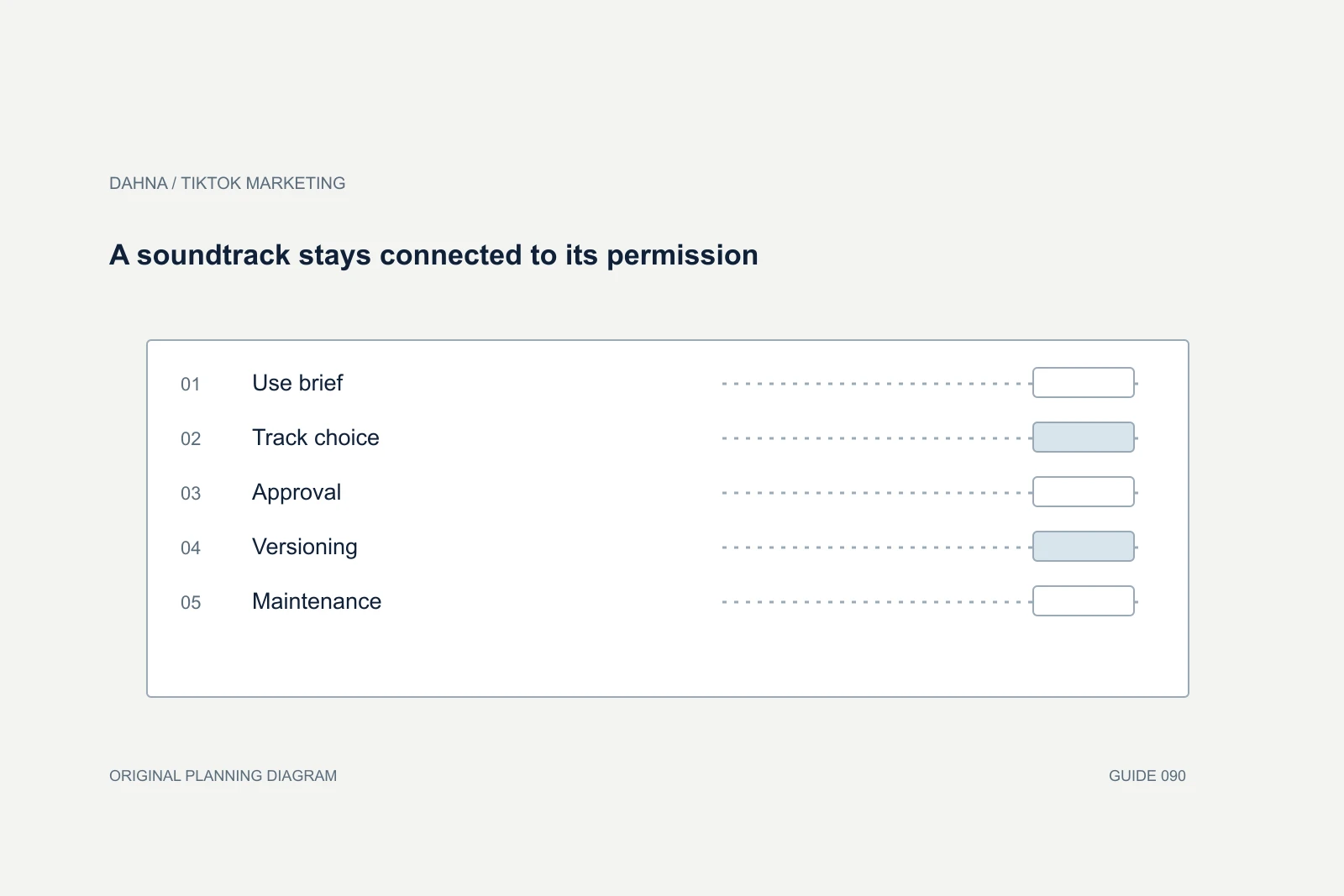
A soundtrack stays connected to its permission
Use brief
Market, account, placement and reuse.
Track choice
Creative fit and documented source.
Approval
Confirm the scope before publication.
Versioning
Keep organic, paid and external uses clear.
Maintenance
Monitor expiry, changes and platform notices.
Keep a clean master only when the agreement permits it
A clean voice or product-audio master can make future adaptation easier, but it should be requested within the production agreement. Do not assume the brand receives raw files, isolated voice tracks or permission to synthesize a new performance simply because it bought one finished video. Specify the actual deliverable and permitted edits before production.
The editor should label the approved master and each derivative version clearly. If the brand later changes the music, inspect the whole message again: a different soundtrack can alter tone, timing or the apparent meaning of a scene. The rights check and creative review belong together. This makes versioning more than file administration; it protects the product explanation and gives the next campaign a reliable asset instead of a collection of nearly identical exports with unclear permissions.
What to ask an agency to include
Bring Dahna the planned channels, creator arrangements and existing video assets. We can help build an audio workflow that makes useful content easier to adapt and launch. The scope should include the rights record, review responsibility and the alternate versions the campaign actually needs.
A good process preserves creative freedom because the editor knows the boundaries early. It also gives the brand an inspectable answer when someone asks whether a successful post can become an ad. The answer should come from the asset’s documented use and permissions, not from the fact that other brands appear to be using the same sound.
Continue with the related decision
Use these guides when the next question goes beyond the scope of this article.
Use the editable decision sheet
Download the completed tables as a CSV, then replace the example inputs and add your evidence, owner and review date. Illustrative figures are teaching examples, not default targets.
Sources & further reading
Bring this decision to Dahna
Use this guide to prepare a focused brief. Tell Dahna what needs to change, which evidence you already have and when you need a decision.
Why consider Dahna for this work?
Dahna brings bilingual Korean and English strategy together with creator, content, and measurement work for brands growing in the US. You can review the people behind the recommendations and the kind of work we propose before starting a conversation.
Founder experience includes prior and contracted roles. Sample deliverables illustrate our approach; they are not client results or a performance promise.