When should a brand use Duet or Stitch on TikTok?
Use a collaborative response format when showing the original context makes your answer more useful and the intended use is appropriate. Check the creator’s available settings, preserve the meaning of their content and separate an organic response from any later advertising or reuse. A feature being technically available is not a reason to treat another person’s video as a free campaign asset.
Dahna, original planning diagram
In this article
Overview
Use a collaborative response format when showing the original context makes your answer more useful and the intended use is appropriate. Check the creator’s available settings, preserve the meaning of their content and separate an organic response from any later advertising or reuse. A feature being technically available is not a reason to treat another person’s video as a free campaign asset.
Have a useful reason to include the original video
A side-by-side reaction can help compare an explanation or demonstrate a relevant technique. A clipped introduction can establish the question a brand is answering. But including the original content is not always necessary. If the brand can answer a general product question clearly on its own, a fresh demonstration may be simpler and more respectful than using a stranger’s face to create a promotional hook.
Write the editorial reason before producing the response. It might be to clarify a misunderstanding, add missing context or participate in a creator’s explicitly invited demonstration. Avoid making the creator appear to endorse the brand when they have not done so. The response should be understandable to someone who has not followed the original conversation.
| Need | Possible approach | Check before production |
|---|---|---|
| Compare two demonstrations | Side-by-side response where available | Original context remains fair |
| Answer a specific video question | Short contextual clip plus answer where appropriate | Creator settings and intended commercial use |
| Explain a general product fact | Original brand video | No need to include another person |
| Reuse a creator endorsement in ads | Separate paid-content workflow | Explicit commercial scope and authorization |
Respect the creator’s choices and the current feature
TikTok’s original Stitch announcement describes a feature for incorporating a portion of another video into a new response, with creator controls and attribution. Treat that as background to the format, then inspect the current app and the specific post. Features and eligibility can vary; do not build a campaign around an assumed control that the actual account or creator does not offer.
If reuse is disabled, do not treat downloading and reuploading the same material as an automatic workaround. Ask for an appropriate collaboration or create your own explanation. A direct permission request can also clarify whether the creator is comfortable with a brand response, especially when the subject is personal or the response will be promotional. The operational record should preserve what was actually agreed.
A remix example is not a commercial license
TikTok’s UK Stitch announcement references Curtis Roach’s “Bored in the House” and subsequent remixes. That historical example illustrates how content can inspire new creative responses. It does not establish that a beauty brand can use a particular recording, performance or video in its own advertising.
The useful distinction is between participating in a conversation and acquiring a campaign asset. A brand may need different permissions for music, a creator’s performance, edits and paid distribution. Have the appropriate commercial or legal owner resolve uncertain rights before publication. The creative team should not be expected to infer a complete license from the presence of a button in the app.
Review the response for a misleading impression
Watch the original in full enough to understand the point being answered. A five-second extract can reverse the meaning of a longer explanation if it removes a qualification or a joke. The reviewer should compare the proposed edit with the source and ask whether an ordinary viewer would misunderstand what the creator said or their relationship to the brand.
If the creator is being paid, gifted product or otherwise connected to the brand, the FTC’s guidance on clear disclosure of material relationships is relevant. A platform feature does not by itself settle that disclosure question. Keep the connection understandable in the actual content and seek appropriate review for uncertain situations rather than assuming attribution alone communicates sponsorship.
A fictional moisturizer response with two possible routes
A fictional creator posts a general question about how to compare moisturizer textures. A brand wants to respond with its own product demonstration. Route one is an appropriate collaborative response that preserves the question and clearly identifies the brand’s role, after reviewing settings and permissions. Route two is a standalone video answering the same general question without reproducing the creator’s content.
The team chooses the second route when the creator’s post contains personal context that is unnecessary to the answer. It credits inspiration only in a way that is accurate and agreed where appropriate, without implying endorsement. If the brand later wants the creator to appear in a paid comparison, it opens a separate commercial discussion rather than treating the original public question as consent.
| Review question | Decision in the example |
|---|---|
| Is the original person needed to understand the answer? | No; the texture question stands alone |
| Does the source contain personal context? | Yes; avoid amplifying it unnecessarily |
| What will the brand produce? | A fresh side-by-side texture demonstration |
| Will the creator be presented as an endorser? | No |
| What if paid creator participation is later desired? | Negotiate a separate defined collaboration |
Plan for deletion, correction and later reuse
Keep the source link, the published response and the approval record connected. If the original creator changes or removes their content, review what that means for the response and any agreed use. If the brand discovers that its own explanation was wrong, correct the affected content rather than relying on the original creator’s presence to make the answer seem credible.
A successful organic response may tempt the media team to promote it. Pause for a fresh scope check: does the permission cover advertising, does the soundtrack fit and does the destination preserve the message? A new use is a new decision. This is why the asset record should distinguish the original response from any later paid-ready version.
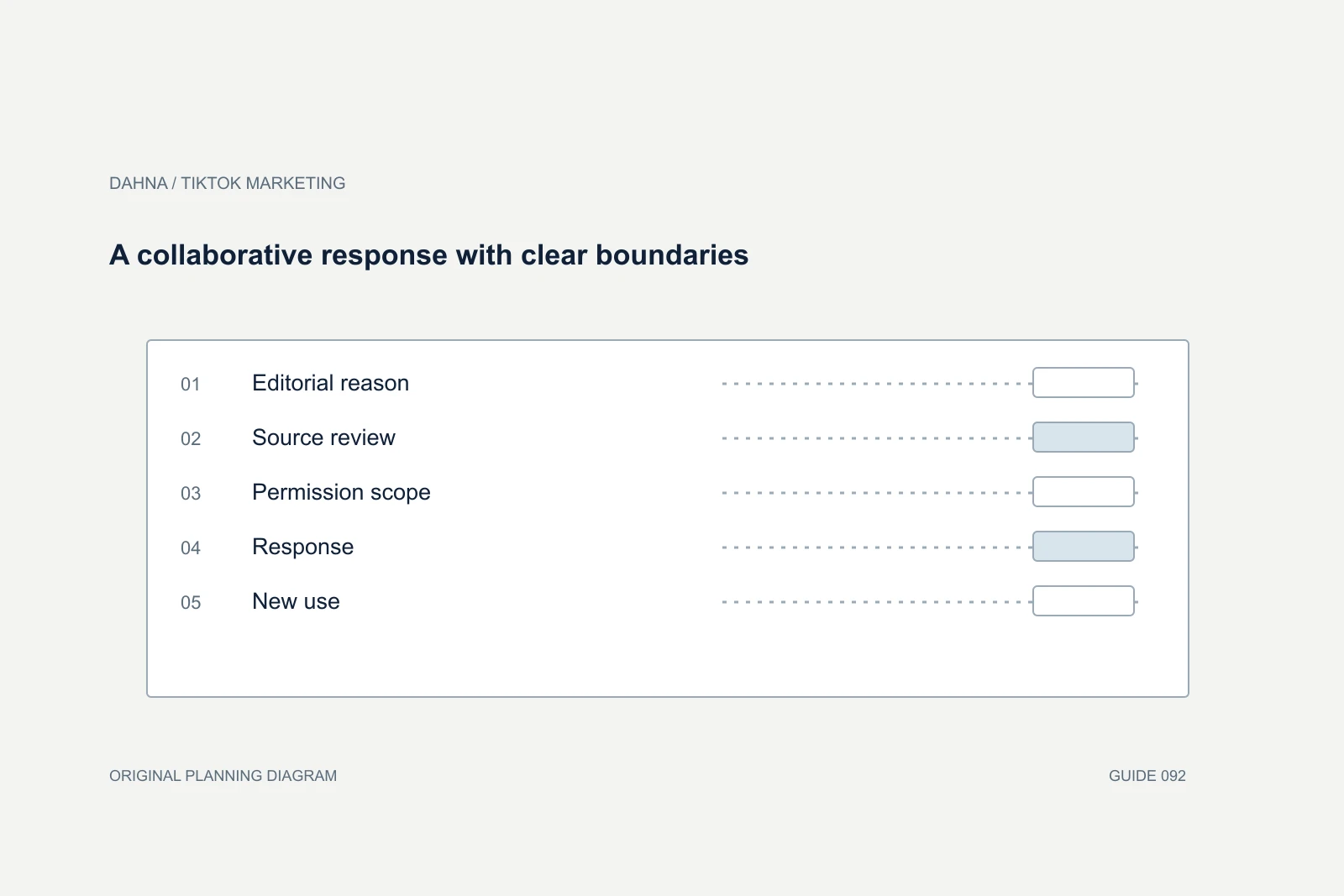
A collaborative response with clear boundaries
Editorial reason
Explain why the original context helps.
Source review
Preserve meaning and creator choices.
Permission scope
Confirm the intended brand use.
Response
Publish a clear, fair answer.
New use
Recheck before ads, edits or external reuse.
A correction should not become a personal attack
If a creator says something inaccurate about the product, answer the factual issue without turning the person into a target. Verify the source context, identify the precise correction and decide whether a public response will help customers. A private clarification or a standalone product explanation may resolve the issue with less unnecessary amplification.
The review should also consider the imbalance between a brand account and an individual creator. Avoid language that invites followers to confront the person, and do not expose private correspondence to make the brand’s argument look stronger. The useful output is a clear product fact or corrected buying expectation. A response that generates engagement by escalating a personal dispute can create more confusion and relationship cost than the original error, even if the view count looks impressive.
What an agency review should include
Bring Dahna the original post, the proposed response and the intended distribution. We can help evaluate the editorial fit, coordinate the permission record and prepare an answer that remains useful outside the original thread. The scope should identify questions requiring specialist review and provide an alternative original-content route when collaboration is unsuitable.
The goal is a response the brand can explain and stand behind. It should contribute something meaningful to the conversation, preserve the creator’s context and avoid turning a casual interaction into an unapproved endorsement. That discipline supports a more credible content program than treating every popular post as material to be repackaged.
Continue with the related decision
Use these guides when the next question goes beyond the scope of this article.
Use the editable decision sheet
Download the completed tables as a CSV, then replace the example inputs and add your evidence, owner and review date. Illustrative figures are teaching examples, not default targets.
Sources & further reading
Bring this decision to Dahna
Use this guide to prepare a focused brief. Tell Dahna what needs to change, which evidence you already have and when you need a decision.
Why consider Dahna for this work?
Dahna brings bilingual Korean and English strategy together with creator, content, and measurement work for brands growing in the US. You can review the people behind the recommendations and the kind of work we propose before starting a conversation.
Founder experience includes prior and contracted roles. Sample deliverables illustrate our approach; they are not client results or a performance promise.