How to audition a TikTok LIVE host for your beauty brand
Audition a LIVE host using the situations the show will actually create: demonstrating the product, answering an unexpected question, welcoming a new viewer and handling an unavailable item. Charisma matters, but it should not outweigh product accuracy or the ability to listen. A useful audition produces specific evidence about fit and coaching needs before the brand commits to a larger schedule.
Dahna, original planning diagram
In this article
Overview
Audition a LIVE host using the situations the show will actually create: demonstrating the product, answering an unexpected question, welcoming a new viewer and handling an unavailable item. Charisma matters, but it should not outweigh product accuracy or the ability to listen. A useful audition produces specific evidence about fit and coaching needs before the brand commits to a larger schedule.
Decide which parts of the show belong to the host
A host may demonstrate products and speak to viewers while a producer manages links, timing and technical checks. A moderator may handle repetitive questions and escalate order problems. If the brand expects one person to do all three jobs, the audition and quote should reflect that workload. Do not compare a presenter-only fee with a complete production team as if they buy the same service.
Define the product knowledge required before the audition. A makeup demonstration may need shade and application fluency; a skincare device may need careful explanation of setup, included components and approved use information. The host should know when to defer rather than improvise an answer. A confident unsupported claim is a poor result even if the delivery feels persuasive.
| Responsibility | Host expectation | Separate support to confirm |
|---|---|---|
| Product demonstration | Show the actual item clearly | Camera/lighting and product preparation |
| Audience conversation | Acknowledge and answer relevant questions | Moderator triage |
| Product selection | Explain the currently linked offer | Producer manages pins and stock updates |
| Claim boundaries | Use approved information and defer unknowns | Brand product contact |
| Technical interruption | Stay composed and follow agreed response | Production troubleshooting owner |
Use a short, paid exercise with realistic interruptions
Give candidates the same product pack, approved facts and a simple show objective. Ask for a short demonstration, then introduce a few realistic questions: what is included, how the item differs from another variant and whether it is suitable for a concern the brand has not approved a claim about. Explain the evaluation in advance so the exercise tests relevant work rather than surprise performance under arbitrary pressure.
Pay for substantial custom audition work and clarify whether any recording may be used publicly. The audition should not become an unpaid commercial asset request disguised as selection. Keep the recording internal unless separate permission is obtained. The brand can then review candidates consistently and identify what training or production support would make the best fit successful.
Mitchell Halliday is an example of product fluency, not a hiring shortcut
The TikTok Shop and WGSN report includes Mitchell Halliday discussing Made By Mitchell’s LIVE activity and the team’s preparation. That founder-led UK example shows a close connection between product, personality and show experience. It does not mean an external host should imitate Halliday or promise comparable sales.
A founder brings history, authority and an existing audience that a hired presenter may not have. The audition should test how the candidate builds clarity and trust with the resources available to this brand. A calm, precise demonstrator may be a better fit for a considered device purchase than someone whose strongest skill is rapid discount announcements. Fit is contextual, not a universal personality ranking.
Score observable behavior, then discuss the tradeoffs
Use a small number of criteria with written anchors. “Good energy” is hard to compare; “keeps the product visible while answering and returns to the next useful step” is observable. Have reviewers note the moment that supports each score. Avoid combining everything into a mysterious numerical rank that hides a serious accuracy problem behind strong presentation marks.
Treat certain failures as reasons for correction before any public work: inventing a product benefit, making an unsupported delivery promise or continuing to sell a unavailable variant after being informed. Other gaps may be coachable, such as rushing a transition or forgetting to reintroduce the product for new viewers. The final decision should distinguish those categories.
| Criterion | Strong evidence | Needs work |
|---|---|---|
| Product clarity | Shows amount, scale or components at the relevant moment | Talks over an obscured product |
| Listening | Answers the actual question before resuming | Repeats a script regardless of the question |
| Accuracy | Uses approved facts and acknowledges limits | Invents claims to avoid uncertainty |
| Show navigation | Welcomes new viewers without losing the thread | Assumes everyone saw the beginning |
| Team coordination | Responds clearly to stock or link updates | Keeps promoting the wrong offer |
A fictional audition with a useful disagreement
A fictional skincare-device brand auditions two hosts. Host A is highly energetic and keeps conversation moving, but answers an unapproved treatment question with a confident promise. Host B explains the controls clearly and defers the same question appropriately, but needs coaching on welcoming new viewers. The team should not average the scores and ignore the difference in claim judgment.
It selects Host B for a bounded rehearsal with a producer, then tests the weak transition skill again. Host A can receive feedback and a chance to demonstrate a corrected approach if the brand considers that appropriate. The example is not a rule that quiet presentation always wins; it shows why the selection should preserve the risk and coaching evidence behind the score.
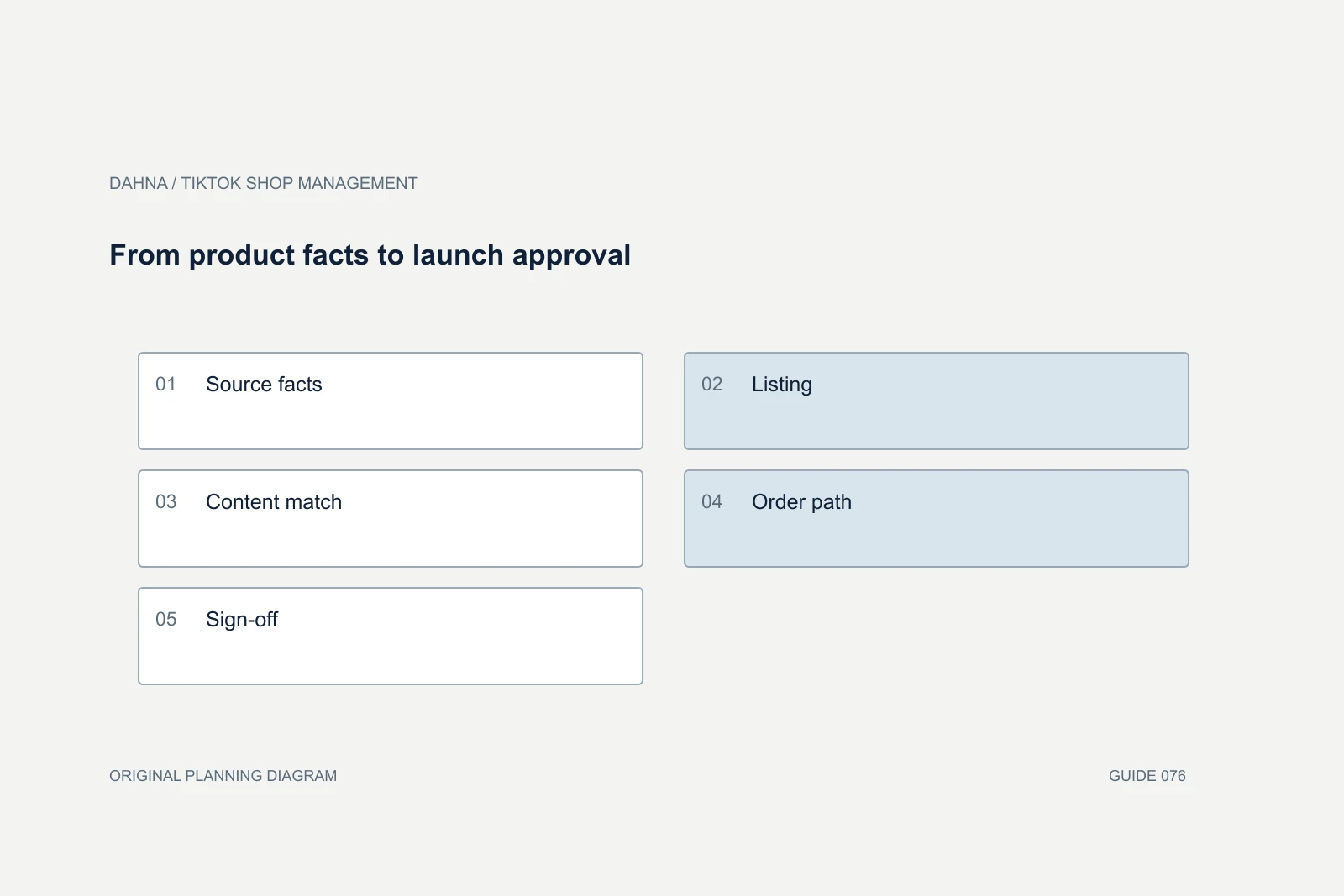
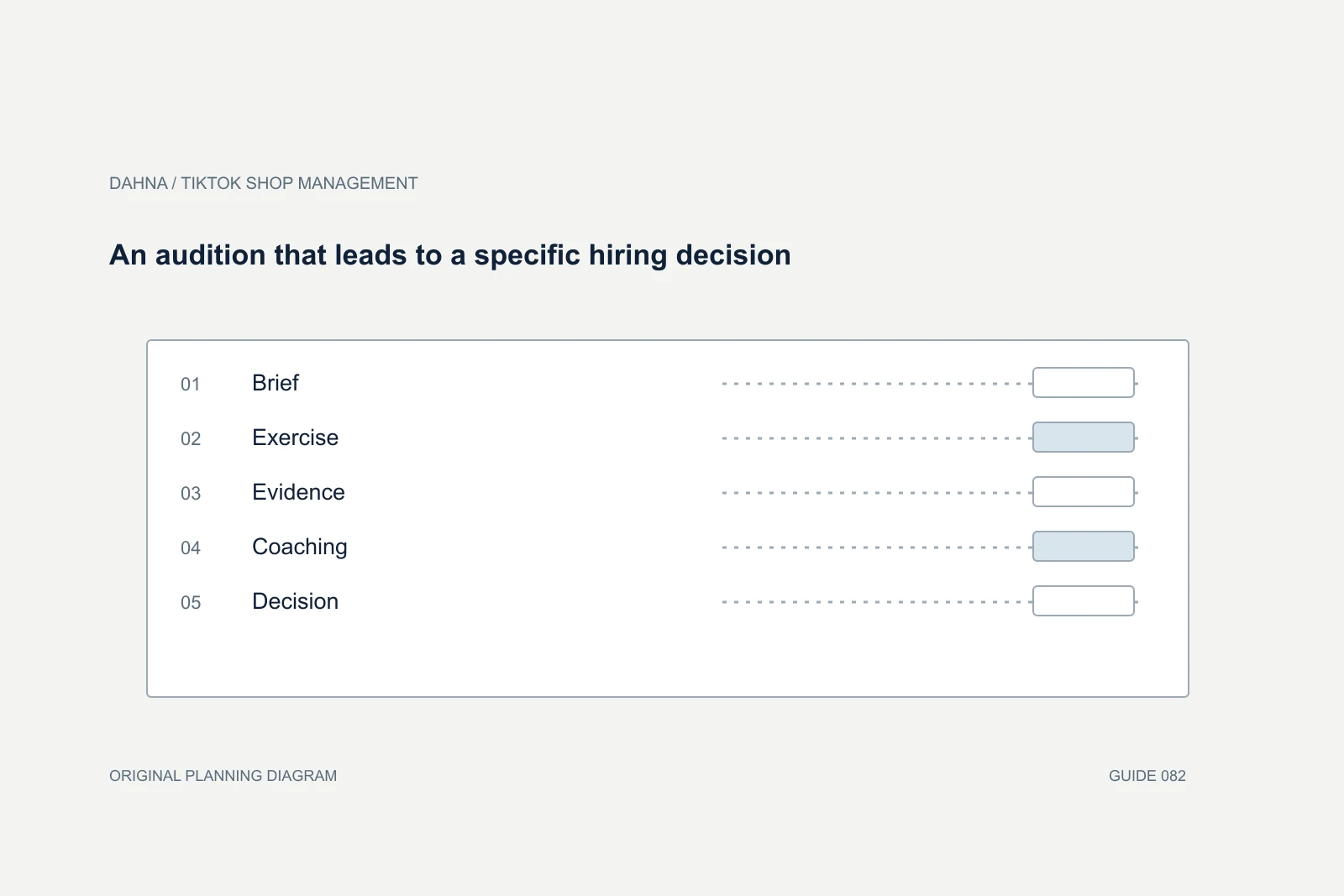
An audition that leads to a specific hiring decision
Brief
Provide equal product facts and role expectations.
Exercise
Demonstrate, answer and respond to a change.
Evidence
Record observable strengths and gaps.
Coaching
Retest the issues that can be improved.
Decision
Select a defined role for a bounded pilot.
Test a correction without humiliating the candidate
Include a planned product or stock update during the audition and tell candidates that the exercise may contain such a change. The aim is to observe coordination, not to catch someone out. For example, the producer can say that the demonstrated shade is unavailable and ask the host to continue with an approved alternative. A strong response acknowledges the change clearly, avoids inventing a replacement promise and keeps the customer oriented.
Review how the candidate handles a correction to their own wording as well. A host who can accept a concise factual correction and restate the point accurately may be easier to work with than someone who delivers a flawless memorized script but becomes defensive when the product owner intervenes. Keep the feedback specific and respectful. The recorded evidence should support a coaching decision, not a subjective label about personality.
Finally, consider endurance and preparation separately from a short audition. A ten-minute demonstration cannot prove that someone can host several hours with consistent accuracy. If the proposed schedule is longer, use a bounded rehearsal and appropriate breaks before committing. The brand should buy the role and support structure it actually needs, rather than assuming a strong first impression establishes every aspect of LIVE performance.
Make the first booking match the evidence
The initial agreement should specify preparation, rehearsal, show duration, breaks, production support and any use of recorded material. Confirm the commercial model without treating a performance bonus as a substitute for a fair scope. If sales incentives are used, define the metric and exclusions carefully so the host is not rewarded for misleading urgency or promises the operation cannot keep.
Bring Dahna the product, approved facts and intended show format. We can help build an audition and pilot brief that connects the host’s strengths to the buying questions the show must answer. Review the first session’s product clarity, questions, operating issues and economics separately. That gives the brand a more useful hiring decision than choosing the loudest presenter or the largest follower count.
Continue with the related decision
Use these guides when the next question goes beyond the scope of this article.
Use the editable decision sheet
Download the completed tables as a CSV, then replace the example inputs and add your evidence, owner and review date. Illustrative figures are teaching examples, not default targets.
Sources & further reading
Bring this decision to Dahna
Use this guide to prepare a focused brief. Tell Dahna what needs to change, which evidence you already have and when you need a decision.
Why consider Dahna for this work?
Dahna brings bilingual Korean and English strategy together with creator, content, and measurement work for brands growing in the US. You can review the people behind the recommendations and the kind of work we propose before starting a conversation.
Founder experience includes prior and contracted roles. Sample deliverables illustrate our approach; they are not client results or a performance promise.