Should your brand invest in TikTok LIVE or shoppable videos?
Choose LIVE when real-time questions and demonstrations can materially help the purchase, and choose shoppable videos when the explanation can work well without a scheduled host. Many brands can use both, but the first investment should reflect the actual product and team. Compare the full production and operating costs, the useful life of the content and the contribution from fulfilled orders rather than treating a platform sales headline as a format verdict.
Dahna, original planning diagram
In this article
Overview
Choose LIVE when real-time questions and demonstrations can materially help the purchase, and choose shoppable videos when the explanation can work well without a scheduled host. Many brands can use both, but the first investment should reflect the actual product and team. Compare the full production and operating costs, the useful life of the content and the contribution from fulfilled orders rather than treating a platform sales headline as a format verdict.
Does the buyer benefit from a conversation?
A shade-selection demonstration, a routine comparison or a device setup can generate questions that change what the host should show next. That is a plausible reason to test LIVE. A simple product feature or a repeatable application step may be communicated more efficiently in a short video that viewers can encounter at different times. Start with the uncertainty the content needs to resolve.
Do not assume that a longer format is automatically more educational. A show that repeats discounts without answering questions may offer less clarity than a focused thirty-second demonstration. Equally, a short video can leave important qualifications unexplained. Review actual customer questions and identify which require interaction, which require a better visual and which belong with customer support rather than promotional content.
| Buying task | LIVE advantage to test | Shoppable-video advantage to test |
|---|---|---|
| Compare variants | Host can respond to the viewer’s question | One clear comparison can be revisited |
| Understand setup | Demonstration can adapt to confusion | A concise sequence can stay focused |
| See texture or scale | Multiple angles and questions in real time | Controlled close-up and editing |
| Discover an unfamiliar product | Personality and conversation may sustain interest | Several concise concepts can reach different situations |
Compare the work before comparing the revenue
LIVE requires a host, product preparation, technical setup, moderation and someone who can respond to stock or offer changes during the session. Shoppable videos require scripting, production, editing, permissions and ongoing monitoring of the linked offer. Neither format is free because a team member already owns a phone. Record the time and outside costs needed to produce useful work consistently.
Also compare scheduling constraints. A US audience may need coverage during hours that differ from a Korean or European headquarters. A host can explain an offer only if an operating owner can resolve a problem when it occurs. Recorded content offers scheduling flexibility, but an old video can keep circulating after a bundle or price changes. The maintenance burden belongs in both sides of the comparison.
The Beauty Story used both formats, without proving one always wins
TikTok’s The Beauty Story case describes a Singapore Korean-skincare reseller using creator videos and LIVE shopping in parallel. The published return figures reflect that campaign’s conditions; they are not a randomized format comparison or a US cost benchmark.
The useful idea is to assign different jobs to the formats. A recorded demonstration can introduce the product, while a LIVE session can address recurring questions that remain. Afterward, a newly filmed answer can make the most useful explanation available asynchronously. Any reuse of the session still needs the appropriate participant and content permissions. The brand should choose this combination because the customer journey benefits, not because a case study contains two impressive numbers.
A fictional $4,800 comparison
Imagine a fictional beauty brand with $4,800 for a learning project. One option is a supported LIVE pilot with preparation, hosting, production and review. Another is a small set of shoppable videos with different product explanations and a defined review period. The amounts in the table are invented planning allowances, not agency or host market rates. Both options exclude product and order-level costs, which must be added to the contribution analysis.
The team should compare the question each option can answer. If the brand does not yet know which explanation interests buyers, a varied video set may be more useful. If it already sees repeated questions that need demonstration, a LIVE pilot may answer them more directly. The budget should purchase a learning opportunity the team can operate, not merely the most content minutes.
| Cost area | LIVE option | Video option |
|---|---|---|
| Preparation and product briefing | $900 | $700 |
| Host/creator and production | $2,200 | $2,400 |
| Moderation, publishing and operating support | $800 | $500 |
| Measurement and review | $900 | $1,200 |
| Total planning allowance | $4,800 | $4,800 |
Allow each format a fair observation period
A LIVE session concentrates activity into a scheduled window, while videos can continue receiving views after publication. Comparing one evening’s LIVE orders with a video’s first hour would favor the event’s concentrated delivery. Define the review period and attribution conventions before publishing, then report the timing difference rather than forcing both formats into a misleading single-day score.
Include fulfilled orders, returns, discounts, commissions and the fixed project costs. Track useful questions and product misunderstandings separately from sales. A session can reveal a listing problem even if its direct economics are weak, but that learning should not be relabeled as profit. Decide in advance how much the brand is willing to spend on learning so the later review does not need to invent a justification.
Avoid a comparison where the formats secretly support each other
If videos promote the LIVE event, the show’s outcome includes that support. If the host directs viewers toward an existing video explanation, the video contributes to the experience. This can be good marketing, but it means the program is not a clean head-to-head format test. Label it a combined pilot and account for both sets of costs.
For a more focused comparison, document the promotional support each option receives and the customer groups exposed. Formal causal testing may not be feasible at the brand’s scale. A practical operating comparison can still identify which format the team can produce accurately, which buying questions it resolves and whether its economics warrant another test. Keep those conclusions at the level the evidence supports.
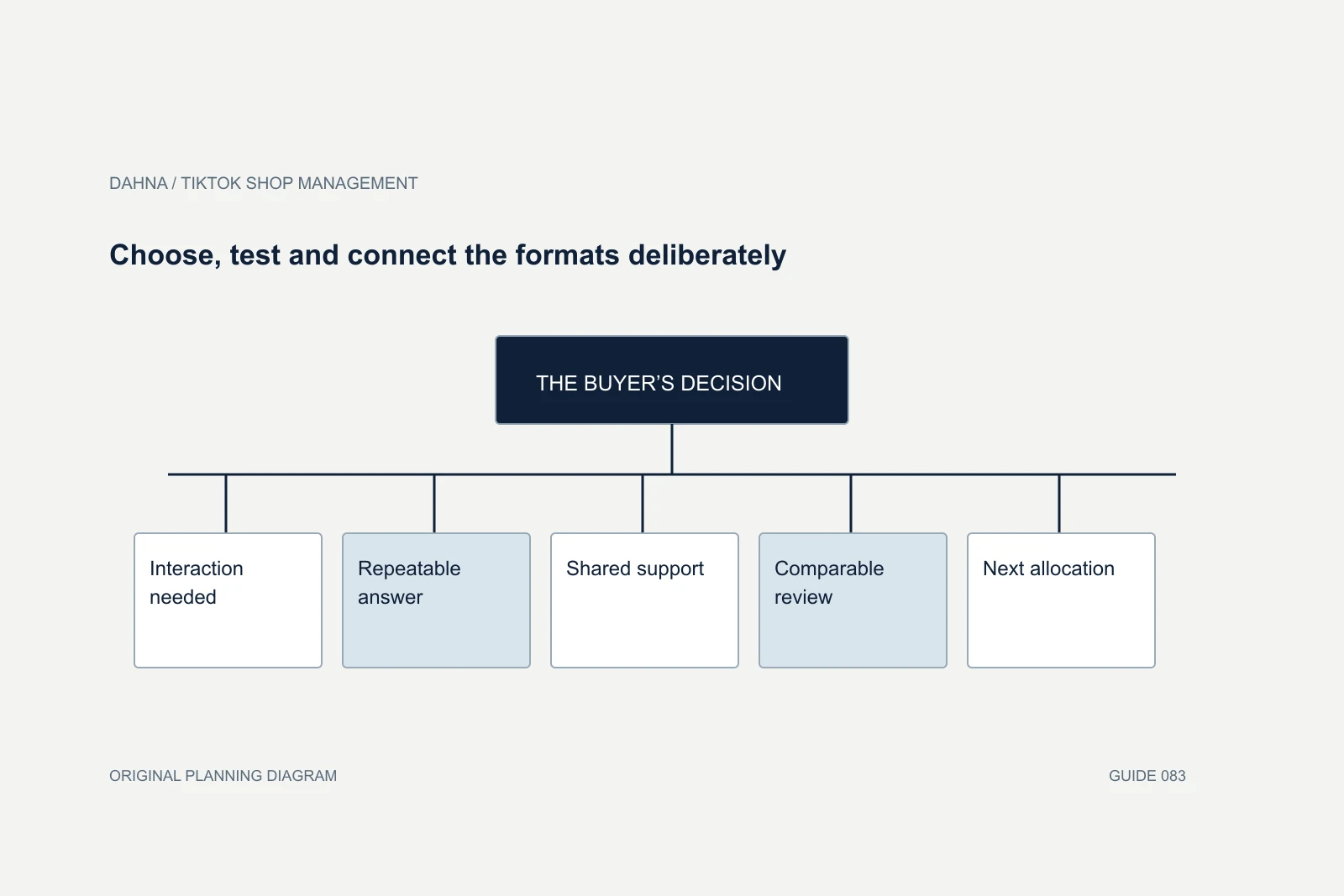
Choose, test and connect the formats deliberately
Interaction needed
Test a supported LIVE explanation.
Repeatable answer
Test a focused shoppable video.
Shared support
Record when one format promotes the other.
Comparable review
Include timing, full costs and fulfilled orders.
Next allocation
Expand the job that the evidence supports.
When the team can afford only one production day
If one production day is the real constraint, compare what can be prepared and maintained afterward. A filmed demonstration set may provide several useful answers, while a LIVE session may reveal questions the team did not anticipate. The first choice depends on the missing information. If the brand does not yet have accurate product visuals, recording those may improve several future uses. If it has strong visuals but unresolved selection questions, a supported conversation may be more informative.
Do not count hypothetical repurposed clips as guaranteed extra value. A LIVE recording may contain music, participant permissions, changing offers or technical interruptions that make reuse difficult. Identify the specific excerpts or clean demonstrations the production plan intends to capture and confirm the rights. The review can then count actual usable assets and the editing time they required, rather than multiplying the show length into an inflated content-output claim.
What the next brief should ask for
Bring Dahna the product, recurring customer questions, current content and available operating hours. We can help compare a LIVE pilot with a video program using the same commercial assumptions. The proposal should identify the specific buying question, production roles, support needs and review decision for each option.
End the pilot with a concrete allocation: repeat the LIVE with a better host brief, produce more of a useful video explanation, combine the formats with transparent costs, or repair the offer before funding either. The right answer can change as the brand develops. What should remain stable is the requirement to connect the format to the customer’s decision and the team’s ability to deliver it.
Continue with the related decision
Use these guides when the next question goes beyond the scope of this article.
Use the editable decision sheet
Download the completed tables as a CSV, then replace the example inputs and add your evidence, owner and review date. Illustrative figures are teaching examples, not default targets.
Sources & further reading
Bring this decision to Dahna
Use this guide to prepare a focused brief. Tell Dahna what needs to change, which evidence you already have and when you need a decision.
Why consider Dahna for this work?
Dahna brings bilingual Korean and English strategy together with creator, content, and measurement work for brands growing in the US. You can review the people behind the recommendations and the kind of work we propose before starting a conversation.
Founder experience includes prior and contracted roles. Sample deliverables illustrate our approach; they are not client results or a performance promise.