Which customer questions belong in a product FAQ?
Publish questions that remove a real uncertainty about the product or purchase. Put the answer where the customer needs it, use verified facts, and link to deeper instructions when necessary. A FAQ should make the product easier to understand; it does not need a separate URL for every wording variation of the same question.
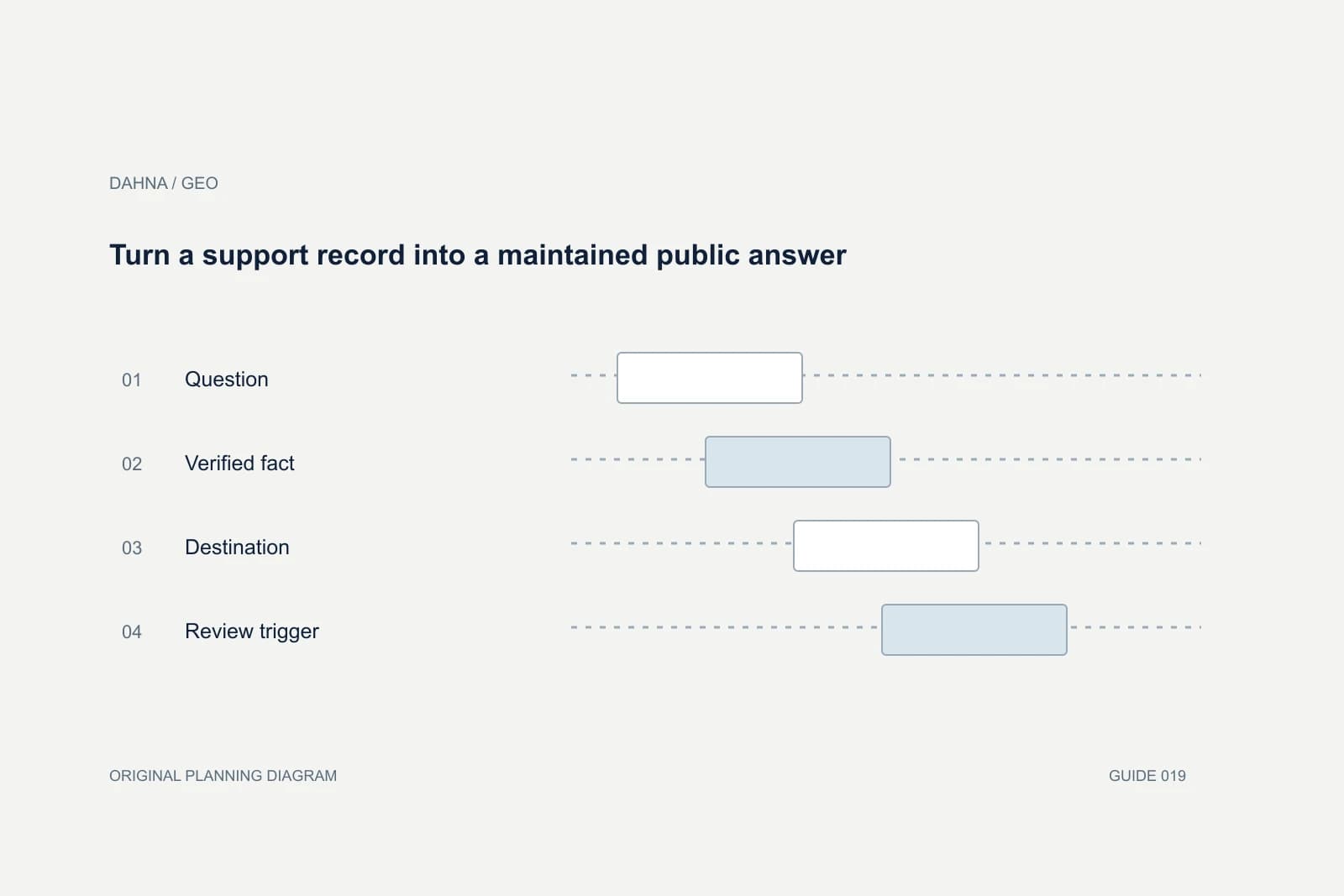
Dahna, original planning diagram
In this article
Overview
Publish questions that remove a real uncertainty about the product or purchase. Put the answer where the customer needs it, use verified facts, and link to deeper instructions when necessary. A FAQ should make the product easier to understand; it does not need a separate URL for every wording variation of the same question.
Collect the question and the reason behind it
Customer wording is useful, but the literal sentence may conceal a deeper uncertainty. “Can I use this every day?” could concern instructions, compatibility with another product, or a personal health condition. The editorial team should identify which part the brand can answer from approved information and which part needs qualified support.
Collect a defined sample of support tickets, onsite searches, product comments, and sales questions. Remove personal details and record the period and source. Count recurring decisions rather than counting every repeated word as a separate topic. A single serious compatibility confusion may deserve attention even if it is less frequent than a routine delivery question.
Choose the destination before writing
An item-specific question belongs near the item. A general delivery question may belong in a policy page with a concise product-page link. A complex setup question may need a full instruction resource. This keeps answers consistent and avoids copying a long block of policy text into every product description.
Google’s generative-AI guidance encourages useful content and cautions against producing many pages merely for query variations. Our application is to group genuinely equivalent questions and maintain one clear answer at an appropriate destination. A FAQ format alone does not guarantee a special search appearance or AI citation.
| Question type | Best starting destination | Why |
|---|---|---|
| Does this refill fit my bottle? | Exact product and compatibility resource | The answer depends on the item |
| What is included in the box? | Product page | The buyer needs it before purchase |
| How do I clean the device? | Approved instructions with a product link | The complete procedure must remain accurate |
| Where do you ship in the US? | Delivery policy plus concise product-page signpost | One maintained source prevents contradictions |
| Is this appropriate for my medical situation? | Qualified support or professional guidance as appropriate | A generic marketing answer may be insufficient |
Versioned devices make precise questions necessary
CurrentBody’s US LED mask page identifies model-specific product details. That visible versioning illustrates why an answer should identify the exact model when features or instructions differ. “Does the mask include this accessory?” is incomplete unless the reader knows which model and market the answer describes.
This is an observation about product-information structure, not a clinical assessment or a claim about the brand’s support performance. A skincare brand can apply the same principle to different bottle sizes, formulas, or refill packages. The answer should name the item instead of relying on a pronoun whose meaning becomes unclear outside the page.
Write the shortest complete answer
Lead with the direct answer, then give the condition or explanation that prevents misunderstanding. If the answer is “yes, for this bottle version,” the version is part of the answer, not a footnote. If the brand does not know a restock date, say so and provide a useful next action.
Use the customer’s language while retaining necessary precision. Explain technical terms when they change the decision. Avoid turning each answer into a sales paragraph or repeating the brand name unnaturally. A customer who asks about included accessories should not have to read a long statement about the brand’s mission first.
Turn a support record into a maintained public answer
Question
Capture the decision without personal information.
Verified fact
Assign the product or policy owner.
Destination
Choose product, support, policy, or deeper guide.
Review trigger
Update the answer when its underlying fact changes.
Illustrative refill question triage
Imagine a brand receives twelve support conversations about whether a refill works with an older pump bottle. The product owner confirms that only the newer bottle is compatible. The website currently says “refill available” without naming the compatible package. The team adds a clear compatibility answer, a visual identification aid, and a link from the refill product page.
The team does not publish separate articles for “does refill fit old bottle,” “old pump refill compatibility,” and “can I reuse the previous package.” Those phrases describe one decision. It maintains one verified explanation and makes it discoverable from relevant pages.
The brand later reviews a comparable support period and checks whether confusion persists. A decline would be useful evidence, but other changes may also affect contact volume. The example numbers and outcome process are illustrative; no actual reduction is claimed.
Give every consequential answer an owner
A FAQ can become inaccurate when shipping terms, product quantities, compatibility, or instructions change. Keep a small register of the source, owner, public location, and review trigger. The register should connect the answer to the underlying fact rather than merely schedule an annual copy refresh.
If the answer touches a product claim, preserve the approved wording and limitations. The editor can improve clarity with the owner’s review, but should not casually turn a cautious statement into an absolute promise. For uncertain questions, a helpful route to support is better than a confident guess.
| Answer | Source owner | Trigger | Public locations |
|---|---|---|---|
| Refill compatibility | Product team | Bottle design or refill changes | Product page and support guide |
| Included accessories | Catalog owner | Bundle contents change | Product page |
| Delivery estimate explanation | Operations | Carrier or fulfillment policy changes | Delivery policy and product signpost |
| Usage instructions | Approved product documentation owner | Instruction revision | Manual and concise FAQ reference |
Use a question threshold that respects both frequency and consequence
The most common question is not always the most important one. A rare misunderstanding about a device’s compatible accessory can lead to an incorrect purchase, while a frequent question about the color of a pouch may have little consequence. Triage using recurrence, customer impact, and the clarity of the available answer.
Keep questions that require individual context out of an overly confident universal FAQ. The public answer can explain what information support needs and where to find the approved instructions. It should not guess at a person’s condition or imply that a general marketing statement resolves an individual suitability question.
Before release, give the draft answer to someone who has not seen the internal product brief. Ask them to explain what they would do next. If they infer a broader promise than the brand intended, revise the wording. This is a comprehension check, not a claim of a formal usability study unless that work was actually conducted.
After publication, support staff should have an easy way to flag an answer that creates new confusion. The useful feedback may be that customers interpret “compatible” as including an accessory that is sold separately, or that a delivery statement appears to promise a date it does not guarantee. These are precise editorial problems that can be repaired without expanding the FAQ into another long generic guide.
Ask Dahna to improve the answer system
Dahna can review recurring customer questions, identify missing or contradictory answers, and organize them across the product and support experience. Bring a privacy-safe sample of questions and the approved product or policy sources. The scope should include who verifies the facts and who maintains them after publication.
If a question requires an original demonstration or a larger comparison, commission that asset separately. The FAQ can introduce the answer and point to the deeper resource without becoming an overloaded substitute for it.
Continue with the related decision
Use these guides when the next question goes beyond the scope of this article.
Use the editable decision sheet
Download the completed tables as a CSV, then replace the example inputs and add your evidence, owner and review date. Illustrative figures are teaching examples, not default targets.
Sources & further reading
Bring this decision to Dahna
Use this guide to prepare a focused brief. Tell Dahna what needs to change, which evidence you already have and when you need a decision.
Why consider Dahna for this work?
Dahna brings bilingual Korean and English strategy together with creator, content, and measurement work for brands growing in the US. You can review the people behind the recommendations and the kind of work we propose before starting a conversation.
Founder experience includes prior and contracted roles. Sample deliverables illustrate our approach; they are not client results or a performance promise.