How to review a beauty campaign concept before production
Review a campaign concept against the customer question, brand idea, product evidence and production reality before choosing the most attractive mood board. A useful review should explain what the audience will understand, why the brand belongs in the idea and what must be proven in a small prototype.
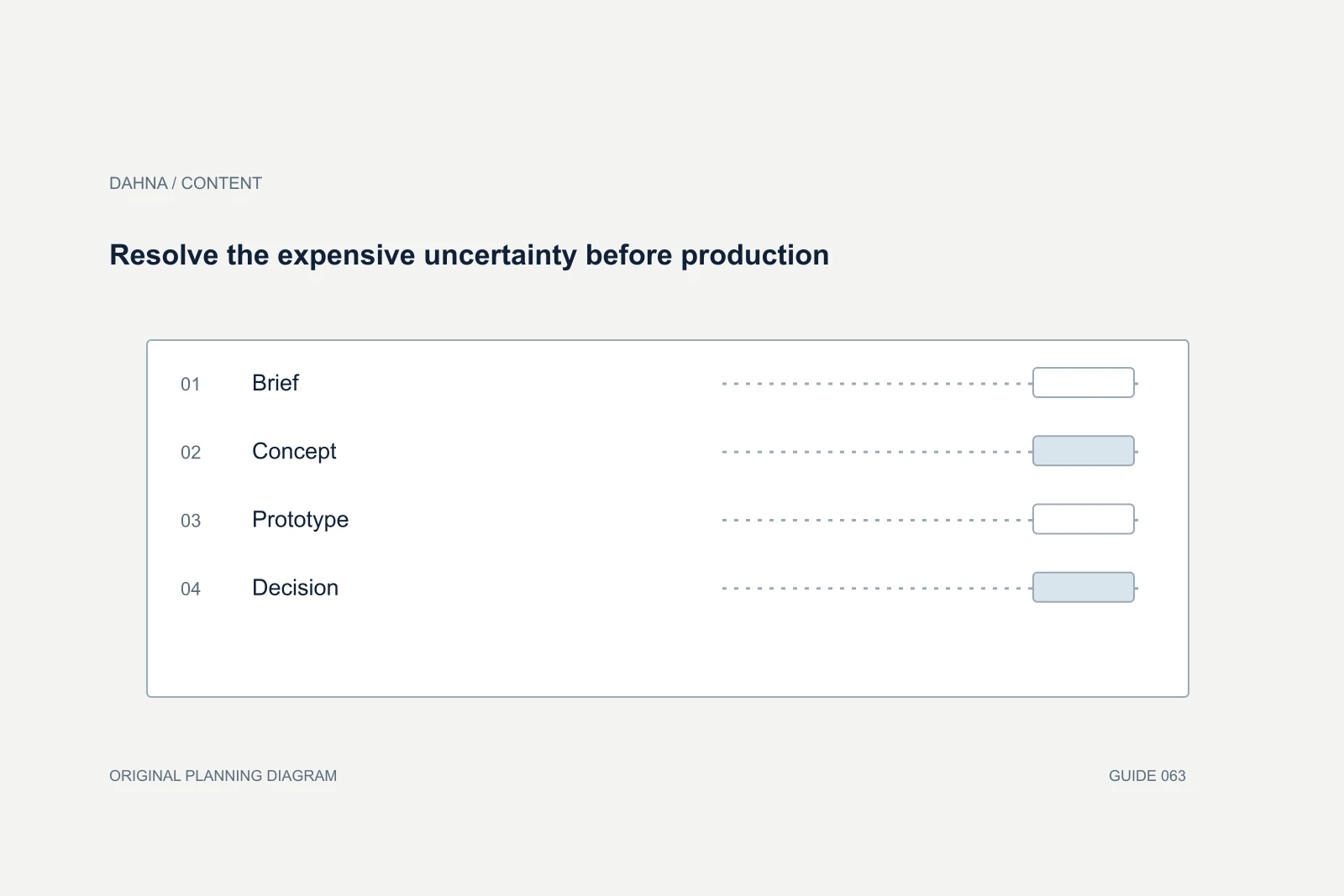
Dahna, original planning diagram
In this article
Overview
Review a campaign concept against the customer question, brand idea, product evidence and production reality before choosing the most attractive mood board. A useful review should explain what the audience will understand, why the brand belongs in the idea and what must be proven in a small prototype.
Agree on the decision before seeing the ideas
Write down the audience, commercial objective, main message and constraints. Specify whether the campaign introduces a product, explains a difference or supports a particular launch. Without this shared brief, reviewers often judge concepts against different imagined goals.
Choose the decision owner and the specialist review roles. A product expert should check factual claims, a production lead should check feasibility and the brand owner should judge fit. Collecting all opinions as equal votes can hide a serious factual problem beneath enthusiasm for the visuals. The process should welcome feedback while making authority clear.
Ask every concept to explain itself in plain language
A concept presentation should state the idea, the audience takeaway and how the product appears. Include a simple storyboard or sample layout with actual copy. A mood board can communicate atmosphere, but it does not show whether the idea will make sense in a short video or a product launch page.
Ask what the audience might misunderstand. A visual metaphor can be memorable while implying an unsupported product effect. Review the intended interpretation and plausible unintended interpretations before the team invests in a set or talent. The product’s role should be integral enough that the campaign does not feel interchangeable with another category.
Use a brand’s stated boundary as a creative criterion
Dove’s Real Beauty Pledge publicly describes commitments around real people, digital distortion and participant approval. As an example, it shows how a brand principle can rule out some creative approaches and support others. The pledge is a stated policy, not a performance study or proof of every execution.
Your brand can define its own relevant boundaries with equal clarity. A company promising practical product education might reject a concept that hides the product until the last second. A brand centered on a particular craft might require the process to be shown accurately. The criterion should come from the brand and customer task, not a borrowed aesthetic.
Use a scorecard to structure discussion, not automate taste
Scorecards help expose disagreements, but the numbers are only as useful as the reasons behind them. Use a small set of criteria and ask reviewers to cite a concrete feature of the concept. A high total should not override an unresolved claim or an impossible production requirement.
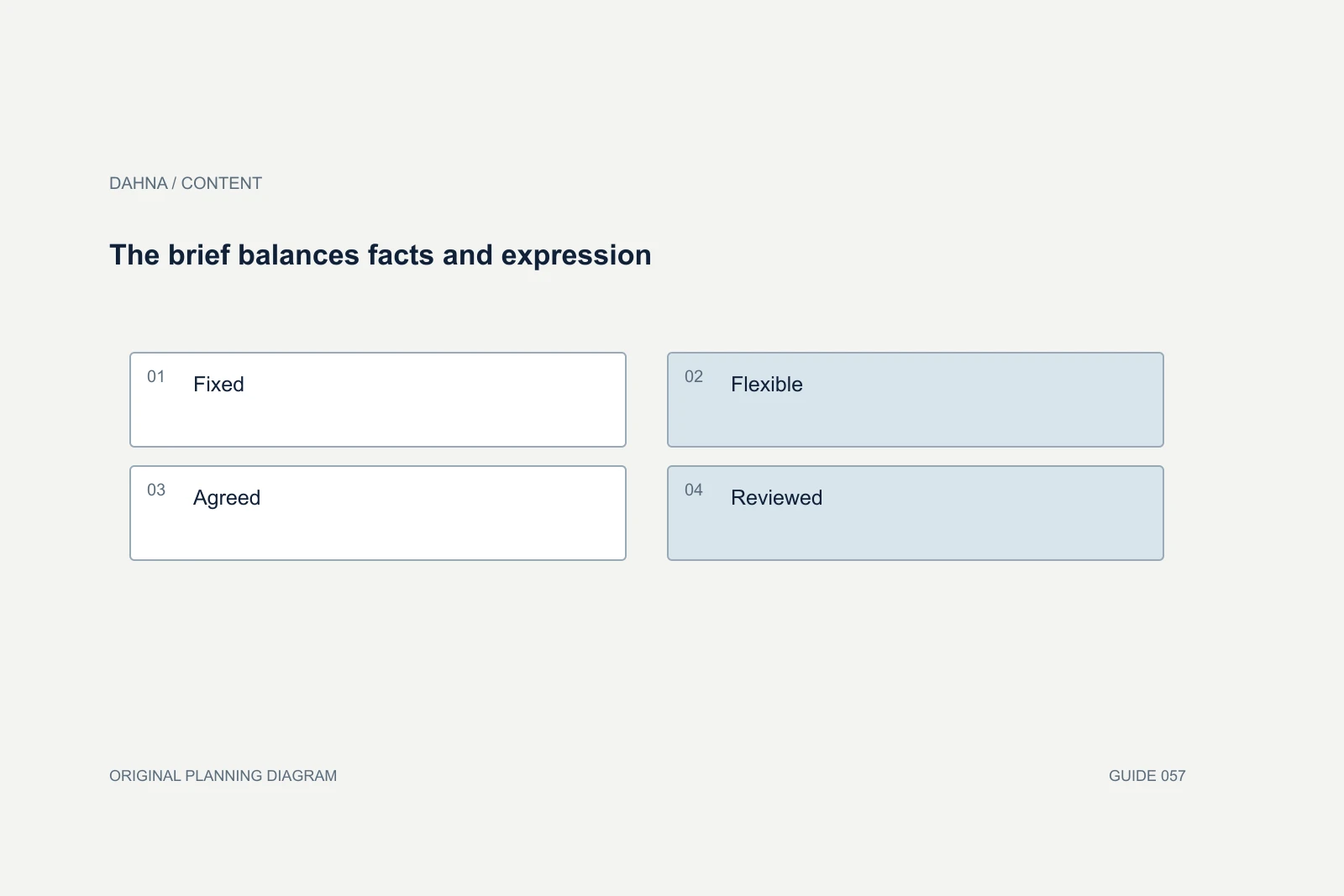
Separate must-pass conditions from preferences. Correct product representation and feasible delivery may be gates. Originality, emotional tone and flexibility can be comparative judgments. This prevents a beautiful but unusable idea from winning because it collected enough points elsewhere.
| Criterion | Question | Evidence in the concept |
|---|---|---|
| Customer clarity | What will someone understand after one viewing? | Plain-language takeaway and storyboard |
| Brand connection | Why is this idea right for this brand? | Recognizable assets and relevant product role |
| Evidence | What claims does the idea imply? | Approved facts and review notes |
| Feasibility | Can it be made within the real constraints? | Production approach and dependencies |
| Adaptability | Can it work in required placements? | One vertical and one website example |
| Distinctiveness | What makes it memorable without obscuring meaning? | A specific creative device, not an adjective |
Worked example: a floating-product concept
Imagine a fictional serum campaign built around a bottle floating through a surreal landscape. The mood board is compelling, but the storyboard never shows the product texture or explains its purpose. The team must decide whether the concept’s job is pure brand atmosphere or product introduction.
If the launch needs product understanding, the agency can prototype a version that connects the visual device to a clear demonstration and supported message. If that addition destroys the idea, the team may choose a different concept. The example does not reject expressive creative; it asks the concept to meet the brief the business is actually funding.
Resolve the expensive uncertainty before production
Brief
Audience and message agreed
Concept
Idea shown with real copy and product role
Prototype
Most uncertain moment tested cheaply
Decision
Proceed, revise or stop with reasons
Prototype the part most likely to fail
A prototype should answer a concrete question: whether the visual effect reads correctly, whether the product is visible in a small frame or whether the spoken line feels natural. It can be a rough animatic, a tabletop test or a short rehearsal. It does not need finished production value to be useful.
Avoid polishing the easy parts while leaving the core uncertainty untouched. If the concept depends on a reflective package against a bright background, test that combination. If it depends on a creator’s explanation, hear the line spoken. Record the decision the prototype enabled so it does not become another round of subjective presentation.
Write feedback that the creative team can act on
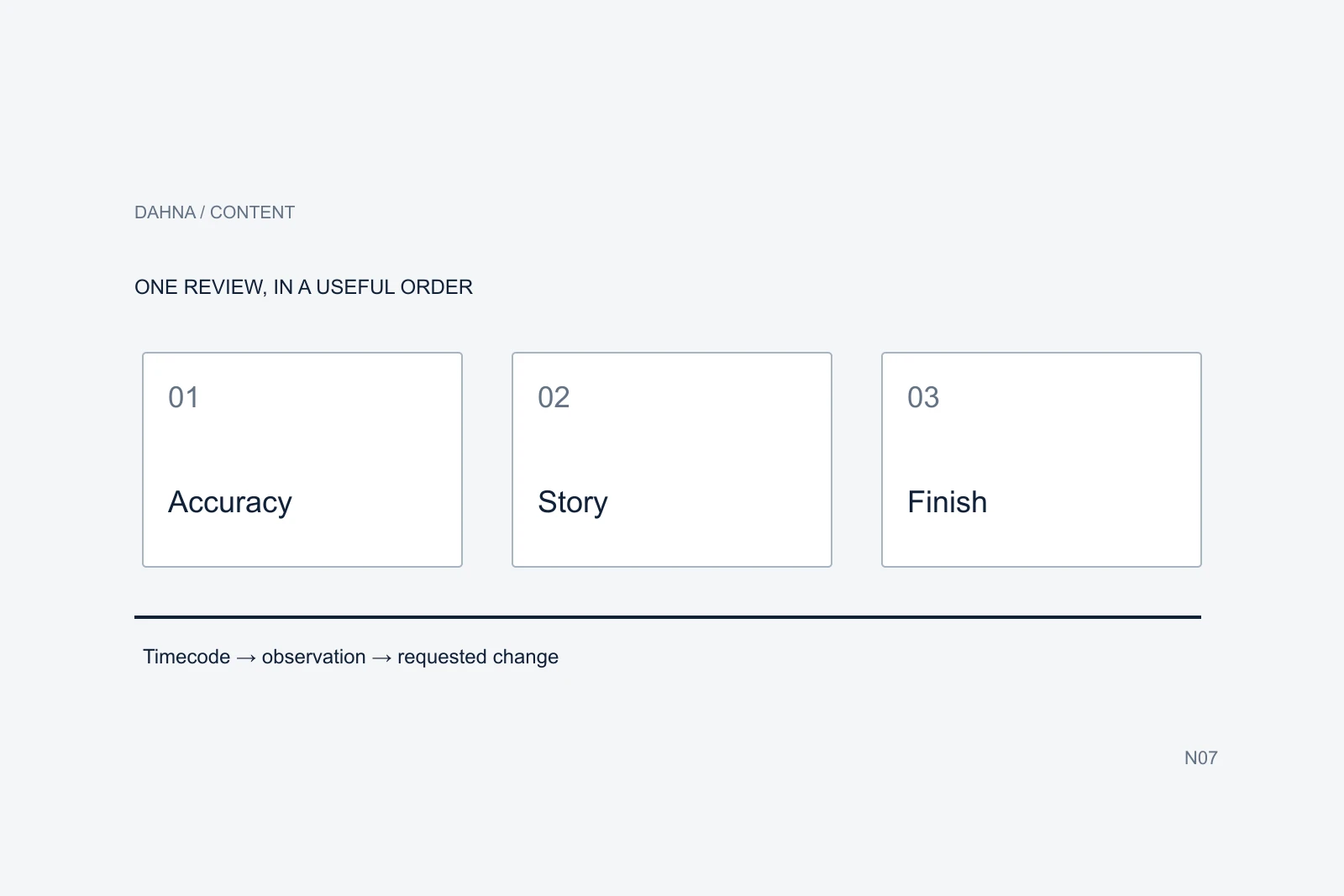
Describe the observed problem and the intended outcome. ‘The product type is unclear until the end’ is more useful than ‘make it stronger.’ Ask the agency to solve the problem rather than prescribing an arbitrary visual adjustment unless a factual constraint requires it.
Consolidate conflicting comments before returning them. A request to make the brand quieter and another to increase logo presence need a decision, not a forwarded email chain. Keep a record of approved changes so the team does not reopen settled questions during production without acknowledging the impact on time and cost.
Freeze the right decisions and leave execution room
Approve the core concept, message, claims, deliverables and major production choices. Allow the director or creator to make ordinary execution decisions within that boundary. Excessively scripting every gesture can remove the natural quality the concept depends on.
If a major assumption changes, revisit the approval. A different product, unavailable location or reduced runtime may require a new solution. Treat the change explicitly instead of expecting the original idea to survive any constraint. The final production brief should identify the approved version and the person who can authorize deviations.
Ask for a reasoned recommendation
Dahna can help connect campaign ideas to product evidence, brand direction and the placements the business needs. Bring the launch objective, available assets and budget constraints into the concept discussion. The agency’s recommendation should explain the tradeoffs and the uncertainty worth testing.
A strong review ends with an idea the team understands and can execute, plus a clear reason for choosing it. That is more useful than a room agreeing that a mood board looks premium while leaving the actual customer message unresolved.
Continue with the related decision
Use these guides when the next question goes beyond the scope of this article.
Use the editable decision sheet
Download the completed tables as a CSV, then replace the example inputs and add your evidence, owner and review date. Illustrative figures are teaching examples, not default targets.
Sources & further reading
Bring this decision to Dahna
Use this guide to prepare a focused brief. Tell Dahna what needs to change, which evidence you already have and when you need a decision.
Why consider Dahna for this work?
Dahna brings bilingual Korean and English strategy together with creator, content, and measurement work for brands growing in the US. You can review the people behind the recommendations and the kind of work we propose before starting a conversation.
Founder experience includes prior and contracted roles. Sample deliverables illustrate our approach; they are not client results or a performance promise.