Beauty influencer rate calculator: fees, usage rights and whitelisting
Price a creator deal from your own quotes: base fee, usage rights, whitelisting, exclusivity, product and agency fees, with a worked deal and worksheet.
What does a beauty influencer deal cost?
Say you sell a cleanser, and a creator quotes $1,500 for one TikTok video and two Instagram stories. Then your team asks to reuse the video for 90 days. You also want to run it as an ad for 60 days. And you want the creator to stay away from other cleanser brands for 30 days. In the invented deal we’ll follow on this page, that $1,500 becomes $3,504.
We found no authoritative public rate card for beauty creators. So this influencer rate calculator gives you a way to price a deal from your own quotes. A deal costs the base fee for the content. Then you add usage rights, whitelisting (ad access) and exclusivity. Price each one as a percentage of the base for every 30 days. After that, add product, shipping and any agency or platform fee.
The same post costs more once you want to run it as an ad for three months and keep the creator away from competitors. The calculator separates those terms. You can see what each one adds and decide which to drop.
Why doesn’t this page list typical influencer rates?
We couldn’t find a rate source that a regulator or platform publishes and stands behind. The figures in circulation are estimates from marketing software companies and surveys. They use different follower bands and methods. As far as we can tell, they describe a post without stating the rights attached.
Our guide to beauty influencer tiers and costs lists several of those published estimates with their publishers, as planning ranges. Use them to sense-check a budget. Don’t use them to price the quote in front of you.
A structure helps more than an average when you’re holding a real quote. Two creators can quote the same fee and offer very different deals. One includes 30 days of paid use. The other includes none. Put both quotes through the same lines and the difference shows.
Which terms change the price of a creator deal?
Seven lines cover most quotes. Ask every creator or manager to quote the same lines. That holds even when the answer is “included” or “not offered.”
For the cleanser deal, ask the creator to price usage, ad access and exclusivity on their own lines. Do this even if they’d rather give you one number.
The lines of a creator deal and how each is entered
| Line | What it covers | How you enter it |
|---|---|---|
| Base fee | Making and posting the agreed deliverables on the creator's account | Quantity and fee for each deliverable; the calculator adds them |
| Usage rights | Your right to use the video on named channels (your social accounts, ads from your handle, product pages, retailer listings, email) | Percent of base for each 30 days, and the number of 30-day periods |
| Whitelisting (ad access) | The creator's authorization to run the post as an ad from the creator's handle: Spark Ads on TikTok, partnership ads on Meta | Percent of base for each 30 days, and the number of 30-day periods |
| Exclusivity | The creator's promise not to work with named competitors or a category for a period | Percent of base for each 30 days, and the number of 30-day periods |
| Product and shipping | Units sent to the creator, at your cost, plus postage | Units, cost per unit, shipping per unit |
| Agency or platform fee | A fee charged on creator payments by an agency, a manager on your side or a marketplace | Percent of the creator total |
| Total | Everything above | Calculated |
What do usage rights, whitelisting, Spark Ads and partnership ads mean?
Usage rights are the part of a creator’s copyright that the creator licenses to you. The US Copyright Office says “Everyone is a copyright owner”: the person who creates an original work and fixes it, meaning records it, is its author and owner.
So a creator’s video belongs to the creator unless a contract changes that. The Office’s page on transfers says “all or part of the rights in a work may be transferred by the owner to another.” A good quote for usage rights names the channels, the term and the countries. It also says whether you may edit.
We didn’t find the phrase defined on the TikTok or Meta pages we read. So we take the definition from the Copyright Office.
Whitelisting is an industry word for letting a brand run ads from the creator’s handle. It doesn’t appear on the TikTok and Meta pages we read. On TikTok the format is Spark Ads. TikTok’s help page (last updated June 2026) defines it as “a native ad format that allows you to leverage organic TikTok posts and their features in your advertising”.
TikTok’s page says that includes “organic posts made by other creators (with their authorization)” and that “all of the Spark Ads post engagement will be attributed to the original organic post.” The creator authorizes one post at a time with a video code. TikTok’s Smart+ guide (last updated October 2025) tells the creator to “select the authorization duration (7, 30, 60, or 365 days).”
On Meta the format is partnership ads. Meta’s developer documentation says “Partnership ads allow you to run Facebook and Instagram ads from a creator or other partner’s handle”. Its guide to boosting an existing Instagram post describes “The ad code shared by the creator you are working with.”
Meta’s Business Help Center pages on partnership ad permissions returned no readable text to us on November 11, 2026. So we don’t state how long a Meta permission lasts or how it’s withdrawn. Check that with the creator in Meta’s own tools.
Buy ad access for as long as the ads will run. Match it to the term the creator sets in the app. Say you buy 60 days of ad access on TikTok for your cleanser video. Then ask for a 60-day code.
Usage rights and whitelisting are separate lines. A license to run the video from your handle doesn’t give you the creator’s handle. A Spark Ads code doesn’t let you put the video on your product page. Our article on Spark Ad permissions covers the record to keep.
What is the influencer rate calculator formula?
The calculator treats each added term as a multiplier on the base fee you set from the quote. A period is 30 days.
Say a creator quotes a flat amount for a term. Convert it. Divide the amount by the base fee and by the number of 30-day periods. A flat $900 for 90 days of usage on a $1,500 base is 900 / 1,500 / 3. That’s 20 percent for each 30 days.
Round each line to the cent and add the rounded lines. The agency or platform fee is charged on the creator total. It isn’t charged on product or shipping. If your agency charges on a different base, change that line. Every rate starts at zero. We found no published rate to use as a default.
- Base fee = sum of (quantity x fee) for each piece of content
- Usage rights = base fee x usage rate per 30 days x number of periods
- Whitelisting = base fee x ad access rate per 30 days x number of periods
- Exclusivity = base fee x exclusivity rate per 30 days x number of periods
- Creator total = base fee + usage rights + whitelisting + exclusivity
- Product and shipping = units x (cost per unit + shipping per unit)
- Agency or platform fee = creator total x fee rate
- Total deal cost = creator total + product and shipping + agency or platform fee
- Deal multiplier = creator total / base fee; cost per piece of content = total deal cost / number of pieces
How does the worked cleanser deal add up?
Every number in this worked example is invented, including the percentages. We chose them to make the math easy to follow. They say nothing about what creators charge.
Here’s the cleanser deal from the top of the page. A skincare brand asks one creator for one TikTok video and two Instagram stories. It also wants 90 days of usage rights. It wants 60 days of ad access to match a 60-day Spark Ads code. And it wants 30 days of exclusivity in the cleanser category. An agency manages the deal.
The base fee is $1,500 and the total is $3,504. The creator total is exactly twice the base, so the deal multiplier is 2.00. The three pieces of content cost $1,168 each, all in. Usage rights are the largest added line because they run for three periods.
Worked deal with invented numbers: one creator, three deliverables
| Line | Invented input | Arithmetic | Amount |
|---|---|---|---|
| Base fee | 1 TikTok video at $1,200; 2 Instagram stories at $150 | 1 x 1,200 + 2 x 150 | $1,500.00 |
| Usage rights | 20 percent per 30 days, 3 periods | 1,500 x 0.20 x 3 | $900.00 |
| Whitelisting | 15 percent per 30 days, 2 periods | 1,500 x 0.15 x 2 | $450.00 |
| Exclusivity | 10 percent per 30 days, 1 period | 1,500 x 0.10 x 1 | $150.00 |
| Creator total | 1,500 + 900 + 450 + 150 | $3,000.00 | |
| Product and shipping | 2 units at $18 cost, $9 shipping each | 2 x (18 + 9) | $54.00 |
| Agency fee | 15 percent of the creator total | 3,000 x 0.15 | $450.00 |
| Total deal cost | 3,000 + 54 + 450 | $3,504.00 |
How does each term change the total?
Add the terms one at a time and watch the total climb. The table uses the same invented deal. The agency fee is a percentage of the creator total. So every added term also raises the fee, and each step is larger than the term alone.
Read the table backwards to negotiate. Dropping exclusivity saves $172.50 in this deal. That’s $150 of creator fee and $22.50 of agency fee. Cutting usage from three periods to one saves $690.
So before you sign, check your media plan. Say it only runs ads for 30 days. Then 90 days of rights is money spent on nothing. Our guide to creator usage rights covers how to hold a renewal option in reserve.
The same invented deal, one term added at a time
| Terms included | Creator total | Agency fee (15 percent) | Total with $54 product and shipping |
|---|---|---|---|
| Base fee only | $1,500.00 | $225.00 | $1,779.00 |
| Plus 90 days of usage rights | $2,400.00 | $360.00 | $2,814.00 |
| Plus 60 days of whitelisting | $2,850.00 | $427.50 | $3,331.50 |
| Plus 30 days of exclusivity | $3,000.00 | $450.00 | $3,504.00 |
What should you ask for in each creator quote?
Send every creator or manager the same request, so the answers fit the same lines. A quote that says “usage included” hasn’t answered the questions below.
The fee doesn’t change who answers for the post. The FTC’s guidance for businesses says “Your company is ultimately responsible for what others do on your behalf.” So put the disclosure wording and a check after posting in the same agreement as the price. This article is general information and not legal advice.
Maybe you want one team to gather the quotes and compare them on the same lines. That team can also keep the rights and authorization dates. That’s the work of influencer and creator marketing.
- The fee for each piece of content, listed separately, with the platform and format.
- Usage rights: which channels, which countries, how many days, whether edits and cutdowns are allowed, and the price to extend.
- Ad access: which platform, how many days, and whether the creator will issue a Spark Ads code or a partnership ad code for each post.
- Exclusivity: the named competitors or category, the number of days and the price.
- Whether product is needed, how many units and by what date.
- Any manager, agency or marketplace fee, and what amount it’s charged on.
What if a creator quotes one bundled price?
Ask for the same bundle with one term removed. The difference is the price of that term. You can enter it as a flat amount, converted by the method above. For the cleanser deal, you might ask for the same bundle without the 30 days of exclusivity.
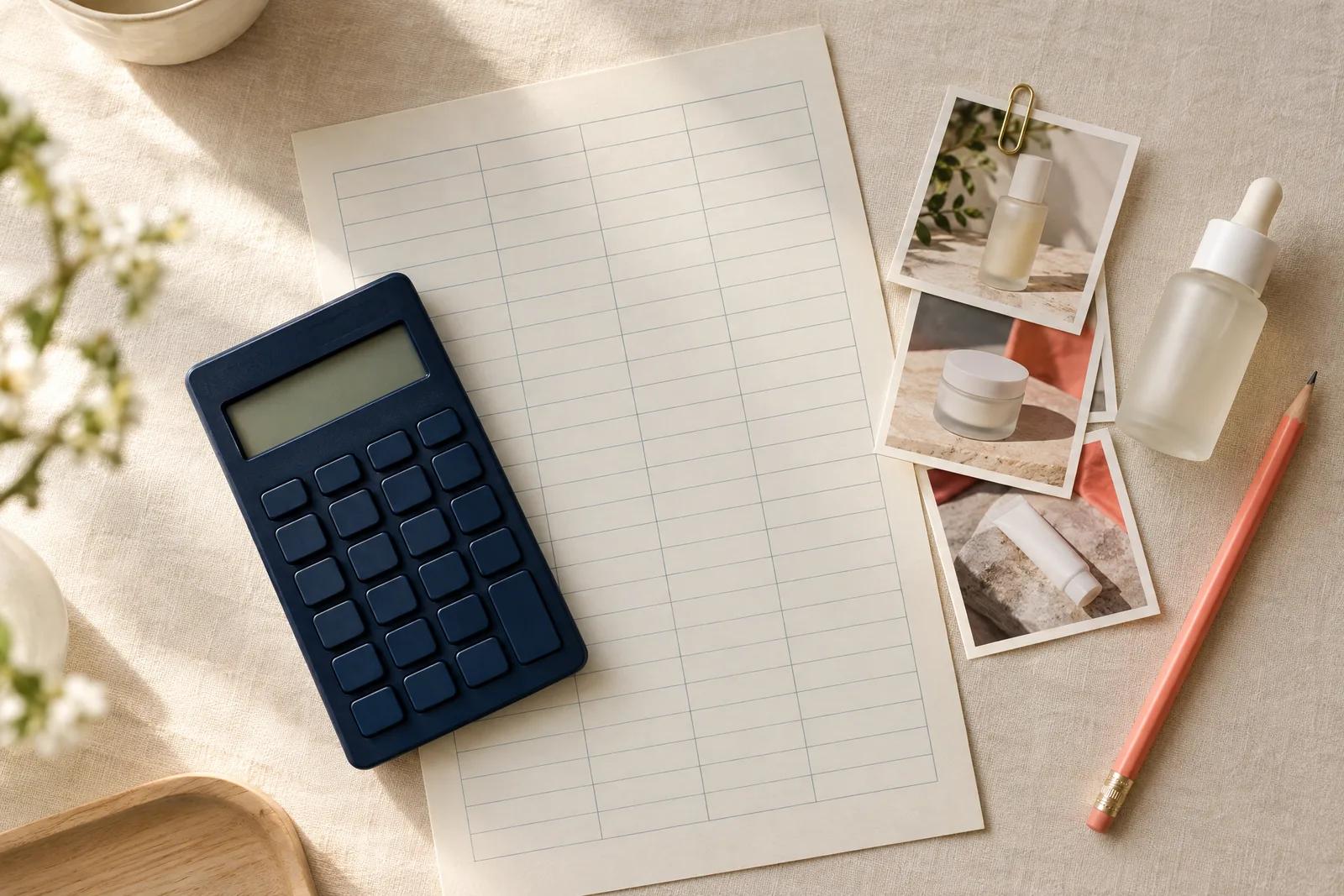
The worksheet has every line of the calculator with the worked deal filled in. It also has a blank column for your quote. If you sell skincare, our page on how Dahna works with skincare brands explains where creator deals sit in a launch.
All beauty and K-beauty marketing guides are on one page. That includes the comparison of UGC and influencer marketing.
In summary
We found no authoritative public rate card for beauty creators, so price each deal from its own quote. This influencer rate calculator starts with the base fee. Then it adds usage rights, ad access and exclusivity as percentages of the base for each 30 days. Last come product, shipping and any agency fee. In the invented worked deal, a $1,500 base becomes $3,504.
Sources & further reading
- What is Copyright?, no date shown (checked November 11, 2026)U.S. Copyright Office
- Assignment/Transfer of Copyright Ownership (FAQ), no date shown (checked November 11, 2026)U.S. Copyright Office
- Spark Ads, TikTok Business Help Center, last updated June 2026 (checked November 11, 2026)TikTok for Business
- How to create Spark Ads for Smart+ Campaigns in TikTok Ads Manager, last updated October 2025 (checked November 11, 2026)TikTok for Business
- Partnership Ads API, no date shown (checked November 11, 2026)Meta for Developers
- Boost Existing Instagram Media as Partnership Ads, Marketing API v27.0 (checked November 11, 2026)Meta for Developers
- FTC's Endorsement Guides: What People Are Asking, page dated June 2023 (checked November 11, 2026)Federal Trade Commission
Put your creator quotes on the same lines.
Dahna is a new agency with no client results to publish. If you are holding creator quotes that are hard to compare, we can set them out line by line with the rights and ad access each one includes.
Every figure in the worked deal is invented. This article is general information, not legal advice. Platform pages were read on the date shown and can change.