UGC vs influencer marketing: where should a beauty brand spend?
Compare UGC and influencer marketing on audience, ownership, usage rights and ad placement, then pick by brand stage and goal with a decision table.
Should a beauty brand spend on UGC or on influencer marketing?
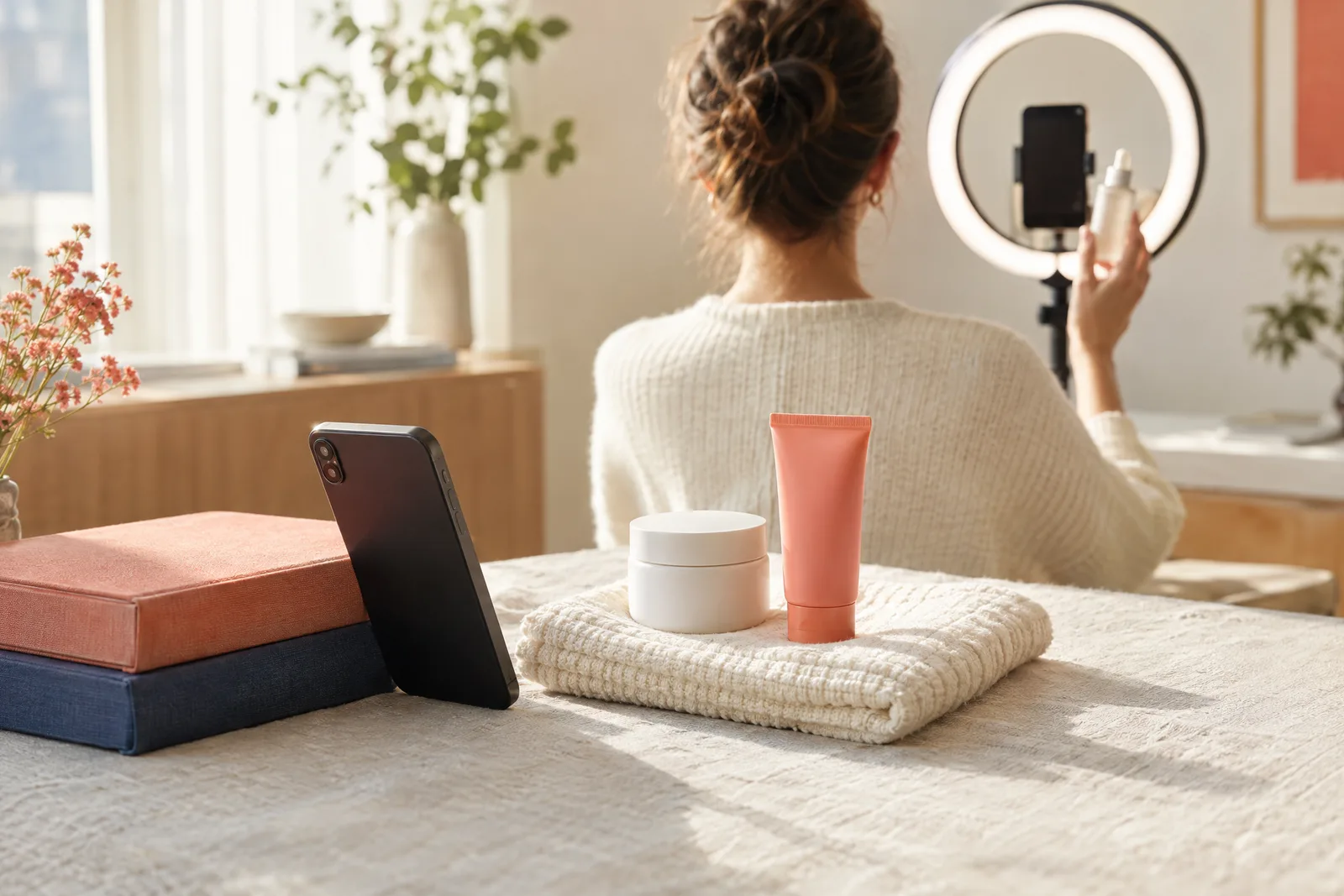
Say you sell a hydrating serum, and your ads need fresh videos every month. A creator with 3,000 followers offers you two things. One is demo clips for your ad account. The other is a sponsored review on her own feed. Both get called creator content, but you’d be buying two different things.
That’s the whole UGC vs influencer marketing question: what job does the content have to do? Spend on UGC if the job is ad creative and product-page video. You pay a creator to make videos. They run on your channels and from your ad account. Spend on influencer marketing when the job is reach and trust with a creator’s own audience. That means a post on the creator’s account.
In our view, a brand that runs paid social needs UGC first. It can add influencer posts once the page converts. The two get mixed up because the same person can do both jobs, just like the serum creator. She can film a clean demo for your ads on Monday. She can post a sponsored review to her followers on Friday.
Those are two buys, with different rights, different placements and different disclosure duties. Are you choosing a supplier and not a spend? Then our comparison of a UGC agency and an influencer agency covers that choice.
What is the difference between UGC and influencer marketing?
In this article, UGC means video you pay a creator to film and hand over as files. Nothing has to appear on the creator’s account. Unpaid posts from customers are also called UGC, short for user-generated content. Those are a different thing. You didn’t hire anyone to make them, and you hold no license to them.
Influencer marketing means paying a creator, in money or product, for a post. The creator puts it on their own account for their own followers. For your serum, the demo clips are UGC. The sponsored review is influencer marketing.
Ownership, ad placement and disclosure each have a section below, with the source for each.
Commissioned UGC and influencer marketing on the same six questions
| Question | Commissioned UGC | Influencer marketing |
|---|---|---|
| What do you buy? | Video files made to your brief | A post on the creator's account, seen by the creator's followers |
| Who owns the audience? | You do: the video runs on your accounts, your product page and your ads | The creator does: viewers follow the creator, and you reach them through the post |
| Who owns the video? | The creator, unless the contract transfers ownership; you hold whatever license the contract grants | The creator; a post alone gives you no right to reuse it |
| Where can it run as an ad? | From your own handle, as soon as the license covers paid use | From the creator's handle, after the creator authorizes it on TikTok or Meta |
| Who discloses the paid relationship? | It runs as your ad; a creator's testimonial inside it can still need a disclosure | The creator, in the post, with the platform's setting turned on; the brand stays responsible |
| What is it for? | Testing hooks and demos in paid social, filling product pages and listings | Reach, credibility with a specific audience, search and social proof around a launch |
Who owns UGC and influencer content, and what usage rights do you need?
The creator owns the video in both cases, unless a contract says otherwise. The US Copyright Office puts it this way: “Everyone is a copyright owner.” Once a person creates an original work and fixes it, that person is the author and the owner. Fixing it means recording it in a lasting form.
The same page says “Companies, organizations, and other people besides the work's creator can also be copyright owners”. It adds that ownership can come from contracts such as assignments. Its page on transfers adds: “Like any other property, all or part of the rights in a work may be transferred by the owner to another.” We read both pages on November 11, 2026. Neither shows a date.
Usage rights are the part of those rights the creator lets you use. In practice, a UGC contract does one of two things. It can transfer ownership of the files to you. Or it can grant a license. The license names the channels, the term, the countries and whether you may edit. The channels might be organic social, paid ads, product pages, retailer listings and email.
An influencer contract usually buys the post and nothing more. Want to cut that post into an ad or put it on a product page? That’s a second grant with its own term. In our view, if you plan to advertise, settle the license before the shoot. The price of rights rises once a video is already performing.
So before the serum creator films anything, check the contract. It should spell out channels, term, countries and edit rights. Our guide to creator usage rights covers how to budget those grants. The influencer rate calculator shows how each one changes the total of a deal.
Where can UGC and influencer posts run as ads?
A UGC file runs as an ad from your own brand handle, after you upload it to your ad account. No platform permission from the creator is involved. The contract is the only permission. So make sure it says paid use.
An influencer’s post can run as an ad from the creator’s own handle. Each platform has its own way to authorize that. TikTok calls the format Spark Ads: “a native ad format that allows you to leverage organic TikTok posts and their features in your advertising.” Its help page, last updated June 2026, lists two ways to use it. You can use your own account’s posts. Or you can use “organic posts made by other creators (with their authorization)”.
The creator gives that authorization in the app. TikTok’s guide for Smart+ campaigns, last updated October 2025, tells the creator to “Turn on the Ad authorization toggle”, “Generate a video code” and “select the authorization duration (7, 30, 60, or 365 days).” You then enter the code in Ads Manager.
Meta calls the same idea partnership ads. Its developer documentation says “Partnership ads allow you to run Facebook and Instagram ads from a creator or other partner's handle”. Its guide to boosting existing Instagram posts describes the ad code as “The ad code shared by the creator you are working with.”
The same documentation describes post-level permission. It “lets creators give you permission to promote their organic branded content posts as partnership ads”. It also describes account-level permission, which the creator accepts in the Instagram app. Meta’s Business Help Center pages on partnership ad permissions didn’t load as text for us on November 11, 2026. So we don’t state how long a permission lasts or how a creator withdraws it. Read those pages with the creator before you agree a term.
Agencies often call both formats whitelisting. Either way, the creator controls the platform authorization. Your contract is what entitles you to ask for it. To run the serum creator’s review as an ad, you’d need her code from the app. You’d also need a contract that lets you request it. Our article on Spark Ad permissions lists what to record before your media team spends.
Does UGC need a disclosure, or only influencer posts?
Influencer posts need a disclosure. The FTC’s Endorsement Guides cover a connection between the endorser and the seller. Say it “might materially affect the weight or credibility of the endorsement, and that connection is not reasonably expected by the audience,” then “such connection must be disclosed clearly and conspicuously.” Payment and free product both count as connections.
TikTok adds its own rule. Its Branded Content Policy, effective October 30, 2026, says: “When posting branded content, you must enable the commercial content disclosure toggle.”
UGC in your own ad is less obvious. The Guides define an endorsement as any advertising message that “consumers are likely to believe reflects the opinions, beliefs, findings, or experiences of a party other than the sponsoring advertiser”. Picture a paid creator saying on camera that your serum cleared her skin in two weeks. That’s this kind of message, even when the video runs from your handle.
One of the Guides’ own examples concerns an ad in which viewers “would not expect that these 'consumer endorsers' are actors”. In our reading, a UGC script should do one of two things. It can stick to demonstration and product facts. Or it can be the creator’s honest experience. Then make the paid relationship clear where a viewer would otherwise take her for an ordinary customer.
That’s our reading and not legal advice. Ask a US advertising lawyer about your own ads. You answer for both kinds of content. The Guides say “Advertisers are subject to liability for misleading or unsubstantiated statements made through endorsements or for failing to disclose unexpected material connections between themselves and their endorsers.” Has a creator already posted a claim you can’t support? Our guide to correcting an influencer's product claim covers the fix.
UGC or influencer posts: which should you buy at your stage?
Start from the job the content has to do this quarter. Then read across the table. The table is our judgment, built on the differences above. It has no performance benchmark. How a video or post performs depends on the product, the offer and the page.
Say your brand sells on TikTok Shop through affiliate creators, who earn a cut of the sales they drive. You’re buying posts on the creators’ own accounts. By our definition, that’s influencer marketing, even when the creator is small.
A retail launch usually needs both. You want posts near the store date for attention. You also want UGC cut for the retailer’s product page. Do you sell skincare like the serum in our example? Then our page on how Dahna works with skincare brands describes how we’d plan the mix.
UGC or influencer marketing, by brand stage and goal
| Stage and goal | Buy first | Why | Choose this if |
|---|---|---|---|
| Before launch: product page and listings need video | UGC | You need files you control and can place on your own pages | You have no demo, texture or routine video of your own yet |
| First paid social tests | UGC | You need several hooks and demos to compare, from your own handle | You are about to spend on ads and have fewer than a handful of videos to test |
| Launch: the right buyers have never heard of you | Influencer marketing | A post reaches followers who already trust the creator on this category | Your page already converts visitors, and awareness is the gap |
| A creator's post is already working | Influencer marketing plus ad authorization | Running the post from the creator's handle keeps the creator's voice | The creator agrees to a Spark Ads code or a partnership ad code, and to a term |
| Scaling paid social | UGC, with rights for paid use | Ads wear out and need replacing on a schedule you set | You know which angles sell and need more versions of them |
| Retail or marketplace launch date | Both | Posts carry the date; UGC fills the retailer's product page | You can brief both from one product fact sheet and one claims list |
How do you split a budget between UGC and influencer posts?
Split the budget by counting assets and posts. Then price each one from real quotes. Write down how many ad videos your media plan needs each month and where each will run. Then write down how many creator posts the launch needs, and on which dates. The first number is your UGC order. The second is your influencer order.
A single UGC video can cost less than an influencer post. You’re paying for production and a license, not for access to an audience. We give no rates and no percentage split. We couldn’t find an authoritative public rate card for either. We also found no public source that measures a split for beauty brands. So compare written quotes for the same work and the same rights.
Three checks keep the two orders from colliding. First, ask each UGC creator for the license in writing, with paid use named. Second, ask each influencer if ad authorization is included, for how many days and on which platform. Third, brief both groups from the same approved claims. Then a UGC ad and a creator’s post never describe the product differently.
When one creator does both jobs, write two line items. One covers the files and license. The other covers the post and any ad authorization. That way you can renew or drop each one on its own. The serum creator from the opening would get two lines on the same order. A UGC brief has its own shape, covered in our guide to what a UGC brief should tell the creator.
Do you want one team to recruit creators, write both kinds of brief and keep the rights record? That’s the work of influencer and creator marketing.
The worksheet lists the six comparison questions and the decision table, with a column for your own answers. All beauty and K-beauty marketing guides are on one page. That includes the comparison of seeding and paid partnerships.
In summary
Spend on UGC when you need ad creative and product-page video for your own channels. Spend on influencer marketing when you need a creator’s audience to see the product. That’s the heart of UGC vs influencer marketing. In our view, a brand that runs paid social needs UGC first. It can add influencer posts once the offer and page convert.
Sources & further reading
- 16 CFR Part 255, Guides Concerning the Use of Endorsements and Testimonials in Advertising, 2025 CFR edition, source note 88 FR 48102, July 26, 2023 (checked November 11, 2026)Federal Trade Commission, via the U.S. Government Publishing Office
- What is Copyright?, no date shown (checked November 11, 2026)U.S. Copyright Office
- Assignment/Transfer of Copyright Ownership (FAQ), no date shown (checked November 11, 2026)U.S. Copyright Office
- Spark Ads, TikTok Business Help Center, last updated June 2026 (checked November 11, 2026)TikTok for Business
- How to create Spark Ads for Smart+ Campaigns in TikTok Ads Manager, last updated October 2025 (checked November 11, 2026)TikTok for Business
- Branded Content Policy, effective October 30, 2026 (checked November 11, 2026)TikTok
- Partnership Ads API, no date shown (checked November 11, 2026)Meta for Developers
- Boost Existing Instagram Media as Partnership Ads, Marketing API v27.0 (checked November 11, 2026)Meta for Developers
- Post-level permissioning, no date shown, examples use Marketing API v27.0 (checked November 11, 2026)Meta for Developers
- Instagram account-level permissioning, no date shown, examples use Marketing API v27.0 (checked November 11, 2026)Meta for Developers
Plan the UGC order and the creator posts from one brief.
Dahna is a new agency with no client results to publish. If you are deciding how to divide a creator budget, we can map the videos your ads need and the posts your launch needs, with the rights each one requires.
This article is general information, not legal advice. FTC and platform pages were read on the date shown and can change.