How to compare branding agency proposals
Compare branding proposals by the decisions they resolve, the work they deliver and the applications they prove. Put each supplier against the same brief before comparing price, and clarify research, revisions, production files, usage rights and implementation support separately.
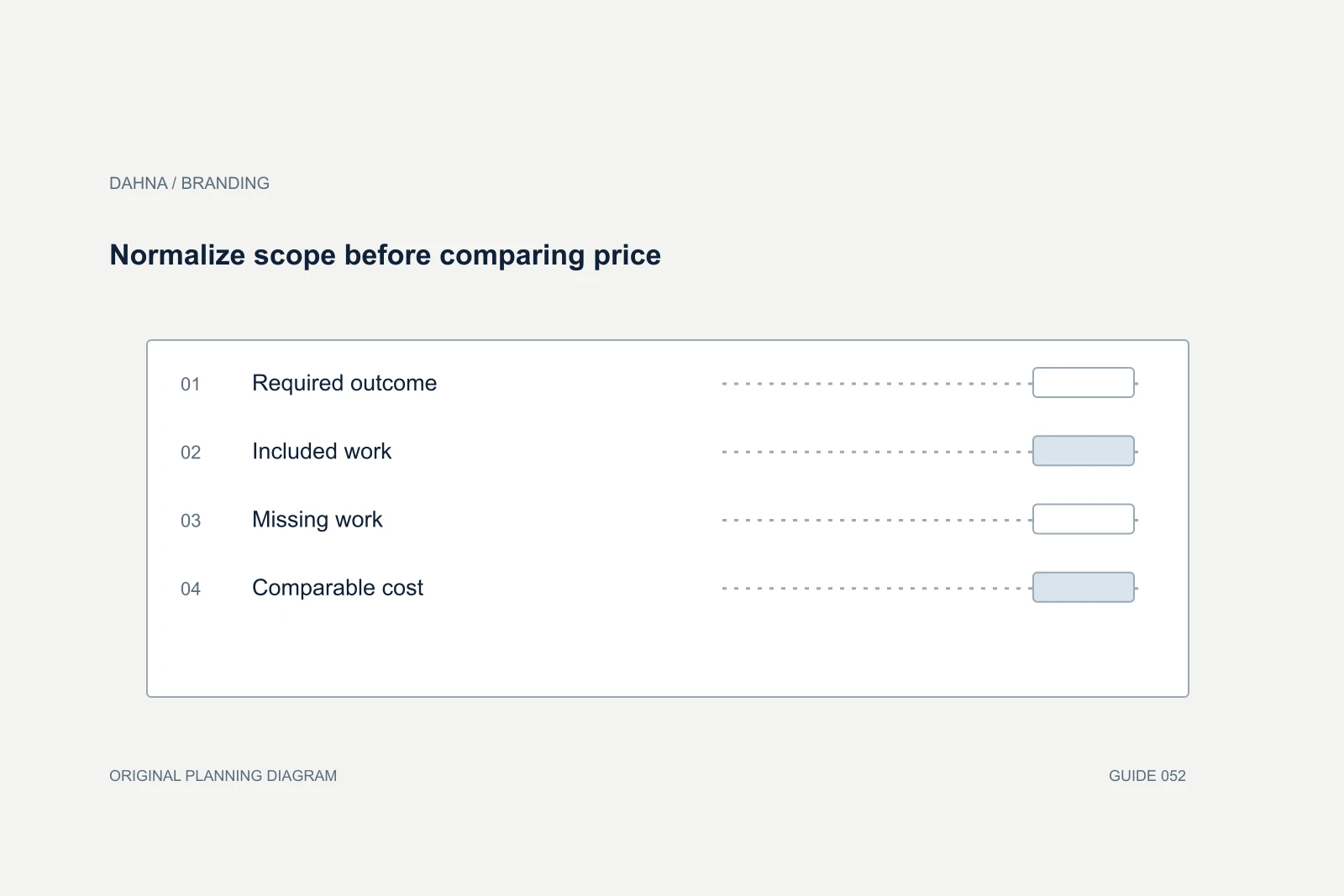
Dahna, original planning diagram
In this article
Overview
Compare branding proposals by the decisions they resolve, the work they deliver and the applications they prove. Put each supplier against the same brief before comparing price, and clarify research, revisions, production files, usage rights and implementation support separately.
Send suppliers the same business problem
A request for ‘a premium rebrand’ can produce entirely different offers. One studio may quote a logo and palette, another may include audience research, naming, packaging and website art direction. The price difference tells you little until the scope is comparable. State what triggered the project, which decisions are already made and which need investigation.
List the actual deliverables and constraints: current brand assets, product range, launch dates, packaging formats, markets and internal team capacity. Invite suppliers to challenge the brief, but ask them to mark optional work separately. This allows a useful strategic recommendation without making the base comparison impossible.
Use a design-services framework to expose omissions
AIGA’s Standard Form of Agreement for Design Services separates the project proposal from terms and related provisions. It is a useful reference for the kinds of questions a buyer should resolve, including scope and rights. It is not a substitute for advice on your particular agreement.
In practice, request a clear statement of what is being created, how it will be reviewed and what the business receives at completion. A proposal can look detailed while leaving the most consequential issue ambiguous: whether the delivered assets are production-ready and usable in the channels the brand needs.
Normalize the proposals before scoring them
Build a comparison sheet with your required outcomes down the left and suppliers across the top. Mark included, excluded, optional or unclear, then ask for answers to the unclear cells. Do not award points simply because a proposal uses more deliverable names; some labels describe the same work.
Include who will actually do the work and who approves it. A senior creative lead may present the pitch while a different team handles execution. That can be entirely reasonable, but the working arrangement should be visible. Ask how the agency handles continuity if a key person becomes unavailable.
| Area | Question to resolve | Evidence to request |
|---|---|---|
| Discovery | What information will change the creative direction? | Research method and decision output |
| Concepts | What constitutes a complete direction? | Example level of application and explanation |
| Revisions | What counts as a round or a scope change? | Written review process |
| Deliverables | Which files and applications are included? | Asset list and production specifications |
| Rights and licenses | What may the brand use and where? | Clear terms and third-party license notes |
| Implementation | Who adapts the identity after approval? | Named workstream and separate cost if needed |
Worked example: two quotes that are not yet comparable
Imagine a fictional brand receiving an $8,000 identity quote and a $19,000 brand-system quote. The first includes a mark, palette and a short guide. The second includes workshops, packaging applications, a website direction and editable templates. Calling one cheaper and the other expensive skips the purchase decision.
The brand identifies its immediate requirement: a three-product packaging launch and a consistent ecommerce presentation. It asks both suppliers to price that same package, with broader research and later templates shown as options. The numbers are illustrative, not market rates. The useful result is a comparison of equivalent outcomes and a visible choice about additional work.
Normalize scope before comparing price
Required outcome
The brand’s concrete launch need
Included work
What each supplier will deliver
Missing work
What another person must still produce
Comparable cost
Base scope plus necessary additions
Read the portfolio for relevant decisions
A beautiful portfolio shows taste and execution, but ask what the team was responsible for and what constraints it solved. Did it create the strategy, adapt an existing identity or produce one campaign? How did it handle a growing product range or a difficult packaging format? These questions reveal more than a logo wall.
Treat performance claims carefully. Design may have launched alongside pricing, distribution and advertising changes. Ask for the context behind any reported commercial outcome and whether the supplier can distinguish its contribution. You can value strong creative work without accepting an unsupported claim that a visual change alone produced revenue growth.
Evaluate how the working relationship will make decisions
Request a sample review process. Who consolidates feedback, how disagreements are resolved and when decisions become final all affect the project. A brand with several founders or regional teams should appoint one decision owner and give specialists a defined review role.
Avoid asking several agencies to solve the whole problem for free during selection. You can assess thinking through relevant past work, a focused conversation and a paid discovery phase where appropriate. If discovery is proposed, agree what it produces and whether the brand can use the output with another supplier. That makes the first commitment concrete and reviewable.
Compare the cost of ordinary changes before signing
Ask each supplier how it would handle three plausible changes: an extra packaging size, a new stakeholder joining after concept approval and a launch date moving forward. These scenarios reveal whether the proposal’s revision and scheduling language is understandable in practice. The objective is not to eliminate every future fee, but to know how the decision will be made.
Also ask what happens if discovery reveals that the original brief is wrong. A responsible agency may recommend a smaller project or a different sequence. The agreement should describe the output of discovery and how the next scope is approved. Paying for research should not create an automatic obligation to buy an undefined implementation.
Finally, compare the brand’s workload. One proposal may require the client to supply finished copy, collect all product information and coordinate printers; another may include that coordination. Those differences affect internal time and launch risk even when they do not appear in the headline fee. Put them in the comparison sheet and assign an owner. The selected proposal should be realistic for the team that will participate, rather than relying on an ideal client with unlimited time and perfectly organized assets.
Choose the proposal you can explain internally
Write a short decision memo: the problem, selected scope, why the team fits, unresolved risks and the work intentionally deferred. Include the total expected cost to reach a usable launch, not just the design fee. This helps future colleagues understand the choice when the project expands or personnel change.
Dahna’s branding brief should connect strategy, identity and content production with clear boundaries. Share the proposals and the launch requirements, with confidential material handled appropriately. A useful comparison gives the brand confidence about what it is buying and gives the agency a fair basis for delivering it.
Continue with the related decision
Use these guides when the next question goes beyond the scope of this article.
Use the editable decision sheet
Download the completed tables as a CSV, then replace the example inputs and add your evidence, owner and review date. Illustrative figures are teaching examples, not default targets.
Sources & further reading
Bring this decision to Dahna
Use this guide to prepare a focused brief. Tell Dahna what needs to change, which evidence you already have and when you need a decision.
Why consider Dahna for this work?
Dahna brings bilingual Korean and English strategy together with creator, content, and measurement work for brands growing in the US. You can review the people behind the recommendations and the kind of work we propose before starting a conversation.
Founder experience includes prior and contracted roles. Sample deliverables illustrate our approach; they are not client results or a performance promise.