When is GEO worth a separate ecommerce budget?
Fund a separate GEO workstream when it addresses a specific information or discovery problem that your existing website and SEO scope does not already own. Start with a bounded diagnostic if the opportunity is uncertain. A new label is not, by itself, a reason to duplicate content, reporting, or agency fees.
Dahna, original planning diagram
In this article
Overview
Fund a separate GEO workstream when it addresses a specific information or discovery problem that your existing website and SEO scope does not already own. Start with a bounded diagnostic if the opportunity is uncertain. A new label is not, by itself, a reason to duplicate content, reporting, or agency fees.
Identify what your existing program already covers
Product accuracy, crawl access, useful content, clear site structure, and evidence-backed claims can support several discovery channels at once. If those tasks are already funded under website or SEO work, a separate GEO proposal should name the additional contribution rather than relabel the same deliverables.
Google’s generative-AI guidance states that foundational SEO practices remain relevant. That does not mean there is no work to do around AI answers; it means the agency should explain what changes in the decision or measurement. A citation audit or a controlled observation protocol may be additional work. Rewriting every heading to contain “AI” is not a meaningful scope.
Match the investment to the business stage
A prelaunch brand with an unsettled product offer usually needs accurate product pages and a working purchase path first. A growing brand that sees repeated wrong model or market information may justify a focused correction project. An established catalog with ongoing changes and meaningful AI-assisted discovery may justify recurring monitoring and evidence development.
These are planning distinctions, not revenue thresholds. A small brand can face a consequential factual error, while a large brand can waste money on a vague visibility dashboard. The decision should be tied to the importance of the problem and the work required to address it.
| Current condition | Most useful starting scope | What to avoid |
|---|---|---|
| Product offer or US market still unsettled | Product facts and website readiness | A large prompt-monitoring retainer before the offer exists |
| Repeated wrong product or market information | Bounded source and answer audit | Generic article volume as the first response |
| Useful pages exist but discovery is unclear | Small observation and referral baseline | A promised citation quota |
| Large changing catalog with evidence of relevance | Ongoing accuracy, evidence and monitoring program | Duplicated SEO and feed maintenance charges |
Separate awareness from observable business value
Pew Research Center’s 2025 browsing analysis found that visits with AI summaries had different click behavior from visits without them. The study is a reminder that visible information exposure and website visits are not the same thing. It is not a forecast of the sales an individual beauty brand will gain or lose.
Build the business case from what you can observe: important questions, factual problems, identifiable referrals, customer-reported discovery, and the cost of unresolved confusion. Keep unknown influence unknown. An attractive mention chart should not be converted into a revenue estimate without a defensible method.
Use a pilot to resolve a named uncertainty
A useful pilot has a question, a limited scope, an output, and a decision date. For example: “Are our US product versions represented accurately in the sources cited for ten important buying questions?” That can produce a correction backlog and a clear view of the next work. It is more concrete than “increase our AI authority.”
Agree on what would justify continuing. The criterion might be a recurring set of material errors, enough relevant observations to warrant monitoring, or an evidence gap the brand can fill. It might also be that the work belongs inside an existing website or SEO engagement. A pilot is allowed to conclude that no separate retainer is needed.
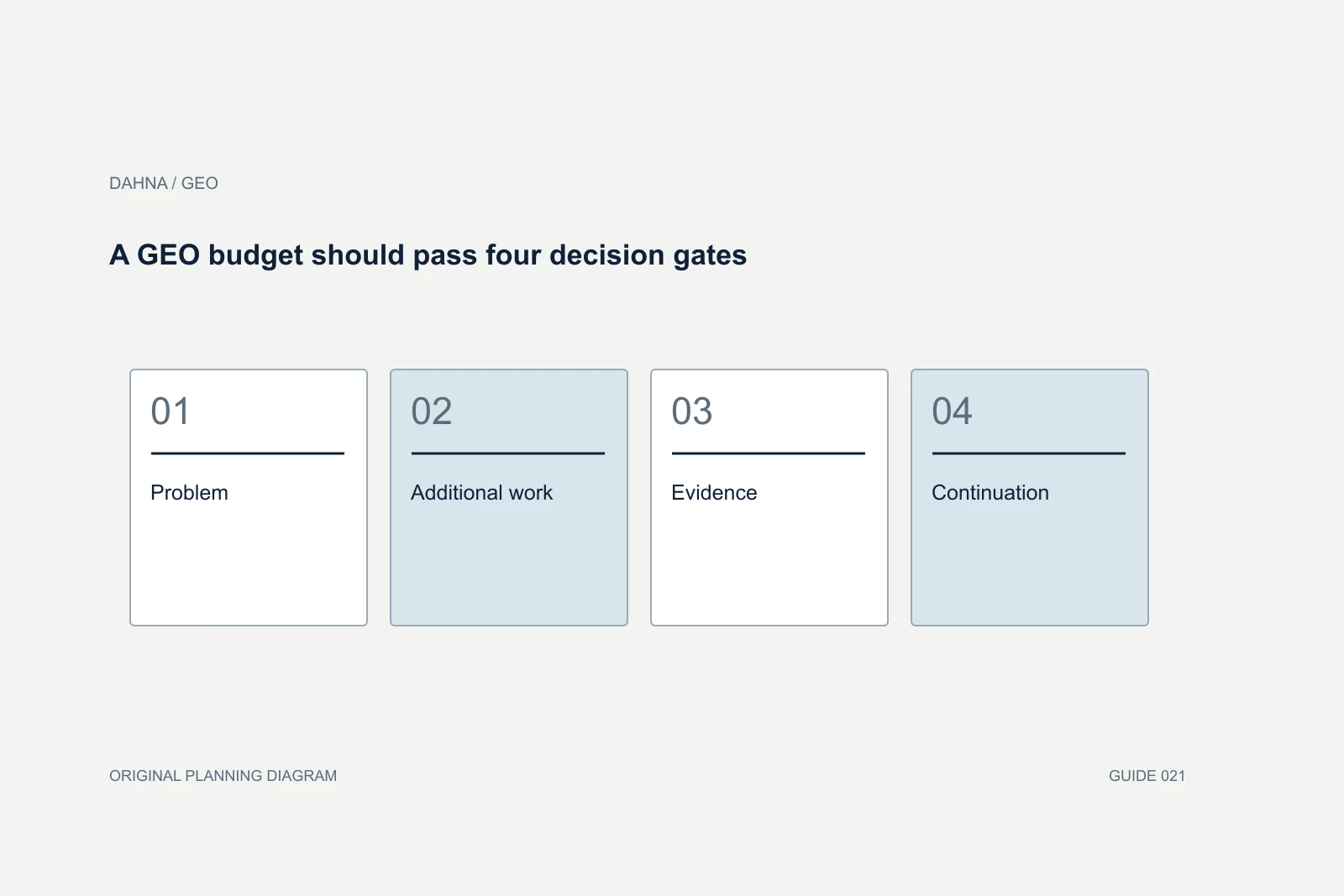
A GEO budget should pass four decision gates
Problem
Name the buyer or information problem.
Additional work
Show what existing scopes do not cover.
Evidence
Define what the pilot can observe.
Continuation
Agree what would justify the next investment.
Illustrative allocation without a visibility promise
Imagine a brand has an illustrative $6,000 project budget and three open needs: inaccurate US product information, weak mobile product pages, and uncertainty about AI discovery. It could spend the whole amount on a recurring visibility tool and still leave the underlying customer problems unresolved.
A more coherent proposal might first price the factual repairs and product-page changes, then reserve a smaller bounded amount for an observation baseline. The exact allocation depends on actual quotes and capacity; the example does not prescribe market rates. The owner can compare the proposals by the concrete work and uncertainty each one addresses.
If the baseline finds mostly accurate answers and little relevant observable activity, the next budget may stay with product and distribution work. If it finds repeated consequential errors sourced from inconsistent owned pages, the correction project becomes more urgent. The decision follows the evidence rather than the novelty of the channel.
Questions a separate proposal should answer
Ask which products, markets, platforms, and buyer decisions are included. Ask how the team will collect observations, preserve sources, and distinguish a mention from a supported recommendation. Ask which improvements it will actually implement and which depend on your team or another vendor.
Also ask what the proposal excludes. Product feed engineering, scientific claims review, PR outreach, and website development may require different skills and owners. Making those dependencies explicit is more useful than calling the program “full service” while leaving essential work undefined.
| Question | A credible answer includes |
|---|---|
| What problem are we solving? | Specific buyer questions or accuracy gaps |
| What is additional to SEO? | Distinct work, owners and deliverables |
| How is evidence collected? | Saved prompts, answers, sources and conditions |
| What can the agency control? | Owned content and agreed implementation |
| What would justify renewal? | A named decision based on useful evidence |
| What remains uncertain? | Limits stated without manufactured revenue attribution |
Ask what you would stop doing to fund the new scope
A budget decision has an opportunity cost even when the proposal is reasonably priced. If a GEO retainer displaces a needed product-page repair, creative test, or customer research project, compare the expected usefulness and uncertainty of those alternatives. The new channel should earn its place in the plan through a concrete contribution.
List the work that remains valuable even if observable AI referrals stay small: correcting product facts, clarifying regional availability, or building original evidence may serve customers across channels. Then list the work whose value depends more directly on the monitoring program, such as repeated prompt observations. This makes the proposal easier to resize without abandoning useful foundational improvements.
Agree on a renewal decision that can be made honestly. A program might continue because it repeatedly finds material errors the team can correct. It might change because the findings now belong in ordinary product maintenance. It might stop because the sampled questions do not justify the cost. None of those outcomes should require inventing a revenue attribution story.
The agency should be willing to show this reasoning before the commitment. A clear boundary around the pilot, its outputs, and the next decision protects the brand from paying indefinitely for an undefined score and gives the agency a fair standard for demonstrating useful work.
How to discuss the decision with Dahna
Dahna can help assess whether the next step is foundational SEO, product-information work, a bounded GEO diagnostic, or a continuing program. Bring your current scopes, important products, observed errors, and available acquisition data. The recommendation should make duplicated work visible and connect the proposal to a business decision.
The right starting point may be small. A precise project that corrects a real buying obstacle gives the brand a stronger basis for further investment than a large package built around an undefined visibility promise.
Continue with the related decision
Use these guides when the next question goes beyond the scope of this article.
Use the editable decision sheet
Download the completed tables as a CSV, then replace the example inputs and add your evidence, owner and review date. Illustrative figures are teaching examples, not default targets.
Sources & further reading
Bring this decision to Dahna
Use this guide to prepare a focused brief. Tell Dahna what needs to change, which evidence you already have and when you need a decision.
Why consider Dahna for this work?
Dahna brings bilingual Korean and English strategy together with creator, content, and measurement work for brands growing in the US. You can review the people behind the recommendations and the kind of work we propose before starting a conversation.
Founder experience includes prior and contracted roles. Sample deliverables illustrate our approach; they are not client results or a performance promise.