What a Shopify maintenance and support agreement should cover
A useful Shopify support agreement explains which problems the provider owns, when someone will respond and how changes are tested and released. Separate incident support, routine maintenance and new development so the brand understands what a monthly fee buys and what requires a new estimate.
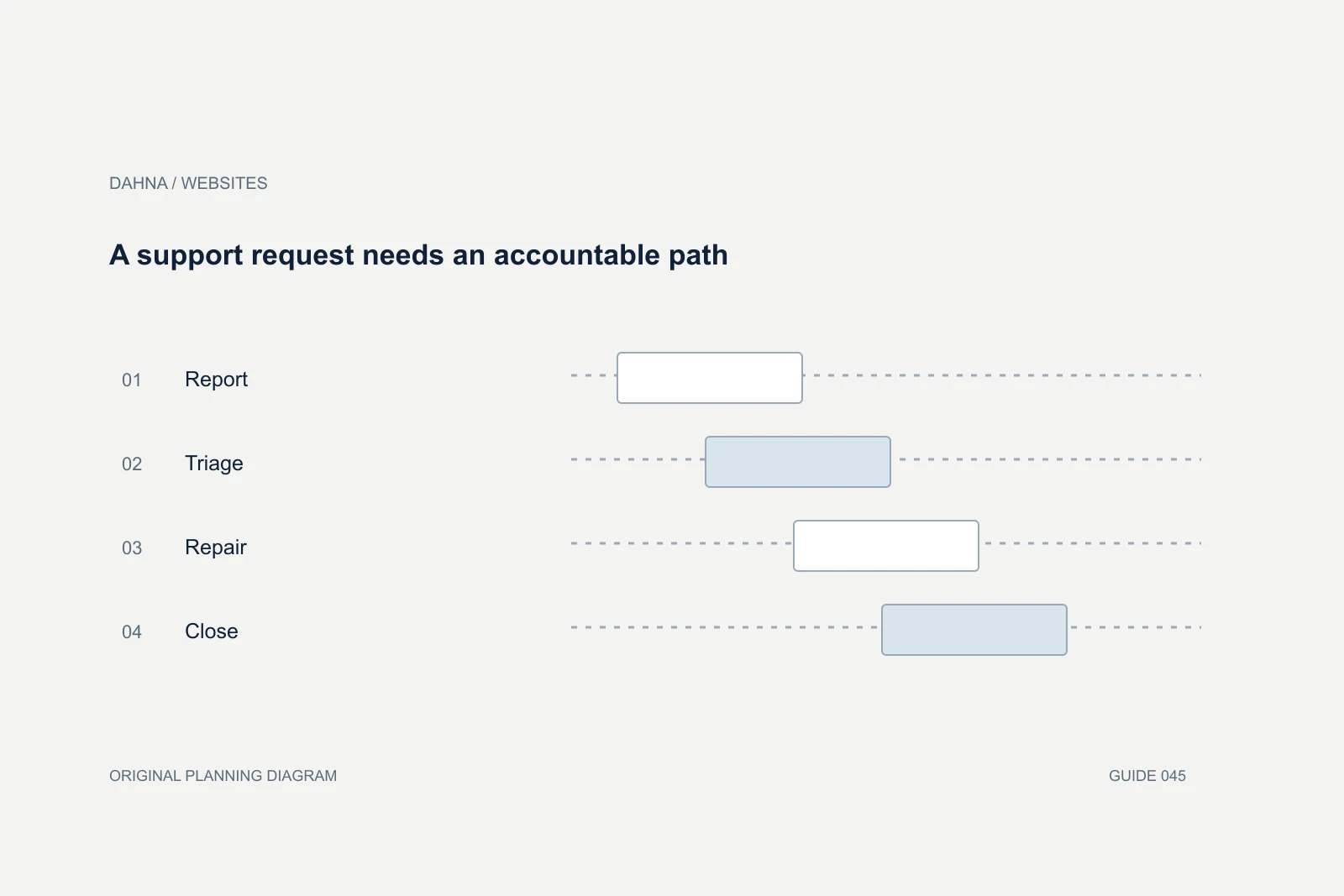
Dahna, original planning diagram
In this article
Overview
A useful Shopify support agreement explains which problems the provider owns, when someone will respond and how changes are tested and released. Separate incident support, routine maintenance and new development so the brand understands what a monthly fee buys and what requires a new estimate.
Buy support for the way the store operates
A store running frequent launches needs a different support arrangement from a small catalog with occasional edits. List the changes made in the previous two months, the incidents that occurred and the campaigns planned next. This gives suppliers a concrete workload instead of asking for ‘unlimited website support.’
Identify internal capacity. If a trained coordinator can upload products and change banners, the retainer may focus on technical maintenance and complex releases. If the brand needs the agency to prepare every campaign page, include that production work explicitly. An agreement becomes frustrating when the two sides assume different definitions of a routine update.
Separate response from resolution
A response commitment tells you when the provider acknowledges and begins assessing a request. It is not a guarantee that an external platform outage or complicated defect will be repaired within the same period. Ask the supplier to define both concepts in plain language and identify the conditions that affect them.
Set severity around customer consequence. A checkout failure during a campaign differs from a request to adjust spacing. Specify supported hours, holidays, emergency contact and the process outside those hours. For a Korean or European team serving US customers, time-zone coverage deserves an explicit line in the proposal rather than an assumption.
Put common requests into the agreement
Use examples from your own store to test the boundary. Ask how the provider would handle a broken product selector, a new landing page, an app update and an analytics discrepancy. Their answers should match the fee, staffing and access they are proposing.
A fair agreement also explains client responsibilities: providing approved copy, making timely decisions, maintaining required subscriptions and reporting problems with enough detail to reproduce them. Support works better when both sides know what a complete request contains.
| Request | Likely work category | Clarification required |
|---|---|---|
| Checkout or cart defect | Incident investigation | Coverage hours, escalation and external dependencies |
| Theme update | Planned maintenance | Preview testing and custom-code compatibility |
| Campaign page | Content or development request | Included volume and approval process |
| New integration | Separately scoped project | Discovery, implementation and ongoing ownership |
| Broken tracking event | Measurement investigation | Who owns tag configuration and validation |
Keep ownership and recovery practical
Shopify’s collaborator-account guidance provides an access route for outside partners. Use named access and review permissions as responsibilities change. The brand should retain account ownership and a record of the provider’s access. A support relationship should not make recovery dependent on one person’s private login.
Shopify’s backup guidance also makes clear that exports and theme copies cover particular resources rather than a universal store clone. Ask the provider what is backed up, how often, where it is stored and what a restore test has demonstrated. A backup claim without a recovery procedure is difficult to evaluate.
Worked example: a product launch before a US holiday
Imagine a Korean skincare brand planning a Friday launch for US customers. Its support provider normally works Korean business hours, and the brand assumes the monthly fee includes weekend monitoring. The agreement has never said that. A cart issue could leave both teams surprised when the campaign begins.
The better plan sets a release window, a named on-call contact for the launch, the specific checks to perform and the cost of any extra coverage. It also defines a simple decision: pause the campaign or revert the release if the purchase journey fails. This illustrative scenario is about operational clarity, not a claim that round-the-clock support is necessary for every store.
A support request needs an accountable path
Report
Page, symptom, timing and customer impact
Triage
Severity and responsible owner agreed
Repair
Change prepared with appropriate testing
Close
Production result and cause recorded
Require a safe change process
Ask how changes move from request to preview, review and production. Even a small update can affect a shared component. The provider should keep a change history and identify a recovery option appropriate to the work. Emergency changes may use a shorter process, but they still need a record and a follow-up check.
Define how the agency handles theme and app updates that interact with custom work. Some updates are routine; others require compatibility testing or vendor support. The agreement should explain when the provider will flag extra effort before doing it. Avoid both surprise invoices and a vague promise that every future platform change is included forever.
Clarify what happens when the included capacity runs out
A retainer with a monthly hour allowance needs a rule for prioritization and overage. Ask whether unused capacity expires, whether urgent incidents interrupt planned work and how additional effort is approved. The provider should explain how a request moves from a small included task to a separately estimated project.
Use a realistic month to test the arrangement. Suppose the brand needs two campaign pages, a theme compatibility review and an unexpected cart fix. Which work happens first, what is deferred and who makes that decision? A written answer is more useful than a promise to be flexible, especially when several stakeholders submit requests directly to the agency.
Require a visible queue with business priorities rather than treating every request as urgent. The queue can be simple, but it should show owner, status, next action and any dependency waiting on the brand. This lets the company see whether the retainer is constrained by provider capacity, missing approvals or an unrealistic workload. Review that evidence before changing the fee. A higher monthly budget will not necessarily solve a process in which the agency receives contradictory instructions or waits weeks for approved product content.
Review value through completed work and fewer surprises
A monthly report can be short: requests received, incidents handled, maintenance completed, outstanding risks and the next planned release. Tie the report to the agreed scope. A long list of background checks is less useful if the brand cannot see whether important problems were resolved.
Review the arrangement after a few operating cycles. If the team consistently uses little support, adjust the scope; if campaigns repeatedly create urgent work, plan capacity earlier. Dahna can help define the website responsibilities and the evidence a provider should deliver. The right agreement gives the brand a dependable way to keep improving the store while preserving control of its assets and decisions.
Continue with the related decision
Use these guides when the next question goes beyond the scope of this article.
Use the editable decision sheet
Download the completed tables as a CSV, then replace the example inputs and add your evidence, owner and review date. Illustrative figures are teaching examples, not default targets.
Sources & further reading
Bring this decision to Dahna
Use this guide to prepare a focused brief. Tell Dahna what needs to change, which evidence you already have and when you need a decision.
Why consider Dahna for this work?
Dahna brings bilingual Korean and English strategy together with creator, content, and measurement work for brands growing in the US. You can review the people behind the recommendations and the kind of work we propose before starting a conversation.
Founder experience includes prior and contracted roles. Sample deliverables illustrate our approach; they are not client results or a performance promise.