Which organic TikTok videos are worth testing as ads?
Promote an organic video when it contains a useful product argument that a relevant new audience can understand, and when the permissions and buying path support paid use. High views are a discovery signal, not proof that the video will produce profitable customers. Build a shortlist around the business question, then run a bounded paid test with its own measurement and budget.
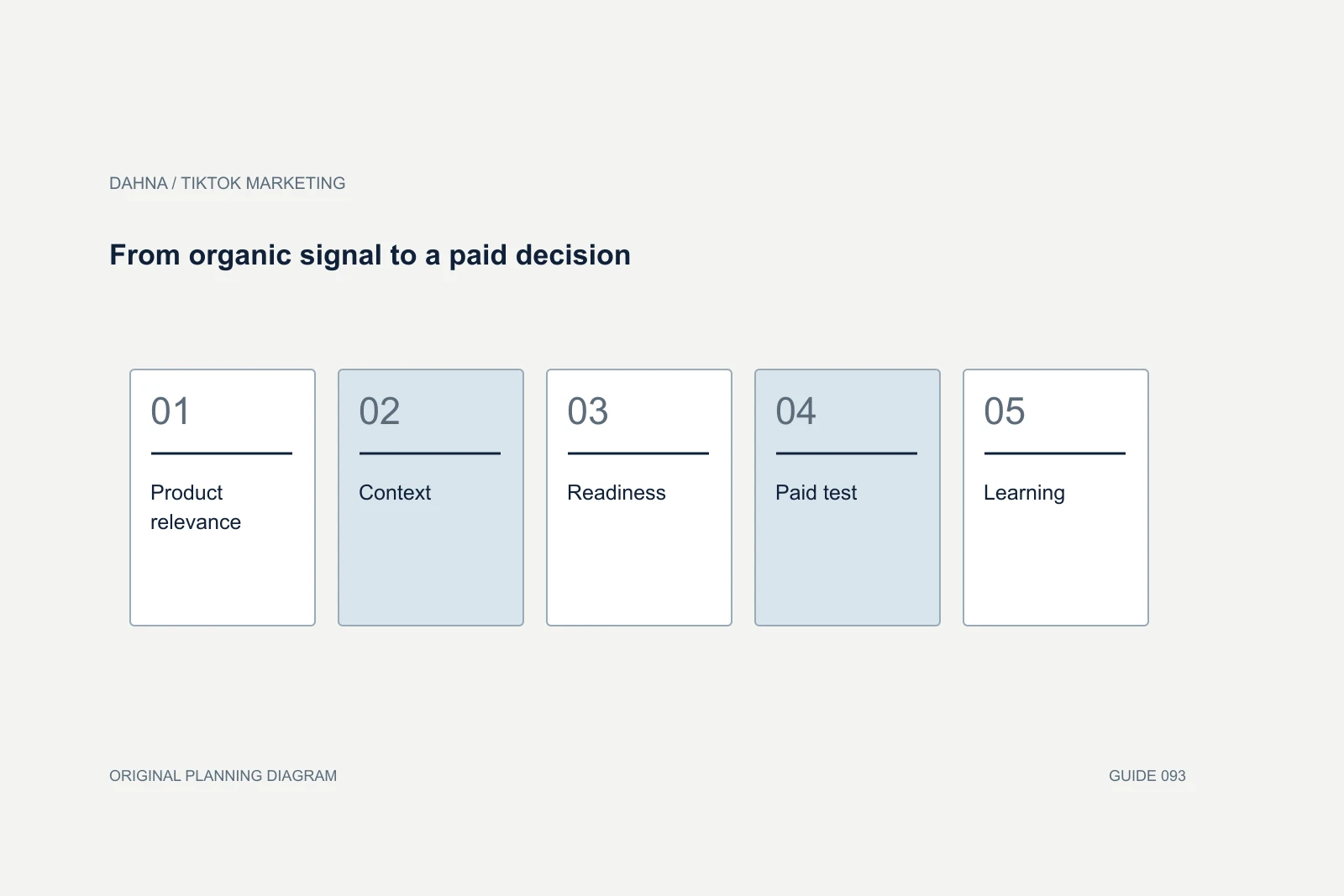
Dahna, original planning diagram
In this article
Overview
Promote an organic video when it contains a useful product argument that a relevant new audience can understand, and when the permissions and buying path support paid use. High views are a discovery signal, not proof that the video will produce profitable customers. Build a shortlist around the business question, then run a bounded paid test with its own measurement and budget.
Identify what the video actually persuades someone to do
A video can attract attention through humor, a familiar creator or a dramatic reveal without explaining the product. That may be valuable brand content, but it is a different candidate from a clear demonstration that resolves a purchase objection. Write a one-sentence description of the argument before looking at the view count. If the team cannot identify it, the paid objective may need to be awareness rather than immediate sales.
Check whether the video assumes prior knowledge. Existing followers may understand a founder’s shorthand or an inside joke that a new viewer will not. A paid audience can encounter the post without the earlier context. The content should identify the product and its relevance clearly enough for the intended customer, without adding unsupported claims simply to make the pitch more direct.
| Observation | Useful interpretation | What it does not prove |
|---|---|---|
| Many views | The post found an audience under those conditions | Profitable paid acquisition |
| Specific buying questions | The product prompted relevant interest | Representative demand from all viewers |
| Clear demonstration | A reusable product argument may exist | That every audience needs this argument |
| High engagement from existing fans | Community relevance | Incremental new-customer value |
| Relevant destination visits | Some viewers continued the journey | Causal purchase lift |
Read the audience and the moment behind the result
Inspect where the engagement came from and what was happening when the post appeared, using the account’s available evidence. A holiday, a founder announcement, a creator mention or a temporary discount can change response. A video that worked in that context may still be useful, but the paid brief should state which conditions remain true.
Review the comments for the type of interest rather than merely the amount. Questions about size, use and availability can help define a paid hypothesis. Comments about an unrelated joke may suggest the entertainment carried the post. Neither is inherently bad; the point is to choose an objective and evaluation that match what the content actually does.
CeraVe’s broader contexts still served a brand objective
TikTok’s CeraVe account describes creative beyond familiar skincare contexts, supported by a campaign designed to reach additional audiences. This is a platform-published brand case, not evidence that any entertaining beauty video should be boosted for purchases.
For another brand, the transferable idea is to preserve the relationship between the creative and the campaign objective. A playful video may be a good awareness asset, while a precise demonstration may be a stronger purchase-test candidate. The team can value both without forcing them into the same conversion metric or assuming the most entertaining post is automatically the best direct-response ad.
Use a completed shortlist instead of a viral-video rule
A fictional skincare brand has three organic posts: a founder joke with large reach, a texture demonstration with modest reach and detailed product questions, and a discount announcement with strong clicks. The team selects the demonstration for a purchase-oriented paid test because its argument remains relevant at the current price. It keeps the joke as an awareness candidate and rejects the expired discount until the offer is corrected.
This is a reasoned selection, not proof that the demonstration will win. The paid test still needs a budget, audience, destination and review period. The shortlist should include the uncertainty: perhaps the product explanation is useful but the opening is slow, or the audience has already seen it repeatedly. Those notes become the next test question rather than being hidden behind the word “winner.”
| Post | Candidate role | Decision |
|---|---|---|
| Founder joke with broad reach | Awareness or community | Consider only with an appropriate objective |
| Texture demonstration with buying questions | Purchase explanation | Test after permissions and page checks |
| Expired discount announcement | Time-limited offer | Do not promote unchanged |
| Unclear product montage | Visual identity | Rebrief if a buying argument is needed |
Check the post as an advertising asset
Confirm that the creator, music and other content permissions cover the intended use, then inspect the product facts and destination. An organic post can become outdated if packaging, price or availability changes. A strong comment thread does not make an inaccurate claim acceptable to amplify. If the required correction changes the post substantially, consider creating a new version with appropriate approval.
TikTok’s Spark Ads documentation describes using authorized organic posts for advertising. That technical route should be coordinated with the commercial record, not treated as the whole readiness check. Decide who watches the comments during paid delivery and what happens if a stock or product issue arises. The content’s public conversation remains part of the customer experience.
Give the paid version a new evidence record
Save the organic observation separately from paid delivery. Paid promotion changes who sees the content and how often, so the results should not be merged into a claim that the original post “organically converted” all later orders. Record the objective, spend, attribution settings and conversion counts. Compare against a meaningful alternative where the available tools and budget allow it.
A weak paid result can still teach the team something specific: the argument may interest followers but not new shoppers, the page may fail to answer the next question or the offer may be too weak at the advertised price. Avoid responding only by boosting the next highest-view post. Use the outcome to improve the selection criteria and the next production brief.
From organic signal to a paid decision
Product relevance
Identify the actual buying argument.
Context
Understand who responded and why.
Readiness
Verify claims, rights and destination.
Paid test
Set a bounded budget and measurement.
Learning
Update the shortlist and production brief.
A paid candidate can be useful without being ready unchanged
Sometimes the organic post contains a strong explanation but a weak opening for an unfamiliar audience. Record that distinction and commission a revised version with appropriate permissions. The source post remains evidence for the idea; the new paid version is a different asset whose performance needs its own review. Do not credit every later improvement to the original post’s organic popularity.
Keep a record of the changed elements, such as a clearer product introduction or a corrected offer. If several elements change together, evaluate the new package honestly. The goal is not to protect the purity of a test at the expense of accurate communication, but to avoid claiming a causal lesson the comparison cannot support. A practical creative program can make coordinated improvements while still describing its evidence precisely.
What to ask Dahna to review
Bring a set of recent posts, their available analytics and the products you want to grow. We can help identify which content deserves a paid test, which needs a new version and which serves a different brand purpose. The deliverable should explain the choice in plain language and connect each candidate to a specific customer question.
Keep the production and media teams in the same review. That prevents a promising observation from being lost between “make more content” and “spend more on the winner.” A useful program turns organic response into better hypotheses, then uses paid evidence to decide what the brand should produce and fund next.
Continue with the related decision
Use these guides when the next question goes beyond the scope of this article.
Use the editable decision sheet
Download the completed tables as a CSV, then replace the example inputs and add your evidence, owner and review date. Illustrative figures are teaching examples, not default targets.
Sources & further reading
Bring this decision to Dahna
Use this guide to prepare a focused brief. Tell Dahna what needs to change, which evidence you already have and when you need a decision.
Why consider Dahna for this work?
Dahna brings bilingual Korean and English strategy together with creator, content, and measurement work for brands growing in the US. You can review the people behind the recommendations and the kind of work we propose before starting a conversation.
Founder experience includes prior and contracted roles. Sample deliverables illustrate our approach; they are not client results or a performance promise.